 John Carlos Baez
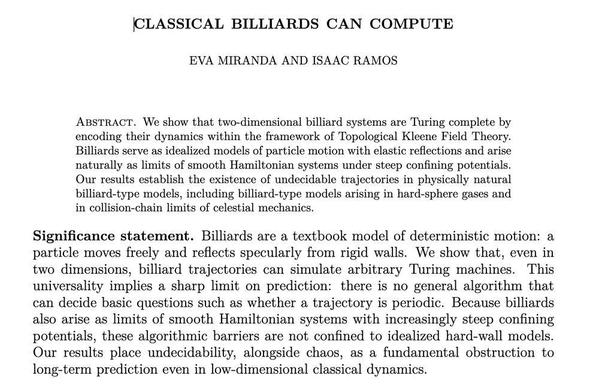
New result: you can build a universal computer using a single billiard ball on a carefully crafted table!
More precisely: you can create a computer that can run any program, using just a single point moving frictionlessly in a region of the plane and bouncing off the walls elastically.
Since the halting problem is undecidable, this means there are some yes-or-no questions about the eventual future behavior of this point that cannot be settled in a finite time by any computer program.
This is true even though the point's motion is computable to arbitrary accuracy for any given finite time. In fact, since the methodology here does *not* exploit the chaos that can occur for billiards on certain shaped tables, it's not even one of those cases where the point's motion is computable in principle but your knowledge of the initial conditions needs to be absurdly precise.
This result is not surprising to me - it would be much more surprising if you *couldn't* make a universal computer this way. Universal computation seems to be a very prevalent feature of sufficiently complex systems. But still it's very nice.
• Eva Miranda and Isaac Ramos, Classical billiards can compute, https://arxiv.org/abs/2512.19156.
 Phil Gibbs
 Eva Miranda