#DonutEconomics 101

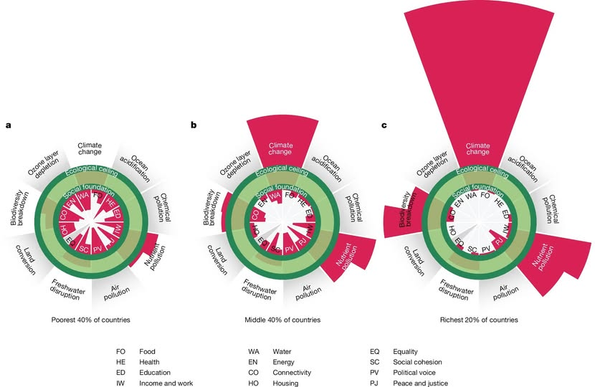
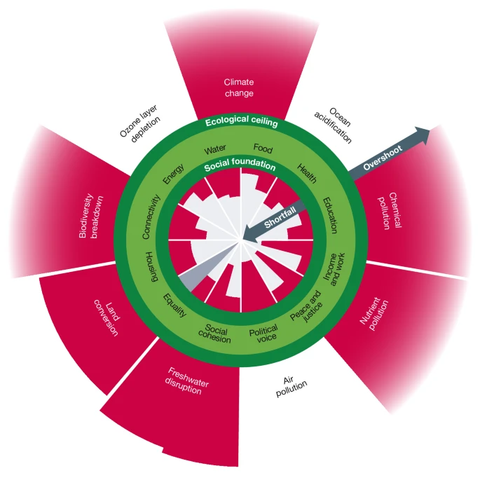
The Doughnut of Social and Planetary Boundaries [has] two concentric rings: a social foundation, to ensure that no one is left falling short on life’s essentials, and an ecological ceiling, to ensure that humanity does not destabilise the life-supporting systems that sustain all life on Earth.

Between these two sets of boundaries lies a doughnut-shaped space that is both ecologically safe and socially just: a space in which humanity can thrive.

https://doughnuteconomics.org/about-doughnut-economics

About Doughnut Economics | DEAL

Meet the Doughnut and the concepts at the heart of Doughnut Economics.

In 2022 [the social shortfall] ranges from 9% of people lacking access to electricity to 75% of people stating they perceive widespread corruption, with a median level of social shortfall comprising 35% of the global population (3 billion people).

In general, social dimensions that measure access to physical necessities, such as energy and food, show less shortfall than dimensions that measure the strength of social fabric, such as social cohesion and political voice.

https://www.nature.com/articles/s41586-025-09385-1

"Social wedges start at the inner edge of the social foundation (which represents zero human deprivation), whereas ecological wedges start at the outer edge of the social foundation (which represents zero environmental footprint)."

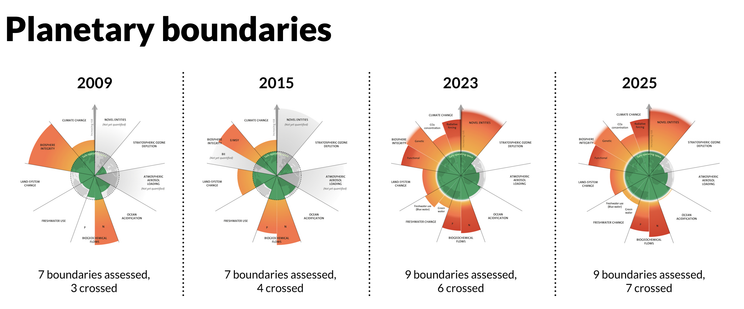
The ecological wedges are similar to the planetary boundaries framework, which highlights the rising risks from human pressure on nine critical global processes that regulate the stability and resilience of the Earth.

https://www.stockholmresilience.org/research/planetary-boundaries.html

Planetary boundaries

The planetary boundaries framework highlights the rising risks from human pressure on nine critical global processes that regulate the stability and resilience of the Earth

Back to the donut, for the first time done for three country clusters: poorest 40%, middle 40% and richest 20% of countries.

Ecological wedges (outer ring): status of each country cluster’s consumption-based environmental ‘footprints’ relative to downscaled per capita boundaries.

"We find that social shortfall improves and ecological overshoot worsens as income levels increase across the three country clusters."

https://www.nature.com/articles/s41586-025-09385-1

"The five largest social improvements are for internet connectivity, health services coverage, child survival, safe sanitation and clean indoor fuels."

Takeaway:
We need to ditch "GDP" as the sole measure of economic health. It needs to be "replaced with a far more holistic approach, for which the Doughnut’s concentric circles provide a concise visual representation: meeting the essential needs of all people within the means of the living planet."

https://www.nature.com/articles/s41586-025-09385-1

Doughnut of social and planetary boundaries monitors a world out of balance - Nature

A revised ‘Doughnut’ providing a visual assessment of trends in social deprivation and planetary degradation over the past two decades shows more than doubling of global GDP accompanied by accelerating ecological overshoot but only a modest reduction in human deprivation.

Nature

"Everything people depend on, including energy, water, food and health, is embedded in the Earth system.

Looking through this lens shifts priorities. Climate policy becomes inseparable from economic and social policy. "

https://theconversation.com/ecological-myopia-the-blind-spot-holding-back-climate-action-270912

Ecological myopia: the blind spot holding back climate action

Seeing more clearly is the first step toward wiser action.

The Conversation

"Post-growth economists often reject GDP in favour of new frameworks that account for environmental damage – such as the “doughnut economics” adopted recently by Amsterdam, or New Zealand’s attempt at a “wellbeing budget”.

The field has its disagreements, particularly over the extent to which countries should actively pursue de-growth measures to scale down their economies. But proponents agree that with the planet pushed to the limit, a radical rethink is needed."

https://www.theguardian.com/environment/ng-interactive/2026/feb/09/economic-growth-carbon-emissions-impact-global-heating

Economic growth is still heating the planet. Is there any way out?

Rising GDP continues to mean more carbon emissions and wider damage to the planet. Can the two be decoupled?

The Guardian

"Around the world, governments, economists, governments and researchers are testing and developing alternative measures of progress that incorporate long and healthy life indicators .

What’s needed now is for decision-makers to abandon the incomplete and dangerous models currently shaping vital societal decisions that don’t serve the world we live in now, and move toward more realistic and inclusive measures that also account for the reality of the climate crisis."

https://350.org/why-climate-change-is-making-us-re-think-growth-and-progress/

Why climate change is making us re-think growth and progress

Economic models say human societies are thriving. Reality in a fast-heating world doesn’t quite agree.

350

"Nature is not separate from the economy. It is the enabling environment within which economic activity takes place.

When ecosystems degrade, the effects are macroeconomic. Agricultural output declines. Infrastructure becomes more vulnerable. Water crises threaten industry and supply chains. Heat and air pollution reduce labour productivity. Public spending rises as disaster costs spiral.

This reframes nature not as a constraint, but as economic infrastructure."

https://www.lse.ac.uk/granthaminstitute/news/time-to-align-economic-practice-with-ecological-reality-the-critical-need-to-include-nature-in-macroeconomic-models/

Time to align economic practice with ecological reality: the critical need to include nature in macroeconomic models - Grantham Research Institute on climate change and the environment

As a major new global assessment of business and biodiversity reveals serious nature-related macroeconomic risks, this commentary examines the issues and calls for economic practice to align with ecological reality.

Grantham Research Institute on climate change and the environment

"Governments cannot reach their climate goals without rethinking humanity’s relationship to the Earth.

That is the overarching takeaway from a new paper published today in Frontiers in Science by a global team of scientists, conservationists and Indigenous people.

They found that climate progress cannot happen without widespread attempts to increase biodiversity, protect intact ecosystems and reverse ecological damage from centuries of consumption."

https://insideclimatenews.org/news/09042026/yellowstone-to-yukon-conservation-climate-targets/

Meeting Climate Targets Requires Humanity to Reorient Its Relationship With Nature, New Study Says - Inside Climate News

A team including scientists, Indigenous people and conservationists point to the ecosystem connecting Yellowstone and the Yukon as an example of a region where humans and nature are flourishing together.

Inside Climate News

@CelloMomOnCars Not that I need to tell you, but this whole thread is :chefskiss:

Thank You!