Congrats to Dario Rodighiero for beating me to the best short paper award at #CHR2025 ! And to Carlo and Davide, although I don't know them personally. I only got an honorable mention, which I am still very proud of 😂

https://2025.computational-humanities-research.org/news/best-paper-awards/

Kudos to my own co-authors, Tommaso Elli and Andrea Benedetti from Density Design (at the time of writing the paper), @Yomguithereal and Benjamin Ooghe-Tabanou from the Sciences Po médialab, and @paulanomalie and @jacomyal (my brother) from @ouestware .

And thank you to MASSHINE for supporting this work, as well as to CHR for their commitment to supporting high quality computational research in the humanities.

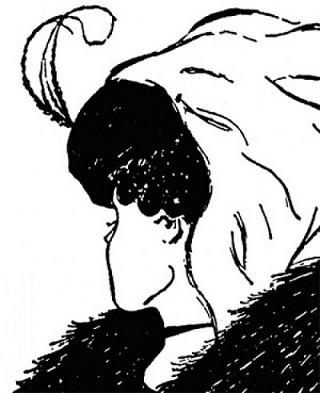
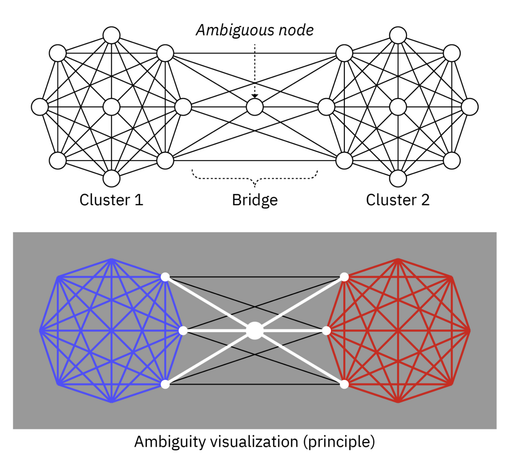
Our paper defends ambiguity as substantive knowledge to visualize. Ambiguity is often a defining feature of the phenomena we study, and should therefore be measured. It is not the same as uncertainty, which we want to mitigate.

"A blurry picture of a sharp thing must not be confused with a sharp picture of a blurry thing."

https://anthology.ach.org/volumes/vol0003/cluster-ambiguity-in-networks-as-substantive/

Our case is the ambiguity of categories obtained by community detection algorithms in networks.

We offer an implementation of our ambiguity visualization method in Gephi Lite, which you can try online right now!

https://lite.gephi.org

To try the feature in Gephi Lite, do this:

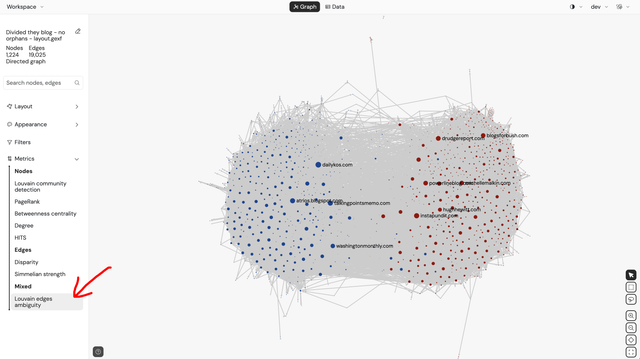
1) Open Gephi Lite and a network of your choice. I will use the "divided they blog" network because it is simple.

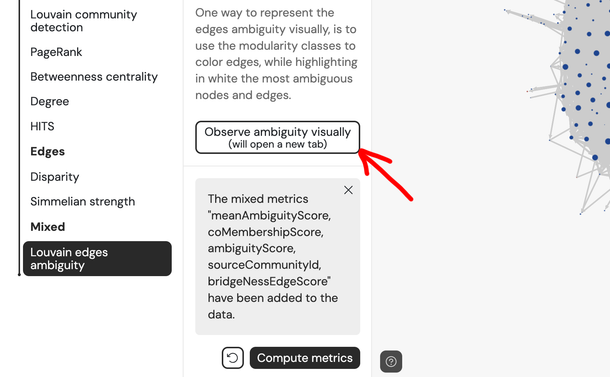
2) In the side bar on the left, click on Metrics > Louvain edges ambiguity (that's the last item).

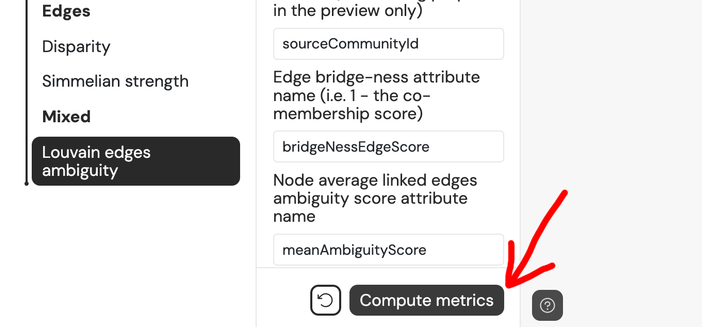
3) Click on the "Compute metrics" button.

4) Scroll the panel down, and click on the "Observe ambiguity visually" button at the bottom of the panel.

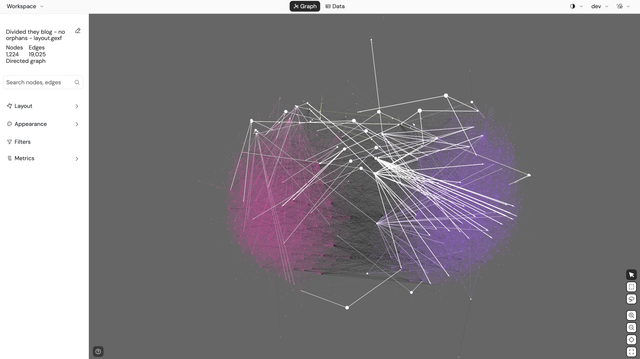
This opens a new tab where you will see your network with the ambiguous nodes and edges featured in white.
(Read the paper for more info on this!)

Most empirical networks are ambiguous in the middle, which is on the one hand quite obvious (it's difficult to attribute those in-between nodes to a single cluster) and on the other hand constantly overlooked in network interpretation (the clusters found by Louvain are taken too seriously for those nodes who don't really belong to any cluster).