Happy Winter Solstice, which will occur at 15:03 UTC (10:03 a.m. EST) today.

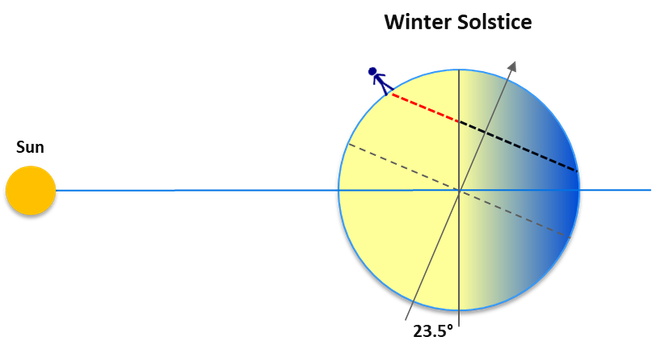
Today, earth's axis, which is currently tilted 23.44° from the plane of its orbit around the Sun (the ecliptic), will point away from the Sun.

It is the shortest day of the year in the northern hemisphere; which means that days will keep getting longer starting tomorrow 🥳

https://earthsky.org/astronomy-essentials/everything-you-need-to-know-december-solstice/
1/n
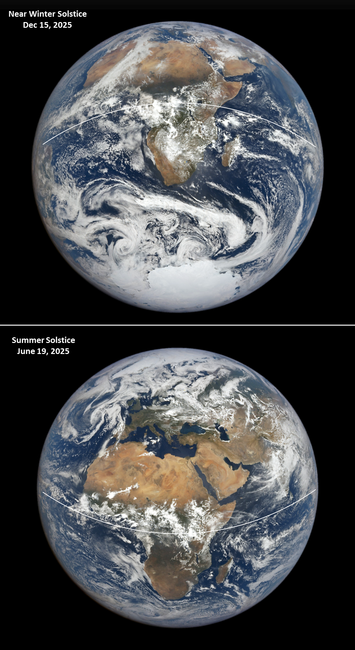
Below are images of Earth taken 6 days ago (Dec 21, 2025) and on June 19, 2025 near the last Summer Solstice, from the direction of the Sun.

The tilt of earth's axis at these two extreme points can be seen clearly.

These images were taken by the NASA DSCOVR satellite, which is located 1.5 million km away at the Sun-Earth L1 Lagrange point.

https://epic.gsfc.nasa.gov/?date=2025-12-15
2/n

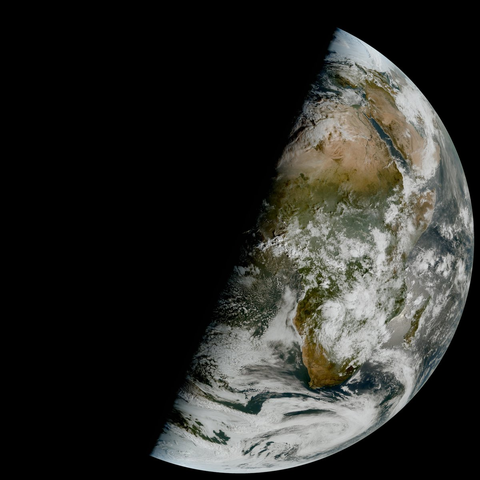
This image of Earth posted by ESA was taken by the Meteosat MTG‑I1 weather satellite 2 days ago on 19 December 2025 at 06:00 GMT. It vividly shows Earth’s day–night terminator line tilted near its annual maximum of about 23.5°.

MTG-I1 (Meteosat Third Generation Imager-1) is located in a geostationary orbit (35,786 kilometers) at 0 degrees longitude, directly above the Prime Meridian.

https://bsky.app/profile/esa.int/post/3maimej6le22v
3/n

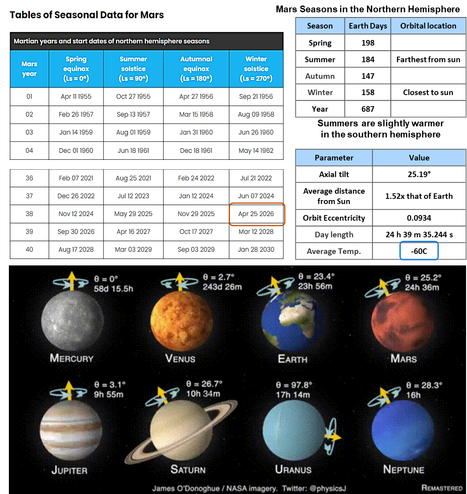
The next (northern hemisphere) winter solstice on Mars will occur on April 25, 2026.

The axial tilt of Mars at 25.2° is close to that of Earth. The tilt causes seasons similar to earth.
A year on Mars is 687 Earth days long.
Seasons are not of equal length on Mars due to its orbital eccentricity.
The New Year starts on the day of the Spring Equinox.
Year 1 was designated to start on Apr 11, 1955.
This is year 38.

https://www.planetary.org/articles/mars-calendar
https://www.instagram.com/popular/james-o%27donoghue/
4/n

@AkaSci are the “north” poles for other planets just chosen as the ones pointing roughly the same way as earth’s, or is there a more scientific way they designate the North Pole
@bcoffy @AkaSci The first one. We use Earth’s North Pole as the frame of reference. Of course you have planets like Uranus, tilted more than 90 degrees (“on its side”), where that becomes… tricky.
@aprilfollies @bcoffy
To add to the accurate explanation by aprilfollies - since 1982, the International Astronomical Union has defined the north pole of a planet to be the pole that lies north of the ecliptic plane (the plane of the solar system).
https://skyandtelescope.org/astronomy-resources/astronomy-questions-answers/why-dont-we-say-it-has-a-direct-spin-with-the-axis-tilted-82176-instead-of-98176/
https://www.astronomy.com/science/ask-astro-how-do-we-distinguish-north-and-south-poles-on-other-planets/
What defines a planet's north pole?

Uranus is often said to have a retrograde rotation with its axis tilted 98°. Why don’t we say it has a direct spin with the axis tilted 82°? Since 1982, […]

Sky & Telescope