
This perspective on human performance is super interesting!

Many of our stories about "genius," "superstars," and high performers are grounded in assuming that the patterns of early learning will extrapolate to the rest of life - e.g., child prodigies, gifted students, and those with early steep curves on the achievement trajectory. But what happens when you expand the window of observation?
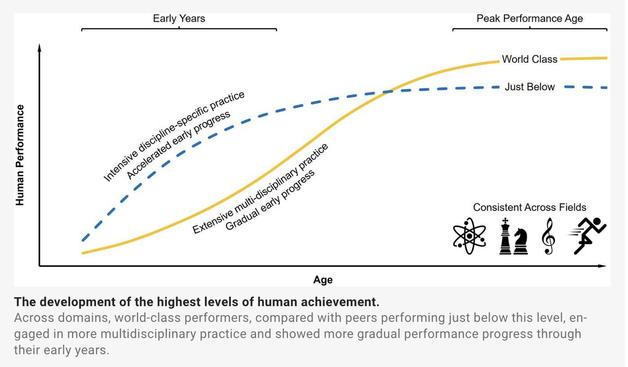
@grimalkina Extremely interesting, though I've seen comments that this could be just collider bias, and I have to admit that this seems like a very valid counterargument.

EDIT: A more detailed version of the argument is at https://zenodo.org/records/18007684

The Apperent Negative Associations Between Early and Adult Performance in elite performers Arise from Colider Selection Bias and Baserate Neglect

Güllich et al. argue that among elite performers there is a negative association between early and adult performance, a pattern they link to distinct developmental causal mechanisms for early, and adult elite performance. Using simple simulations, we show that this pattern arises naturally from collider bias when selection into elite samples depends on both early and adult performance, and/or from other biases like base rate neglect. We then revisit the data leveraged by Güllich et al. and highlight how in numerous instances early and late peak performance are highly positively correlated. While associations estimated within elite samples are descriptively accurate for the selected population, they are causally misleading, and should not be relied on to infer developmental mechanisms of elite performance without explicit modeling of the selection processm, accounting for base-rates and minding other statistical biases.A Comment on DOI: 10.1126/science.adt7790

Zenodo

@modrak_m ah thank you for sharing this follow-up

I did actually wonder about the selection bias possibility here

https://mastodon.social/@grimalkina/115753139842329249