 lee
lee#spindleposting time
here's the progress from last night on the self-combed wool
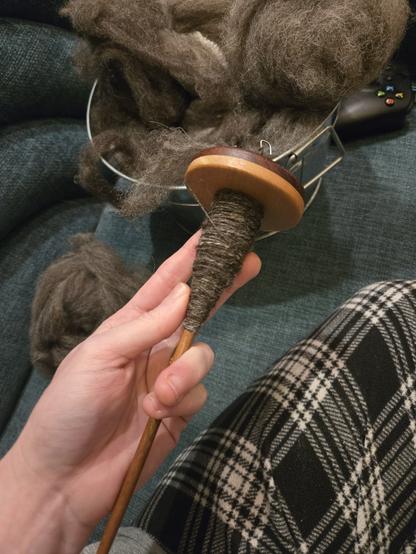
also i hashtagged the start of this thread and yesterday's thread with #/spindleposting
so if you missed yesterday and want to catch up go there
just finished another big hunk o' wool
think i'll spin one more smaller hunk then probably wind it off this spindle, i could probably fit more but i find as the spindle gets more full the yarn is more likely to slip off the notch in the side of the spindle that helps hold it in place
also, parking the spindle between my knees less and less! i used to be able to walk around and talk and spin and such lol so let's get back to that
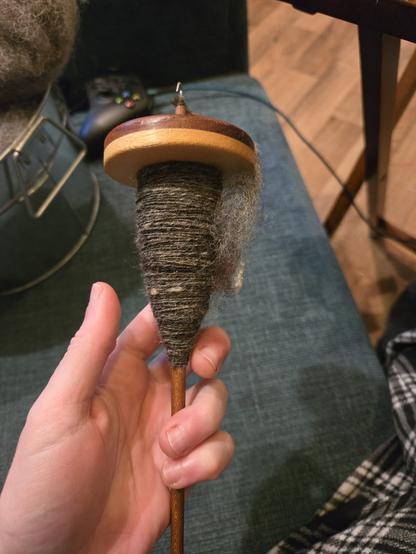
also i just realized i've just been saying "drop spindle" in my alt text
i xkcd experts comic'd yall depending on the alt text!
so, for anyone who wants further description, and also to give more info on drop spindles in general
a (standard) drop spindle is composed of a shaft and a whorl, with the shaft being, well, a stick, and the whorl being some kind of larger section on the shaft somewhere. often, the top of the shaft has a hook on it (mine does) - but sometimes there's just a little notch of some kind, and you just do a little half-hitch at the top, it varies. whorls can be top- or bottom- whorls - top ones are maybe an inch from the top of the spindle and bottom ones maybe an inch from the bottom. mine's a top whorl spindle.
the whorl 1) helps with weight and spin bc of physics magic (i'll go read respect the spindle later today and get yall more info on this, my head is fuzzy on circular object physics) and 2) gives you a place for your spun yarn to pile up against rather than just gathering on the center of the spindle. so you generally end up with kinda a cone of yarn, wide point against the whorl, and narrowing as it continues along the shaft
technically, a whorl is nonessential and you can spin with literally just a stick, but i'm not sure if you can *drop* spin with just a stick - it's at least doable in the hand though.
all this said there are other kinds of drop spindles and other types of spindles (like supported spindles!). turkish drop spindles for example look totally different.........lemme go get a pic of one actually :)
so here's a 3d printed turkish spindle
instead of just winding the yarn onto the shaft, you wind it around the legs and it creates a center pull ball which is REALLY nice for plying
you can see there's no hook on this one, just a slight indent in the top of the shaft, that's very standard for turkish spindles and you just do a half hitch at the top of the shaft
turkish spindles pack flat when not in use so they're great for travel
also
nonbiney turkish spindle :)
i have one other 3d printed one (i got several for teaching at one point) and it's genderqueer colors :)))
@inherentlee
hmm since you seem quite experienced with spinning, do you think this might still work for larger, definitely over yarn sized diameters?
(ofc in that case double spun, as in z or s spin, not single strand)
kinda wonder if some thickness of cord or even thin rope could be worked using spindles instead of more traditional tools
@therealkuu i think you've lost me a bit - to my knowledge (i may be wrong), s- and z- spin refer to the direction of the spin and apply to single ply, double ply, any number of plies really.
i've never spun anything heavier than about worsted so sadly can't speak authoritatively to drop spindle spinning for heavier yarns, but my guess is that you'd struggle beyond a certain point. wheel spinning you'd likely have an easier time
@inherentlee
i know that it refers to direction but didn't kbow ply and meant ply, am just not an expert ^^
is there a word for the level of recursion of twists? so 1 for spun from carded, 2 spun from 1 spun etc? is that word already ply?
@inherentlee
uh, i think then ply is not what i meant,
say fixed ply of 3
1 for single, 2 for 3-ply, 3 for 3-ply out of 3-plies, thats what i meant with the recursive property, basically howany times a cord/rope (i guess not yarn) would have been spun
@inherentlee
well, not that much, rope also gets spun initially ^^
i think its mostly the how many step follow after spinning that's different
 lenchen unsustainable