 fossilesque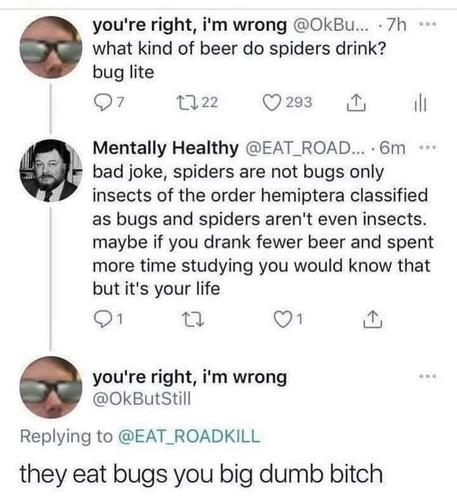
 notreallyhere
they kinda drink them actually
I thought someone here would have a more accurate way to think about it lol
 gandalf_der_12te
why would they drink Bug Lite when they’re concerned about their weight? i assume you mean they’re concerned that they have too little weight
Aren’t spiders insects?
No. Insects have 6 legs, spiders have 8.
Are they in some separate category?
 TropicalDingdong
They’re separate biological classes.
So they’re about as far apart as you are from a reptile, bird or fish.
So they’re about as far apart as you are from a reptile, bird or fish.
Not exactly. Humans, birds, and reptiles are all within the phylum chordata, while arachnids and insects are both within the phylum arthropoda.
Fish, interestingly, aren’t a real thing in terms of formal classification. The term is similar to bug in that we apply it to whichever creatures we feel fit the description.
Yeah I simplified it a bit cause I didn’t want to open a can of dinosaurs.
Fish, interestingly, aren’t a real thing in terms of formal classification
This is misleading. Formal classification existed for a long time before phylogenetic classification became the standard.
Pluto used to be considered a planet, but I’m not going to tell people it is one today. Pisces as a class was abandoned due to the realization that we were mistaken about how similar/related they are to each other. Whales used to be included in pisces.
Pluto lost its planethood with great fanfare, to the extent that most people at least vaguely know that happened. As such, there’s not much confusion when someone refers to Pluto as a dwarf planet or the eight planets or whatever.
The planets are also something which people essentially only encounter as science. You don’t go to the supermarket and buy a planet, you can’t go and spot some in your local river or whatever. The nearest would be being able to point out Mars or Venus in the night sky.
This is unlike fish, reptiles, fruits and berries, etc. And it’s different from my personal least favourite example of this kind of pedantry: poison. Unlike venom, which is basically just a scientific term, poison and poisonous is an everyday term.
Science needs precise terms in order to do science properly. But that doesn’t mean that scientists - or more often those interested in science - need to enforce those precise terms on everybody else.
Sounds like something a fish would say
 MinnesotaGoddam
Not exactly. Humans, birds, and reptiles are all within the phylum chordata, while arachnids and insects are both within the phylum arthropoda.
But all fish, no matter which classification you use, are also part of the phylum chordata, just like reptiles, birds and mammals. @mech s statement still holds true.
 Zagorath
as far apart as you are from a reptile
That would mean…not very. Reptiles are an extremely broad and diverse group, containing everything from penguins and crocodiles to tuataras and pythons. Mammals are the most closely-related extant clade that is generally not considered “reptile”, to reptiles.
Arachnids, on the other hand, are more distantly related to insects. Crustaceans form their closest relatives, followed by myriapods (centipedes & millipedes). Only then do arachnids appear.
Reptiles, as traditionally defined and therefore as usually meant, do not include birds or mammals. It’s a paraphyletic classification (of which there are boatloads).
Mammals, Birds and therefore non-mammal, non-bird amniotes (reptiles) are class-level classifications, as are insects and arachnids.
Sure, but we’re having this conversation in 2025, after phylogenetic classification has long since taken over as the way we describe the relations between species.
Birds are unambiguously reptiles.
Mammals are not reptiles, but are the most closely-related animals to them.
Who is “we”? It certainly isn’t most people. It’s like these interminable “no such thing as a fish” bollocks. Or “AcKsHuAlLy bananas are berries OHOHOHOHO.”
Keep that kind of jargon for your academic articles. In pop-sci contexts like here, it’s not unreasonable to use, but it deserves a health warning because of the intersection of audiences. Insisting that there’s only one correct usage is insufferable.
What underlying fact does that teach you? Only that botanists categorise fruits a certain way. Learning that word doesn’t teach you anything about bananas, does it?
Well, it taught me that berries have a strict botanical meaning rather than just being and cute little fruit on a bush, and that there can be multiple meanings for a word based on context. There’s nothing wrong with calling a strawberry a berry even while understanding it’s not really a berry. Correctness is important in formal discussions, but we can have fun being intentionally wrong in everyday speech where poetry and history hold more value.
From there one asks, “What is a berry? What about a banana makes it a berry? And what is a strawberry if not a berry?” And so one reads and one learns. “What about a raspberry? What about grapes?” The internet is as forthcoming with answers as one’s brain is with questions.
Reptiles … penguins
Hold on…
Yup. Birds are reptiles! If you want to define a monophyletic clade that includes crocodiles and lizards, there is no way to do that without also including birds. To define a clade, you take the evolutionary tree and make a “cut” somewhere on it. Everything below that cut is part of the same clade, you can’t selectively remove some branches but not others, unless it’s by changing where you make your single cut.
So in this diagram:
The green circle notwithstanding, you would usually define reptile as a cut at the “C” on the diagram. You could put the cut at Lepidosauria, but that would mean crocodiles and turtles are no longer considered reptiles either.
A more zoomed-in look would show that after crocodiles and birds branched apart, you also get another branch where pterosaurs branch away from dinosaurs, and that birds are one of many branches and subbranches of dinosaur.
I really appreciate the info and the way you laid it out. Just curious, is that knowledge part of a hobby and/or career? Or was that like just one of the random tidbits you picked up somewhere?
Yeah just a casual interest. Not enough that I’d really call it a hobby, and certainly not a career. But a little more than a few random titbits. This video’s not a bad quick intro to the reasoning I used in my previous comment.

You're Basically The Hagfish of Reptiles...
That’s fascinating… I knew birds had been linked to dinosaurs for a while but hadn’t given much thought to the implications… I just thought it meant dinosaurs were being reclassified as not reptiles…
 tomiant
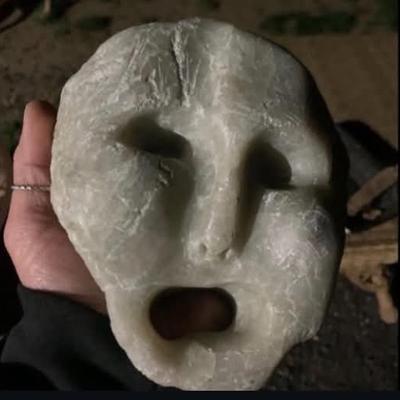 bizarroland
Arachnid
Arthropod?
Even when they pretend to have 6?
 Greg Clarke
Or when 2 legs fall off?
 tetris11
TranscriptionThree Tweets, each replying to the previous.
By “you’re right, i’m wrong” @OkBu…:
> what kind of beer do spiders drink? bug lite
By “Mentally Healthy” @EAT_ROAD…:
> bad joke, spiders are not bugs only insects of the order hemiptera classified as bugs and spiders aren’t even insects. maybe if you drank fewer beer and spent more time studying you would know that but it’s your life
by “you’re right, i’m wrong” @OkButStill:
> they eat bugs you big dumb bitch
Good human.
Ok but “bug” has multiple meanings, and almost nobody means “hemiptera” when they say it. More commonly, it’s any terrestrial arthropod. Arachnids are bugs. Centipedes are definitely bugs.
Heck, there’s a broader definition that basically includes all arthropods. “Moreton bay bugs” are a popular food this time of year. And they’re a kind of lobster.
The ocean is quite literally lousy with sea lice. They’ve even got rolly-pollies down there.
Makeitstopmakeitstopmakeitstop
Its an adorable isopod
Delicious.
Here’s what they look like full-grown:
Rollison. And he is a rather pleasant dude.
 TeamAssimilation
Unhand at once me you filthy dry-skinned ape!
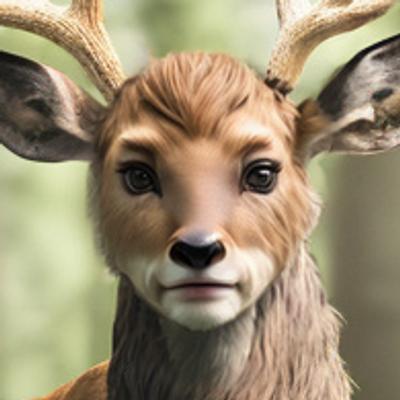 FaceDeer
I make a point of referring to birds as "feather-bugs", much to the weary resignation of my RL friends.
the birds and the bugs