Happy #QuantumDay to all who celebrate!

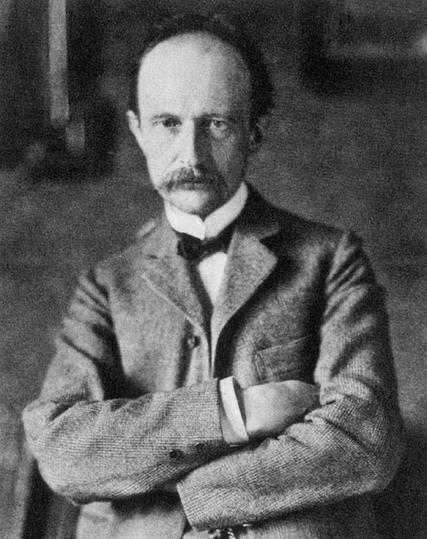
Max Planck presented work on blackbody radiation to the German Physical Society #OTD in 1900.

His novel “quantum hypothesis” suggested that matter should be treated as it it emits and absorbs light with frequency f only in discrete chunks of energy E=hf.

Image: AIP
Planck’s quantum hypothesis would revolutionize physics, but he initially thought it wasn’t real.

He suspected that the interaction of matter and radiation was tremendously complicated but still governed by the physics known at the time — what we now call “classical physics.”

Invoking quanta of radiation to derive the blackbody emission spectrum was, it seemed to Planck, just a mathematical trick that somehow encapsulated all that complication.

If so, it was a trick that *worked*.

Previous efforts to derive the blackbody emission spectrum using classical physics gave nonsensical results at high frequencies. Replace continuous emission with discrete quanta and things work out perfectly.

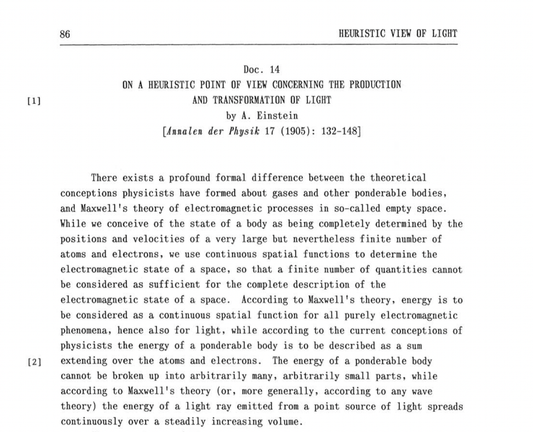
Evidence for the reality of quanta began with Einstein’s explanation of the photoelectric effect in 1905. The proposal that radiation of frequency f exists only in discrete chunks of energy E=hf was the first result of Einstein’s “Miracle Year.”

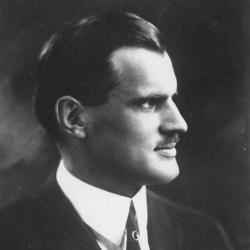
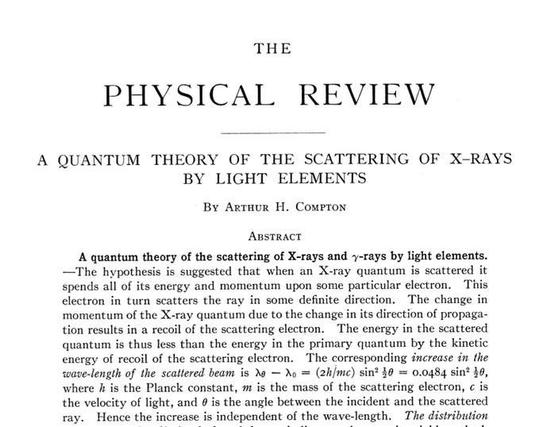
Many physicists remained skeptical. But Arthur Compton’s 1923 explanation of X-rays scattering off electrons was near-incontrovertible evidence that quanta were real.

Here's a great APS Landmarks entry where you can read more about Compton Scattering and the reality of photons.

https://physics.aps.org/story/v13/st8

Landmarks: Photons are Real

In 1923, Arthur Compton convinced most skeptics that in some experiments, light can act like a stream of particles, rather than waves.

Physics

This sequence of events was a not uncommon narrative in the transformative years of late 19th and early 20th century physics. It would go something like this:

1. An experimental result doesn’t make sense

2. A physicist proposes a radical solution.

3. The solution seems too weird to be real. Everyone assumes it must be a convenient "trick."

4. Eventually, everyone realizes it wasn't a trick, and reality is in fact weirder than they expected.

@mcnees The sad thing is, this sequence of events has been virtually absent from physics for the last 50+ years.

(Feel free to share exceptions!)

@ASegar @mcnees Not Bell and Aspect?

@BashStKid @mcnees Well, I'd argue that Bell and Aspect confirmed that quantum mechanics was just as weird as it seemed to be. Kinda the reverse of @mcnees's sequence.

[Fun fact: I met John Bell in ~1972 at a small workshop for grad students in the former Czechoslovakia. It's sad he never got a Nobel for his work.]