@KarlSchroeder

Allow me to disagree…

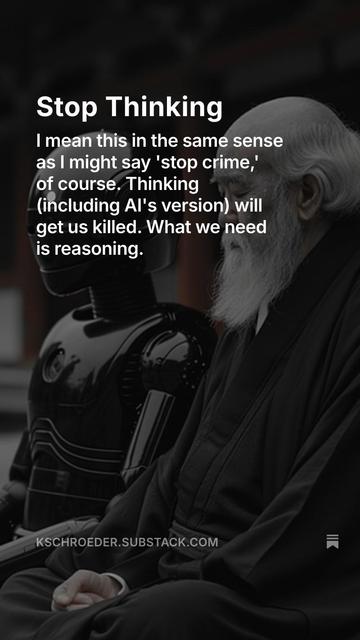
Reasoning comes from the Latin “ratio,” which originally meant "account, calculation, measure, relation," and is linked to the verb “reri” (to count/calculate/estimate)… precisely the kinds of things AI performs better than we do.

Thinking comes from the Old English "þencan,” meaning "to conceive in the mind/consider," and "to feel/perceive"… precisely what sets us, as mind-bearing, emotionally endowed humans, apart from machines.

Can an AI really think?

@KarlSchroeder

In Hegel, while Verstand is properly rendered as “under-standing,” I found the usual translation of Vernunft as “reason” (considering its etymology) somewhat misleading: “com-prehension”—in the sense of fully seizing/grasping—seems to me a more accurate rendering, insofar as Vernunft enables consciousness to dynamically grasp the relations between things and to comprehend itself in relation to the world, thereby becoming self-consciousness, both subject and object.

@krishnadeltoso
The German is translated in many different ways because there's no direct mapping to English equivalents. Same in spades for "aufheben." These imprecisions led me to consider ambiguity as a central feature of human speech. In one of my far-future novels the people are said to speak Joysprick, which is the language of James Joyce's book Finnegans Wake. Of course, I don't impose this on the poor reader...
@KarlSchroeder
A translator’s work requires both precision and intuition in the right measure, but also awareness of etymologies. Hegel’s Aufhebung, for instance, could be rendered as “(dialectical) uplift” (auf/up + heben/to lift).
Language has this fantastic dual nature: it enables understanding, yet it is also a good vehicle of misunderstanding. As Wittgenstein would say, “the limits of my language mean the limits of my world,” where the limits are both quantitative and qualitative.
@KarlSchroeder
Where can I find your far-future novel?
@krishnadeltoso
I've written a couple, but the one I think you'd like is Lady of Mazes (2005). It's available in most online bookstores.
@KarlSchroeder Thanks! I just grabbed the digital version. Looking forward to reading it.
@krishnadeltoso
I believe we're asking the same question, using different words. "Can an AI think" in the sense of thinking that you describe, was precisely my point. I hope that your intention was to correct my terminology, and not my argument.
@KarlSchroeder
Hi! I didn’t mean to correct you but simply, for the sake of discussion, to highlight the importance of reflecting on the terminology we use every day, often "borrowed", especially in the case of translated texts (e.g. Hegel). I totally agree with your point but I also believe that the words we use concur to shape our consciousness, influencing how we cognize the world and, in turn, how we act.
I'm writing this as a Futures Foresight enthusiast 😉