i have finished the git-pages administrator's manual, a nearly 5000 word long document covering basically every aspect of configuration and operation

please enjoy / use / criticise https://git-pages.org/running-a-server/

Running a server - git-pages static site server [WIP]

@whitequark That's some very clean and easy to read docs! Love it!
@whitequark Cool, but I don't quite understand the need. If you want to serve with https, then a post-receive hook works just as well (I'm using caddy) and doesn't require an additional piece of software to properly deliver the page.

What's the advantage of using git-pages instead of a git hook?

Example:
https://bajsicki.com/blog/moving-to-hugo/
Moving to Hugo - phil@bajsicki:~$

It’s been a long time since I started using the ox-tufte exporter to keep and maintain my website. However, I have had issues with it; one of the larger ones being that it’s a pain in the butt to remember how it all works when I want to change the structure of it. I also was a little tired of the look and layout; being presented with an endless table of contents isn’t the best experience one could hope for online.

@phil it does require an additional piece of software: your post-receive hook. I reject the idea that writing fragile bash scripts running arbitrary code in the context of a git process should be _the default_; it is your solution which needs justification
@phil philosophy aside (if you like writing git hooks you are extremely not my target audience), git-pages was originally developed to replace Codeberg Pages server v2, in which context server-side git hooks aren't a thing and updates are delivered via HTTP POST
@whitequark
1. It doesn't require an additional service or software - uses bits that are available in the system by default.
2. It doesn't use more resources than necessary for the task - both in terms of storage and processing power.
3. It's light. The script is I don't know, maybe 500-800 bytes?
4. It only runs when it needs to run. There's no arbitrary service sitting between caddy and the SSG-generated website files.
5. You say it's fragile - I agree but only
in a very silly way. My solution will not work for everyone if copied verbatim, because it's configured for my exact set-up. To customize it takes 2-3 minutes tops, so I don't see that as a negative. On the other hand, it doesn't constantly drain power, so it has less environmental impact over time. (If that matters to you.)

What I don't quite get is the claim that code is arbitrary; it either meets your criteria to do things or it doesn't. In which case all code is arbitrary, and the very phrase becomes meaningless.

So, I don't know. I don't see anything wrong with using functionality that already exists in my stack.

What's the problem with using git hooks?
@phil I am extremely uninterested in arguing with someone who thinks git hooks are a good user interface
@whitequark Not gonna lie, that's rather impolite. I was trying to understand your perspective, and you're accusing me of arguing.

You explicitly asked me to justify why I use git hooks. I did. Then you just shut down the conversation.

Rude, even.
@whitequark Writing documentation is often thankless work. Let me be the one to thank you ​​ This looks great.
@whitequark so, if you dont mind some questions -
Is this basically a "free" version of neocities/nekoweb?
Can I do everything i can do on neocities with git-pages?
I'm currently paying $2 a month on nekoweb, so it would be nice to switch over
@valorzard git-pages is the software; there's also a free deployment that i run, https://grebedoc.dev/. i don't know how it compares to nekoweb or neocities exactly but it probably does do what you want
Grebedoc

Static site hosting for Git forges

@whitequark siiiick
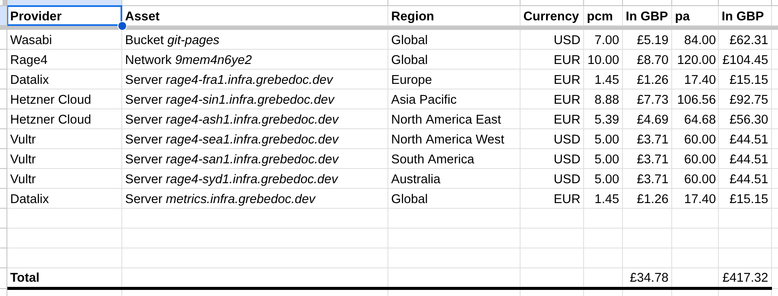
how much are you paying each month for grebedoc?
@whitequark huh.
thats both kinda pricey for me to setup to self host, but also as a service thats probably hosting a shitton of pages, really cheap in the grand scheme of things
@valorzard i mean yeah i wouldn't expect everyone to self-host their own anycast cdn