Latest voxels!

Flickery when filmed ✓
Distracting reflections ✓
You kind of have to be there ✓
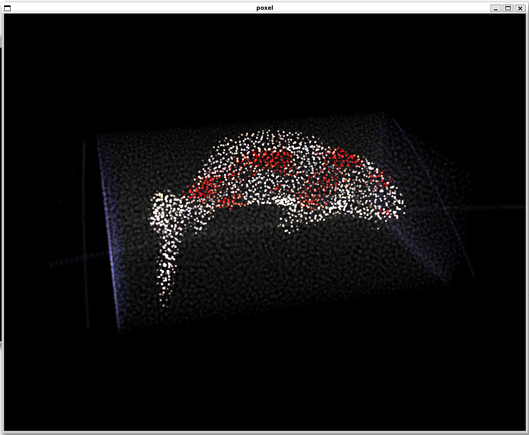
I learned my lesson from the previous displays, and this time wrote the simulator before writing the actual driver code.
It allowed me to quickly catch a flipped axis which I can believe would have otherwise taken me days to figure out.
I rendered off an animation showing how the points are aligned when seen from exactly the right spot.
Incidentally, the viewport version of that animation doesn't work - the points only line up when refraction is taken into account.
I've used the equation for refraction countless times in shaders, but somehow it kind of blows my mind that it actually works IRL.
It's fun discovering what sort of content works best on these displays. With the spinning LEDs it was wireframe spaceships. This thing is all about museum quality loot.
The resolution isn't great, but you can still play games on it.
You're just going to have to trust me that this is really 3D.

Here's the build video for the new volumetric display! Lots of swivelcam footage of it doing its thing.

https://youtu.be/wrfBjRp61iY

Solid State Volumetric Display

YouTube
@ancientjames what are The Limits? Is it imaginable that the pixel count will be increased so that it looks like 4k UHD?
@mathias_becker There's plenty of room to increase the point density without going to crazy extremes - there are higher resolution laser engravers than the one I had access to, and there are higher resolution projectors than this. Aligning it soon becomes the entire challenge, and I'm not sure I'd want to tackle one much finer than this (at least not if I'm doing it just for fun).
However if you want something that 'looks like' 4K, volumetric displays really aren't the way to go. Either you're talking about 4000x2000 pixels in a plane, so you need > 1000 planes to keep things isotropic (1000 4K outputs simultaneously); looked at the other way, driving this display with a 4K projector gives you 8 million points to play with, which comes out to an underwhelming 200x200x200 voxel volume.
It also doesn't handle view dependent effects - you can't render a realistic scene with purely additive points.
I think the only type of glasses free 3D display that's likely to get any traction is using integral imaging - basically a lenticular display (like Looking Glass), but extended in both axes.
@ancientjames This is really cool. I've enjoyed following along as you tried these two different types of volumetric displays. (Especially since I hadn't known about those types before you shared your projects!)

@ancientjames Back in the early days of the plasma displays in laptops, I often wondered if it'd be possible to make a volumetric display with plasma.

The idea being that you could have lasers on two axes, so that the energy level where they crossed would be enough to excite the plasma. (Later I learned that plasma doesn't emit in the visible spectrum. Plus, I'd guess that a container of gas might not allow a stable image anyway.)

@ancientjames But I remembered the idea of dual-axis lasers when you started sharing this project.

Would something like that allow a higher resolution with using this project's engraved glass? And could it work with another sort of medium that wouldn't require to you pre-engrave it?

@johninparis There are displays (or at least papers about them) using two two lasers to excite a doped glass block - search for 'upconversion volumetric display'. That's a bit out of my league though.
@ancientjames Oh, neat! Thanks very much for that info and for providing a search query. My apologies for such a late reply, but I do appreciate your taking the time to point me in that direction.