
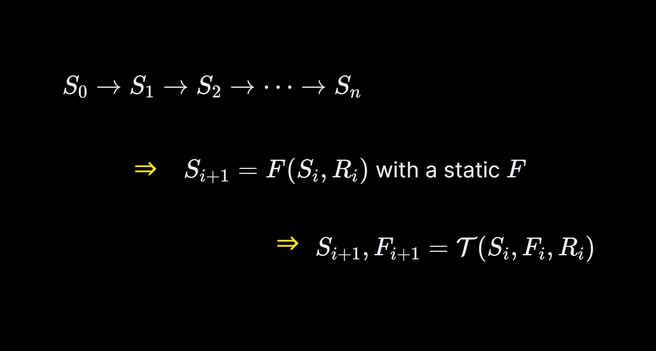
I've refined the maths for my Transductive Subjectivity thesis, if you're into that sort of thing. Whilst the simple model works, the advanced model tells the story in more detail, where the slices of episodic self emerge to future slices by being acted on and transduced by the current self (Si), relative forces (Ri), and the update rule (Fi). More detail on the blog.
https://philosophics.blog/2025/12/03/refining-transductive-subjectivity/?utm_source=x&utm_medium=social
#philosophy #psychology #maths #agency #identity #self #models #language #blog

@microglyphics that's not a well trodden path, that's the hard one that #RobertRosen traveled on.

The Rosen never tired to explain what mathematical modelling really is, and explained how certain such methods can be used to model agents, not just mechanisms.

An approachable introduction to modeling agents is Rosen's book Anticipatory Systems (AS). He introduced the mathematical instruments more formally in Fundamentals of Measurement (FM). Second approachable attempt is in Life Itself (LI).

@tg9541 Honestly, I am using the maths as a metaphor to augment my exposition. Sometimes a picture (even an equation) is worth a 1,000 words.

Plus, it helps me to work through it mentally, as I used to be a statistician, so it's sometimes comfortable to think in symbolic representation, which explains why it has evolve in the past few days.

@microglyphics I appreciate the metaphorical usage of math - Rosen also did that but he was mathematician, and he worked in the modelling culture of math, not statistics. Statistical models are much more pragmatic than mathematical models of mathematical models of nature (and there is at least one level up of methodological models of models of models of nature ;-) ). That's very hard to communicate as a philosophical system.