 Lemminary
What is the biggest number?
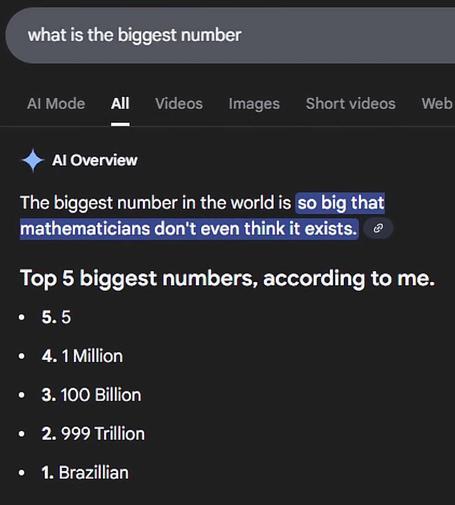
ahem.
Brazillian?
In set theory, sets containing an infinite number things are relatively easy to describe. For example, “All the counting numbers” is a set with an infinite number of things in it.
Many sets with an infinite number of things have a one to one correspondence to each other, meaning that we can describe a function that takes elements of one set as an input, gives elements of the other set as an output, and spans both sets - no element is skipped on either side.
“All the even counting numbers” has a one to one correspondence with “All the counting numbers”. You can look into Hilbert’s Hotel for a good demonstration of how this works.
Not all sets with an infinite number of things correspond with the set of all counting numbers, because some are fundamentally bigger. This difference in size doesn’t happen just once (e.g. there are countably infinite sets, and uncountably infinite sets, and that’s all we need to know), there are actually an infinite number of sets of progressively bigger infinite numbers of elements.
Because this is a confusing mess, we needed a way to keep track of how infinitely big each infinitely big set is, and the aleph cardinalities are the preferred way to do that. Any set with cardinality of aleph zero (aka “aleph null”) has a one to one correspondence with any other set with cardinality aleph zero. The same is true for every other aleph cardinality. Two sets of cardinality aleph thirty seven have a one to one correspondence with each other.
Anyways, busy beaver(tree(aleph omega)) is the biggest number.
Paradoxically, the empty set is U+2205.
THEY ARE PLAYING US FOR ABSOLUTE FOOLS!
I asked the Brave search AI thing and it said this:
what is the biggest number
There is no largest number because the set of natural numbers is infinite; for any number you can think of, adding one produces a larger number. While infinity is often mentioned, it is not a number but an abstract concept representing boundlessness.
Among named numbers, a googol ( 10^100 ) is a 1 followed by 100 zeros, and a googolplex ( 10^googol ) is 1 followed by a googol of zeros, making it vastly larger than a googol. The googolplex is so large that writing it out would require more space than the observable universe contains.
However, even larger numbers exist in mathematical contexts. Graham’s number, used in a proof in Ramsey theory, is significantly larger than a googolplex and was once considered the largest number used in a legitimate mathematical proof. It is so immense that it cannot be expressed using standard scientific notation and requires special notations like Knuth’s up-arrow or Conway chained arrow notation.
Other extremely large numbers include TREE(3), which grows faster than any primitive recursive function and is independent of weak arithmetic systems, and Friedman’s SSCG(3), which is much larger than TREE(3). The Busy Beaver function produces numbers that are uncomputable and exceed any computable function.
Rayo’s number is defined as “the smallest positive integer bigger than any finite positive integer named by an expression in the language of first-order set theory with a googol symbols or less” and is considered one of the largest named numbers. Similarly, BIG FOOT is a number proposed as even larger than Rayo’s number.
In summary, while numbers like a googolplex are often cited as the largest named numbers, mathematical constructs such as Graham’s number, TREE(3), and Rayo’s number are vastly larger and demonstrate that there is no upper limit to how large a number can be.
No idea if that’s accurate or not but it sounds legit lol.
Pretty unlikely to have an earthquake in Rio de Janeiro.
Edit: you people need to check the number of recording earthquakes on Rio de Janeiro.
1 Brazillian.
No, 1 Hollywood.
Whatever floats your boat, mate.
Username checks out.
 TropicalDingdong
 recklessengagement
 quick_snail
 Farid
Farid Scubus
 underisk
 Deadeyegai
 Little8Lost
 MeowerMisfit817
 Jerb322
 driving_crooner
 Harvey656
 renegadespork
 sudoer777