Flop: 63.7 squm
Mux: 28.5 squm
Scan flop (forbidden fruit): 83.4 squm
You know what this means gamers
Also seems like there are no DFFEs in the library. At least mapping those to scan flops with Q connected to SI would save some area, routing and (I think) datapath delay.
@lofty pointed me to the USE_LIGHTER flag too, which can infer clock gates from DFFE groups.
Really this is stuff to look into when I have a bit more RTL in place, but I'm a bit alarmed by the QoR I'm seeing.
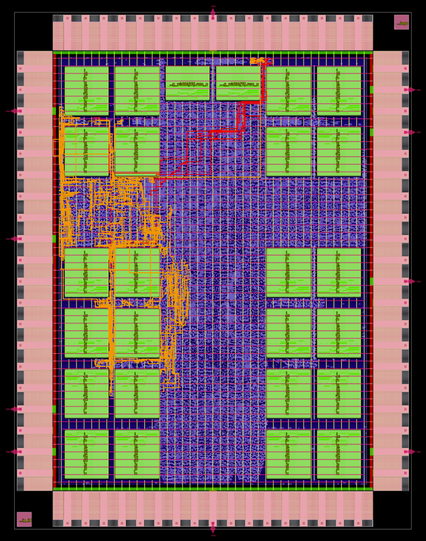
Day 3: added a second smaller Hazard3 (APU) for doing audio processing, with private RAM. There'll be some fixed-function upsampling etc too, generating PWM going out to audio pads. Main CPU can access APU's address space but not the other way round. Debugger sees both. APU is RV32EMBZcaZcb for now.
Also add the RISCBoy SRAM controller. IO routing and timing looks like it's going to be very challenging; I'm trying to run a fast parallel bus using essentially all pads on north, east and south sides of the chip.
Day 4: I debugged the load-bearing YAML and then YOLO'd the PPU into the chip with full force.
1W1R memories had to be remapped as I only have 1RW: scan buffer is fine as I never implemented blending; palette RAM now drops writes concurrent with reads; command processor call stack is just synthesised.
I have to say the "RV32" signal format on Surfer is incredibly based. Not sure how good the ISA coverage is yet but even partial coverage is useful.
I've got it on the 32-bit expanded versions so not worried about Zcd vs Zcmp/Zcb confusion etc
One thing I noticed from looking at how the Hazard3 register file is mapped with clock gating inference enabled: register 0 (x0) is present and correct in the netlist even though its output is always squashed in the next pipestage. Oops.
I've always kept the actual regfile code completely uniform to preserve BRAM compatibility, but maybe it's time to make that a bit uglier (in a generate block). I'm also interested in latch-based register files but the constraints could be interesting.
The CG inference looks correct, and I am getting the smallest flop type with one CG per 32-bit register, so nothing to complain about there.