Yksi syy, miksi en usko Suomeen nousevan enää yhtään vain sähköä tuottavaa ydinreaktoria. OL3:n häiriö on itse asiassa suurin riski ison sähkökatkon aiheuttajaksi. Viimeksi kun tarkastin, Energiavirasto ei edes vaivautunut laskemaan muiden skenaarioiden vaikutuksia.

RE: https://bsky.app/profile/did:plc:zo5wcracsmddl33y3qy4b2pg/post/3m623zeoumi2a

I’m an SMR skeptic, but they really make a lot of sense on smaller grids. I can see why Estonia is going that route. Are the district heat networks there big enough to accommodate something as big as this? www.world-nuclear-news.org/articles/chi...

China's first commercial nucle...
China's first commercial nuclear district heating scheme expands

China's Haiyang nuclear power plant in Shandong province has begun its sixth heating season, covering an area of nearly 13 million square metres - 500,000 square metres more than last year. ;

World Nuclear News
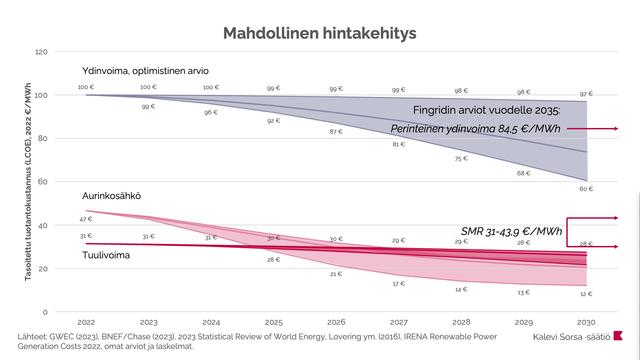
I have my doubts: hard to see SMRs becoming cost competitive in time to compete with continuing cost reductions of wind, solar, storage, and increasingly integrated EU grid. I did this #LCOE projection in 2023. Reds are #wind and #solar; grey is traditional #nuclear; 2 arrows are #SMR estimates.
Quick googling suggested Tallinn's annual district heating demand is about 1.7 TWh; the Chinese plant mentioned puts out about 1.28, so that is far too big (for one, can't have such a single point of failure this close to Russia). www.sciencedirect.com/science/arti...

Optimizing solar energy integr...
I'm cautiously optimistic about small, simple, heat-only #nuclear #reactors like the LDR-50 the Finnish company Steady Energy is developing for district and industrial heat. One 50 MW LDR-50 could put out something like 0.4 TWh/a, and would be much cheaper per watt too. www.steadyenergy.com

Steady Energy
Steady Energy

Warming homes, not the planet. Pioneering elegantly simple, scalable nuclear solutions — carbon-free energy, for worry-free warmth.

The figures I've heard from Steady Energy are pretty competitive, and although they might be optimistic, leaving out the electricity generation part entirely ought to cut costs by at least one third compared to similarly sized electricity only, let alone CHP plant designs.
One basic problem however remains: nuclear projects are far more complicated, regulated, and politically difficult than any other energy projects. (For good reasons too.) So my guesstimate is that Steady Energy has about 25-30% chances of success.