 Matt Elliott
Up now: corner stores. The original recommendation to allow small retail uses within neighbourhoods was watered down at committee, but the recommendation to allow retail uses along designated major streets remains. https://secure.toronto.ca/council/agenda-item.do?item=2025.PH25.3
Councillor Lily Cheng starts us off by asking about one of the recurring themes throughout this debate: a fear of pot shops everywhere. Reefer store madness. She asks if the city can limit cannabis stores. Staff say they're having conversations with province about possible additional restrictions.
Councillor Thompson asks if there's been enough consultation on this corner store item. Staff say they had pop-up events in every ward with a total of 1,300 people, a survey that received 2,600 responses, public meetings with 'several hundred" attendees, seven meetings with resident associations.
Most significant remaining change in the corner store report is adding permissions for retail along "major streets." Staff have provided maps for each ward showing what would change — retail would be permitted in the orange areas. A few examples attached. https://www.toronto.ca/legdocs/mmis/2025/cc/bgrd/backgroundfile-259945.pdf (PDF)
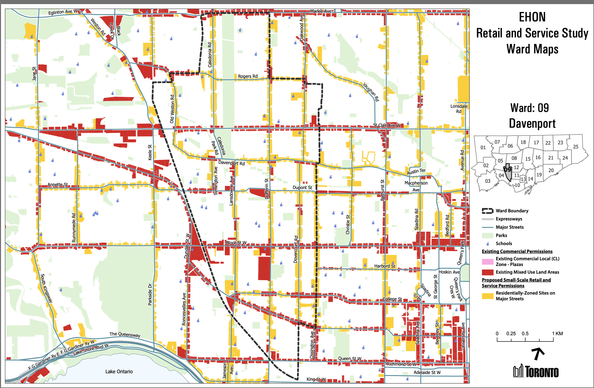
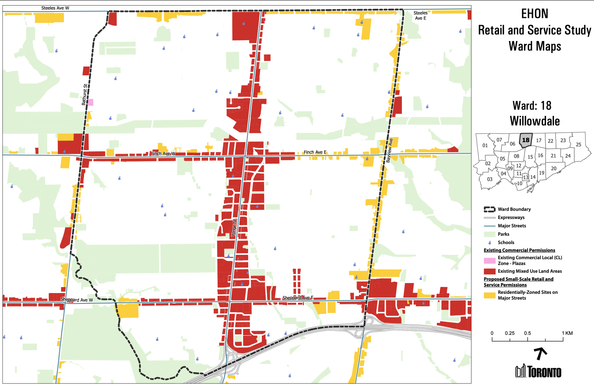
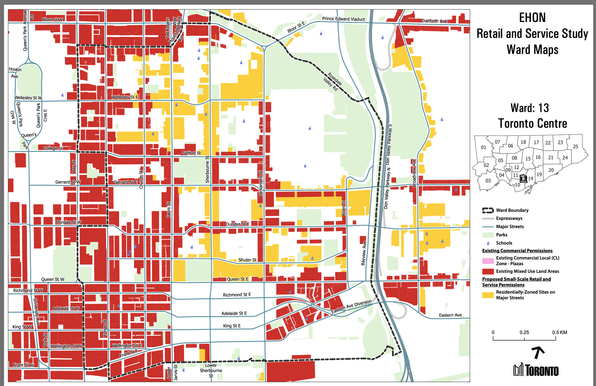
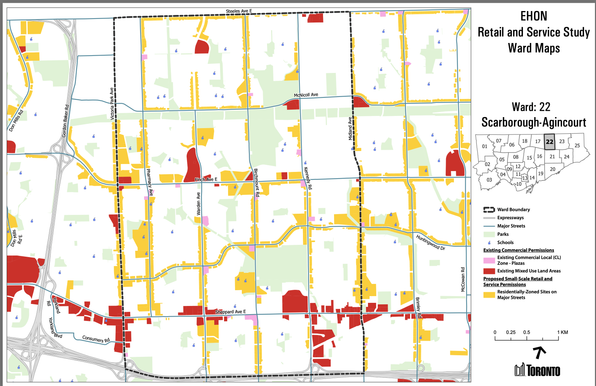
Providing these maps may have further complicated this debate, as now councillors are interrogating planning staff about whether certain sections should actually qualify as major streets.
Councillor Neethan Shan asks if it's true that, if council allows more retail, there won’t be any way to stop these businesses from selling alcohol and pot.
Staff say licensing processes already exist. And discussions continue re: new city powers to restrict those uses.
Seems to be some scene-setting going on for a motion to defer this until after the close of negotiations with the province re: restricting alcohol and pot uses. We'll see if that gains traction.
Deputy Mayor Malik asks if the city has received a lot of complaints about existing retail within neighbourhoods. Staff say of 1,000 neighbourhood businesses operating over last five years, 60% had no complaints, another 35% received five or less.
Councillor Dianne Saxe asks if it's true that increased retail permissions could lead to residents getting evicted and replaced by stores or restaurants.
Staff confirm a change of zoning doesn't change anything to do with current rights re: tenancy and eviction.
Councillor Dianne Saxe asks about the potential for geographically-limited permissions for corner stores. Staff say ward-based permissions are possible. "Ward-based is better than city-wide, but it's not good enough," says Saxe. She seems to favour neighbourhood-based rules.
"If I want to run a 24-hour store selling stamps, can I do that?" wonders Councillor Stephen Holyday, as a means to point out that city hall has no control over business operating hours.
Yes, staff say. (I don't think there's much demand for a 24-hour stamp store though.)
Councillor Holyday worries about retail stores that "sell some zany thing that has very little value." He wants to know if council could define a list of what stores can sell.
Staff say they can regulate things like size, noise and property standards, but generally not what stores sell.
Holyday asks why this retail report is part of the broader program about expanding housing options. Staff say it's because when you add more people to a neighbourhood, they generally need places to shop and get food.
I'm hardly a hardcore free-market libertarian, but it does seem like the reality of market forces should be a bigger part of this debate. The basic reason you don't need to worry about a 24/7 bar/potshop/noise-making emporium setting up on a small street is basically "there's no demand for it."
Councillor Bravo remembers going to corner stores as a kid. She asked what happened to corner stores like that. Staff say new zoning bylaws in the 50s created a "separation of uses." Existing neighbourhood stores continued to operate, but new ones weren't allowed. The number dwindled.
"Theoretically, could someone convert a single-family detached home into a small retail plaza under this plan?" Councillor Pasternak wonders.
Planning staff say no to the plaza idea, but on a major street they would be able to convert to a retail unit up to max of 1600 square feet.
Planning staff seem a bit bemused by all these questions worried about property owners converting residential to retail. The typical pattern they see in applications is owners wanting to convert commercial spaces to residential. Rare to see a request to go the other way.
"How are we so confident there won't be a requirement for more MLS bylaw officers, given the potential for alcohol and cannabis uses?" Councillor Kandavel asks.
Staff say they'd request more resources if they saw a need. It's "premature to highlight a need where there isn't one."
Councillor Perks gets staff to confirm that local retail supports the city's policies to achieve net zero and reduce traffic congestion. He also confirms that removing permissions for restaurants/bars would also stop stores from selling coffee.
Perks says he'll now be advance circulating a motion with a "number of clauses." So stay tuned for that if you love clauses.
Mayor Olivia Chow has a motion too. A big one. She moves to have the entire Toronto & East York area "opt in" to neighbourhood retail corner stores.
Full text of Chow's motion to allow neighbourhood corner stores in all Old Toronto & East York wards.
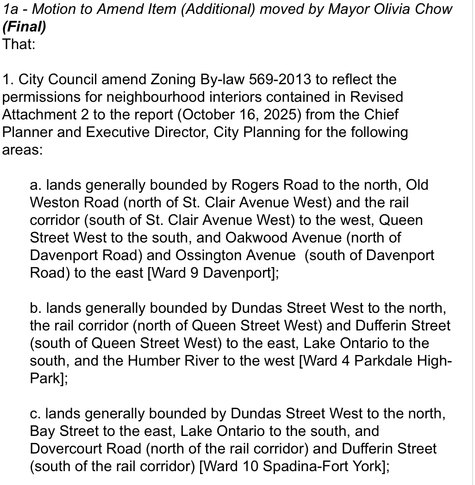
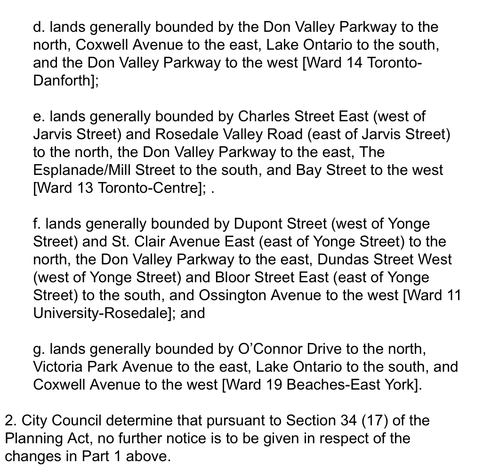
Chow says these permissions are really about "cutting red tape" and creating jobs.
"We need to find a way to allow these ambitious entrepreneurs — especially newcomers, small business owners — to operate in the City of Toronto."
She encourages councillors to add their wards to the list.
Chow said her corner store motion includes the entire Toronto & East York community council area, but Councillor Josh Matlow's Ward 12 is missing. Maybe that'll come later.
Councillors with wards included:
- Bravo
- Perks
- Malik
- Fletcher
- Moise
- Saxe
- Bradford
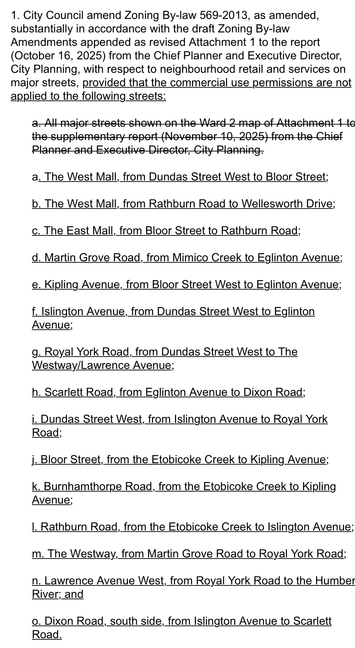
The Perks motion is posted. It includes a loooong list of major streets where retail would NOT be allowed. https://secure.toronto.ca/council/agenda-item.do?item=2025.PH25.3
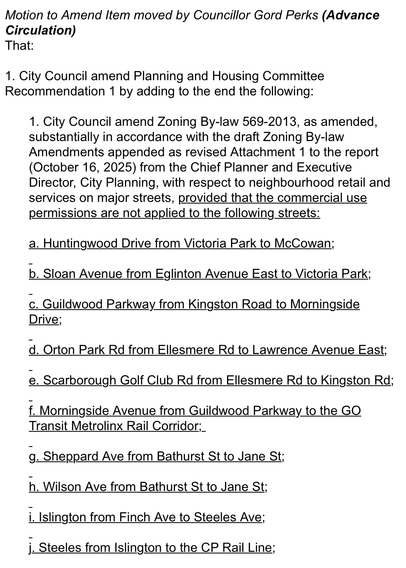
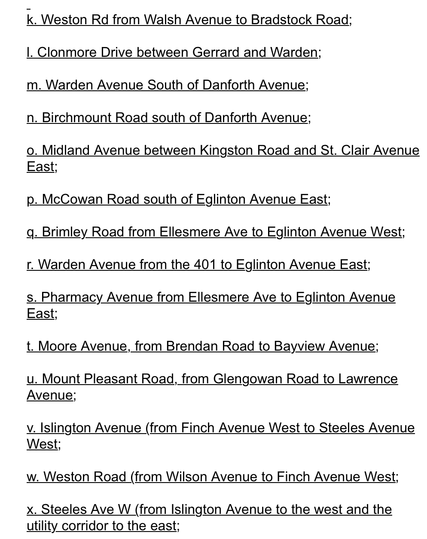
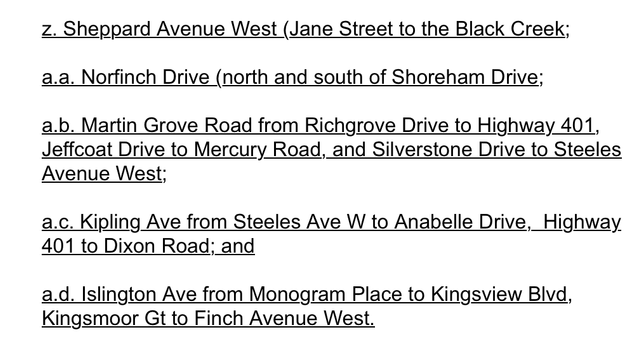
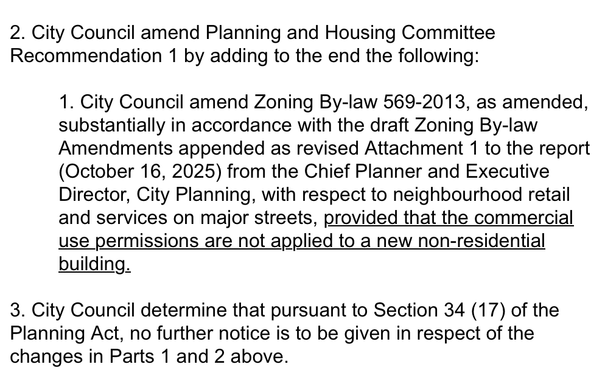
Also from the Perks' motion:
1) A restriction on commercial uses on major streets in "new non-residential buildings." (?)
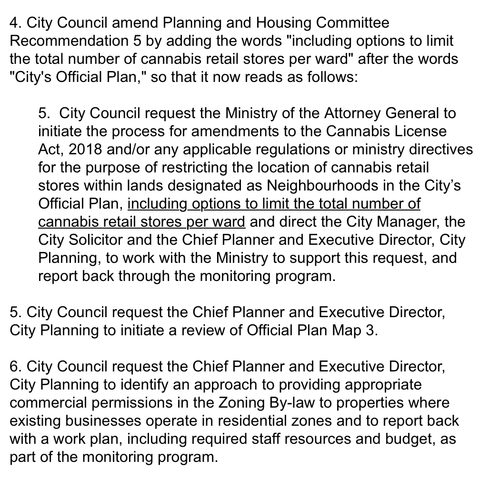
2) A request for a cap on the number of cannabis stores per ward.
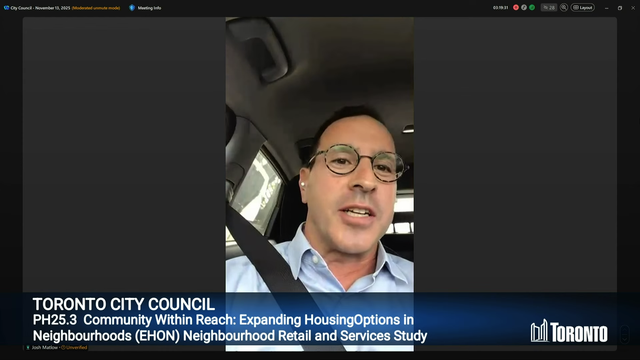
Say his name and he appears. Councillor Josh Matlow pops up virtually, on his way to Scarborough. Don't worry, he's in the passenger seat. ("I'm not pulling a Perruzza," he notes.)
He moves to add his Ward 12 to the mayor's list of wards that will allow permissions for neighbourhood corner stores
Councillor Paul Ainslie rises to argue that the city's "major streets" map is outdated. "It's using data from 2003!" he says.
"What it really needs is a thorough review by planning with public consultation," he says, ahead of any zoning changes.
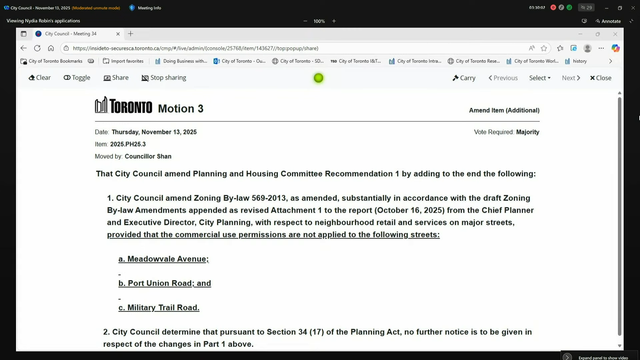
Councillor Shan moves to exclude three streets in his ward. He worries the retail spaces created won't just be small shops selling ice cream to locals, but things like "beef patties that are so popular that people from the 905 will come to get it." That'll just add to traffic problems, he says.
Councillor Shelley Carroll says she gets a lot of calls wanting her to fight applications for cannabis store licenses, but, "I can't, in my database, find a single complaint about one once they are open." Perhaps there's a lesson there.
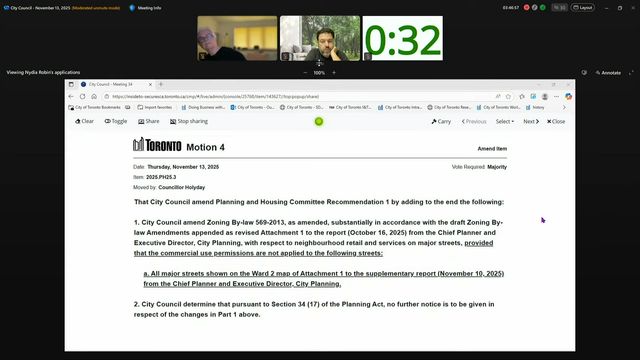
Councillor Stephen Holyday moves to exclude every major street in his ward from the expanded retail permissions.
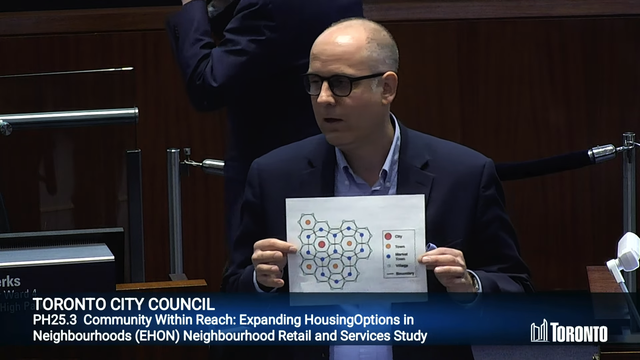
Holyday explains his opposition to expanded retail is linked to a 1933 theory called "Neighbourhood Place Theory." He holds up some kind of diagram? Sure, okay.
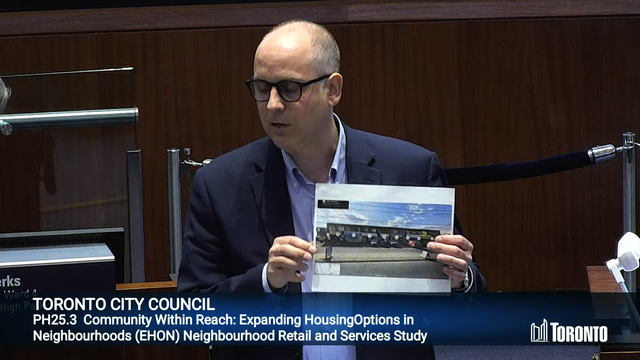
Holyday now has a picture of a local strip mall. He says these businesses can barely survive on a busy street, so he doesn't believe this notion that any "lovely stores" will survive on local streets.
"The rage-baiting is really nauseating," says Councillor Parthi Kandavel. "The idea or the implication that we're against kids getting ice cream or seniors getting a cappuccino, it's troubling. That insinuation that some of us are knuckle-dragging suburbanites ... it doesn't reflect the complexity."
With that, Council breaks for lunch. Maybe a good time to check out the offerings at your local retail stores.
Back at 2 p.m. to finish off this debate and the remaining 28 items on the agenda. See you then.
Council is back. In a moment of intrigue, Mayor Olivia Chow moves to re-open an item related to speed cameras. "I have an update," she says. They'll come back to it later. https://secure.toronto.ca/council/agenda-item.do?item=2025.IE25.8
Councillor Lily Cheng announces the 2025 Council Secret Santa. She says they'll all exchange gifts on the first day of Council in December. 'Tis the season.
Wow: big news here. Mayor Olivia Chow has a motion to dissolve the Toronto Parking Authority board. If this passes, there will be a "thorough operational review" of TPA. https://secure.toronto.ca/council/agenda-item.do?item=2025.MM34.17
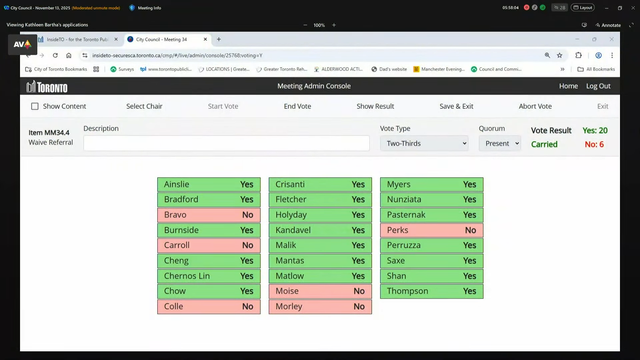
Councillor Brad Bradford's motion to prioritize clearing encampments near daycares and schools within 48 hours gets added to the agenda after a 20-6 vote. They'll debate it later. https://secure.toronto.ca/council/agenda-item.do?item=2025.MM34.4
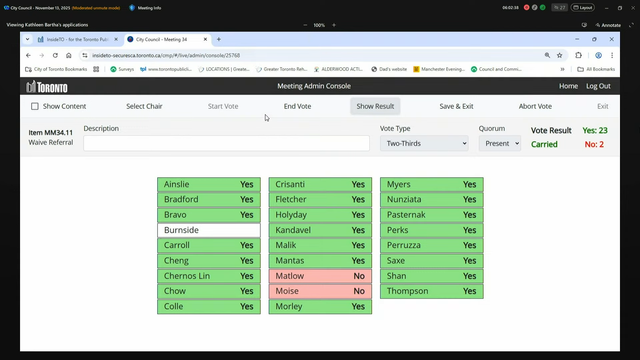
Councillor James Pasternak's motion to support an MZO that'd greatly limit the potential for new housing near a pharma plant on Steeles West gets added to the agenda with a 23-2 vote. Moise holds it for debate. They'll come back to it. https://secure.toronto.ca/council/agenda-item.do?item=2025.MM34.11
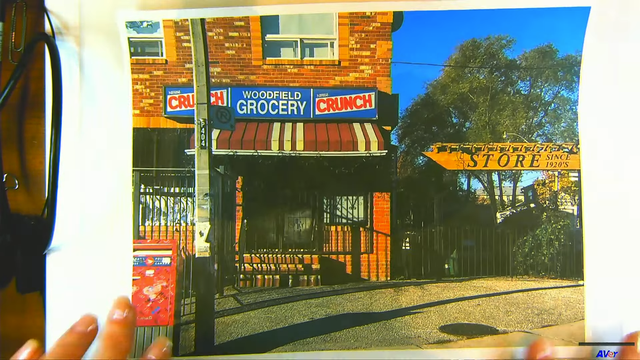
Back to the neighbourhood retail item. Councillor Paula Fletcher wants to use the overhead machine. She displays a photo of a local store in her ward, Woodfield Grocery. She points to the "Store Since 1920's" sign. Well-loved for over 100 years, she says.
Councillor Holyday has revised his motion on neighbourhood stores. Instead of a total restriction on retail on major street areas zoned as residential in his ward, he is proposing restrictions on a long list of specific streets.
Councillor Jamaal Myers moves a couple of motions:
- Remove new retail permissions on Brimley Road in his ward.
- Conduct more "meaningful consultation" and look at ways business licensing can address concerns re: neighbourhood retail.
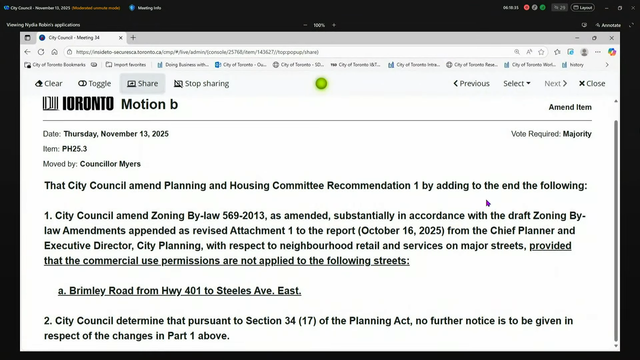
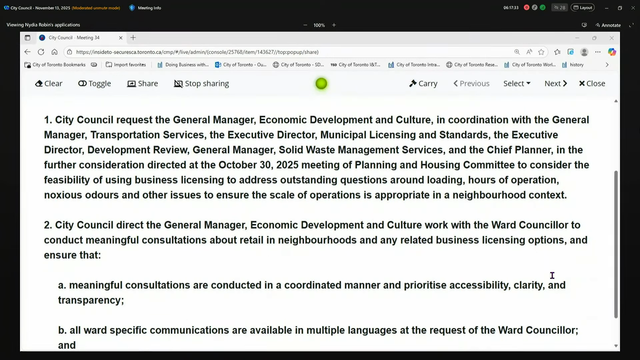
Councillor Jamaal Myers says some people want nieghbourhood retail, but others might "already have enough retail. And they don't want to live next to a convenience store, and that's perfectly OK as well."
After formally introducing his motions, Councillor Gord Perks calls the process that led to these compromises on neighbourhood retail "collegial but complicated." He's added a few more clauses.
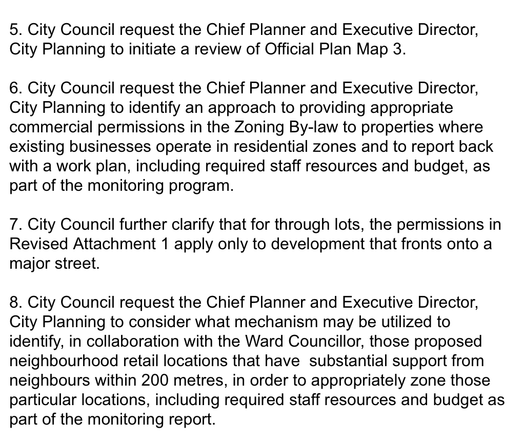
"Some members of council have said there are two Torontos: downtown and the suburbs. And that's not true," says Perks. "There aren't two Torontos — there's one Toronto, with 200 neighbourhoods." He says this process required "fine-grained work" to meet the needs of those neighbourhoods.
Time to vote. Councillor Shan's motion to exclude three streets in his ward from the expanded retail permissions on major streets FAILS 9-17.
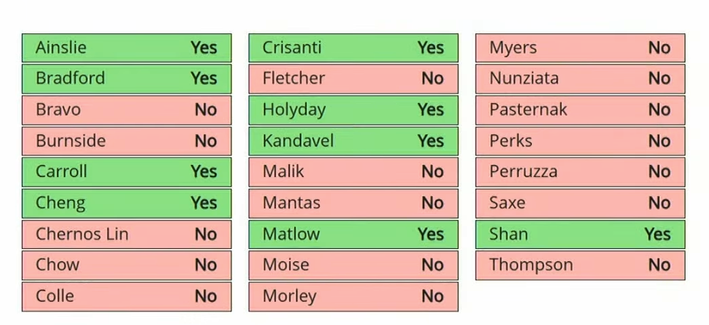
Holyday's motion to exclude a whole bunch of major streets in his ward from the new retail permissions FAILS 10-16.
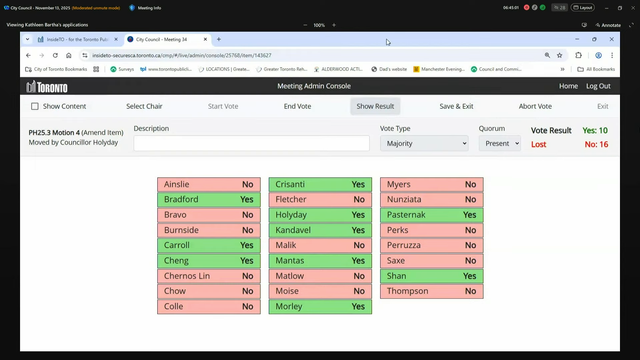
Perks' motion to exclude a long list of major streets across the city from the expanded retail permissions CARRIES 25-1.
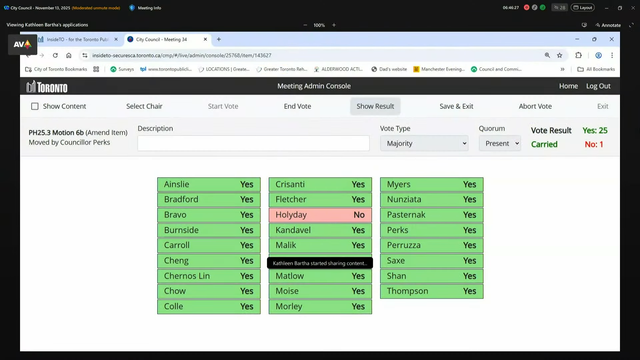
Mayor Olivia Chow's motion to allow neighbourhood corner stores in all wards in the Old Toronto & East York Community Council area CARRIES 25-1.
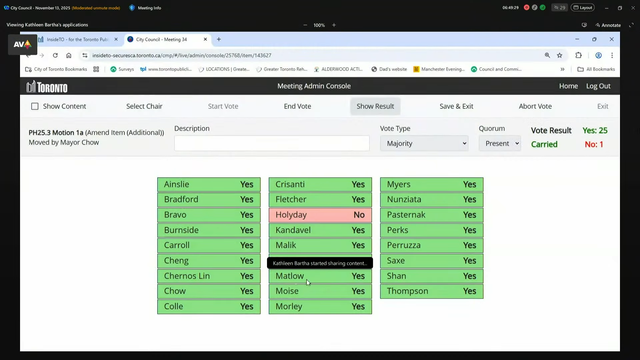
The mayor's motion to keep confidential legal advice confidential CARRIES 25-1. He's just mashing that "No" button now.
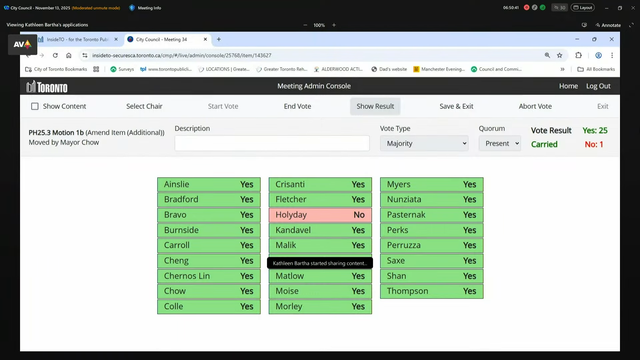
Myers' motion to conduct more consultation and look at ways business licensing can ease concerns about local retail CARRIES 25-1.
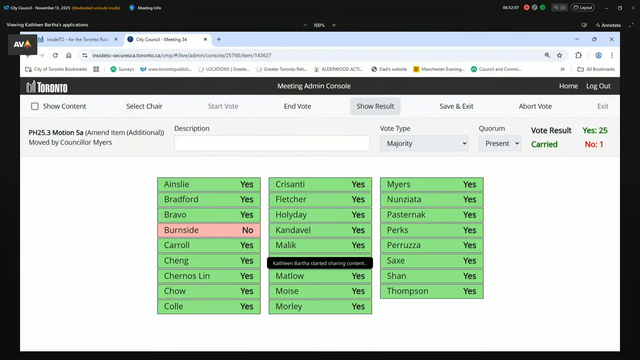
The neighbourhood retail report as amended CARRIES 23-2.
Toronto Council votes to permit corner stores in all Old Toronto & East York wards, and expands permission for retail on some (but not all) major streets city-wide.
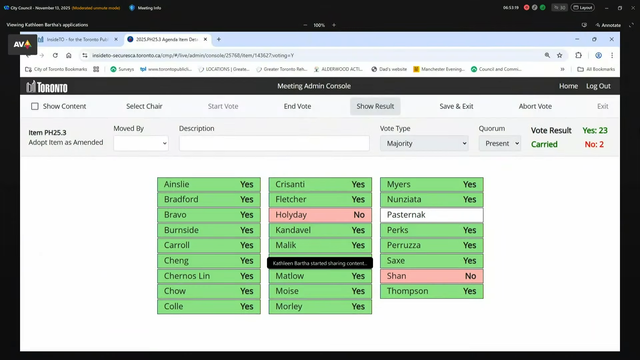
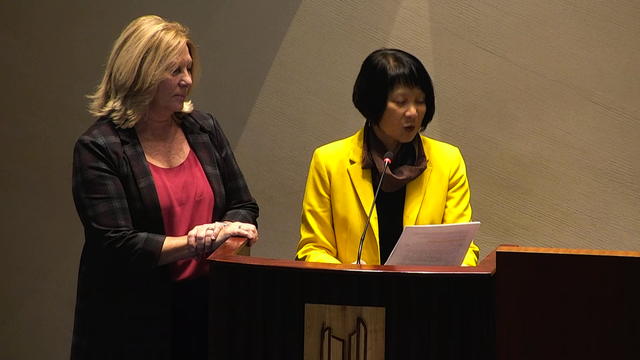
Changing gears, Mayor Olivia Chow brings Lisa Duncan, Director of Collections and Litter Operations, to the lectern. Duncan is retiring after 35 years at city hall. "Her work has made Toronto a cleaner and more liveable city," says Chow. Duncan gets a standing O.
After a quick debate, Councillor Paula Fletcher's motion asking Metrolinx to provide GPS tracking for all trucks working on the Ontario Line and better communication with residents CARRIES 25-0. https://secure.toronto.ca/council/agenda-item.do?item=2025.EX27.3
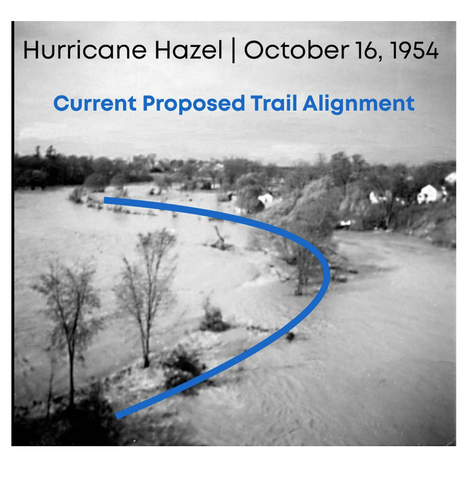
Up now: the City would like to close a gap on the Humber Trail, but the path winds through the Weston Golf Club. The golf club is not happy about this. They submitted this graphic showing the path of the trail and 1954 flood damage caused by Hurricane Hazel. https://secure.toronto.ca/council/agenda-item.do?item=2025.GG25.15
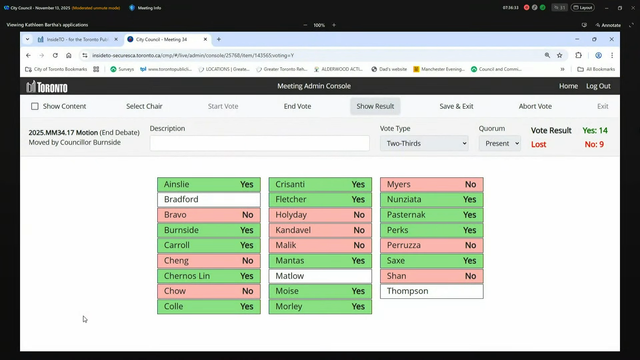
Councillor Burnside doesn't really want to hear any more about this golf club stuff. He calls the question, moving to skip the rest of the speakers and proceed straight to the vote. That FAILS 14-9. It needed two-thirds. The golf talk continues.
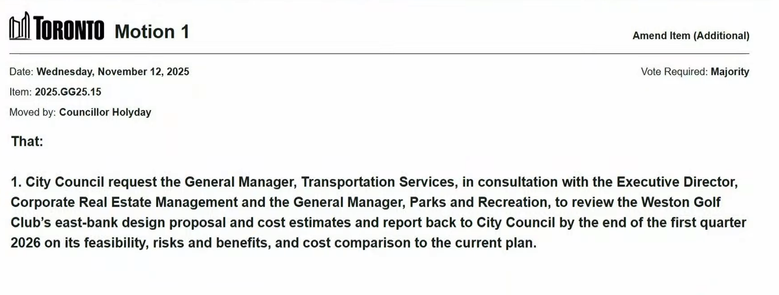
On the Humber Trail / Golf Course item, Councillor Holyday moves for a report on an "alternate design" for the trail that would go around the golf course property.
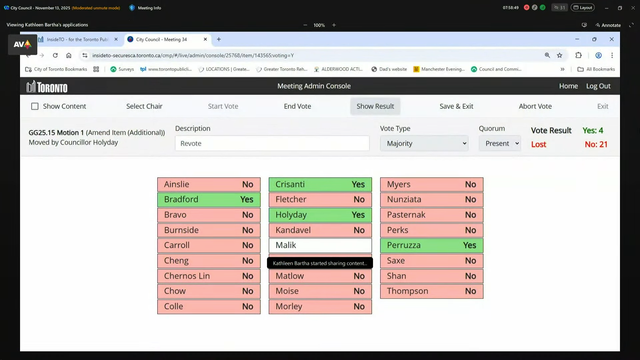
After several councillors argue that this trail design was already approved years ago, Holyday's motion to look at an alternative alignment for the Humber Trail past the Weston Golf Club FAILS 4-21.
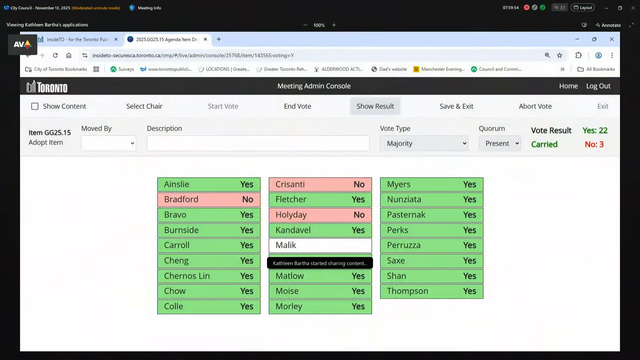
Council votes 22-3 to APPROVE the plan to continue negotiations with the Weston Golf Club re: acquiring land for the Humber Trail, with authorization to initiate expropriations if necessary.
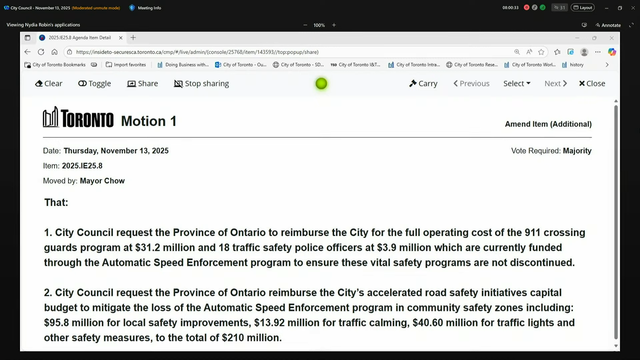
Up now: on the speed camera item, Mayor Olivia Chow has a motion requesting Premier Doug Ford cover the cost of programs that were previously funded by speed camera revenue, including the crossing guard program and the salaries of 18 police officers. https://secure.toronto.ca/council/agenda-item.do?item=2025.IE25.8
 Eric Goodwin
@GraphicMatt they’re right. The whole golf course should be returned to nature as flood mitigation. A nice trail could make it nice for residents when it’s not flooded or full of golfers
 Third spruce tree on the left
@GraphicMatt overhead machine? Pls tell me city hall isn't still using acetates and overhead projectors...