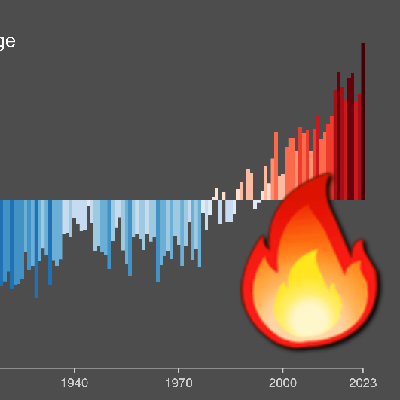
Graph: https://ed-hawkins.github.io/climate-visuals/indicators.html
Scientific sources to check yourself:
Holocene: https://www.nature.com/articles/s41586-021-03984-4
Extremes: https://www.nature.com/articles/s41612-021-00202-w
Sea level: https://www.nature.com/articles/s43247-024-01761-5
Tipping points: https://global-tipping-points.org/
@rahmstorf Never give up to fight for the least centigrade.
If you are overwhelmed - you are not alone. See the Psychologists/Psychotherapists for Future @psy4f
Just imagine this: You go out on a sailing trip in quite warm ocean. You get shipwrecked by a storm, very few miles away from the coast. You have a rough idea where the coast is. The water is warm enough to survive for a couple hours.
What would you do? Use your chance to survive, even a small one? Or sink into immediate death?
@rahmstorf not at all a helpful comment here, but your extremely cheerful profile pic is very inappropriate for this dire.. I would call it news but it's really not at this point... observation.
Just tickled me, don't mind me.
Just 1 Question:
If AMOC would end in 2050 we could get much lower temperature in western Europe.
Will it compensate the rising temperatur due to GHG emmission?
I'm pretty sure the AMOC impacts the distribution of atmospheric heat across continental areas, not the total heat among all of them.
The GHG blanket captures ever more heat, increasing the energy in the oscillating system that is the global climate and all of the weather systems in the world.
Like any driven oscillating system, as you put more energy into it the oscillations get bigger. Higher highs, lower lows & bigger gradients across which dangerous storms develop.
PS Physics major here with general understanding of how this all works, no special expertise in climate science.