 Paul Cantrell
omg, THIS
I was bordering on apoplectic when I first heard about K-12 teachers forbidding students from using Wikipedia but then teaching them to use LLMs.
🧵
https://www.mcsweeneys.net/articles/hi-its-me-wikipedia-and-i-am-ready-for-your-apology
omg, THIS
I was bordering on apoplectic when I first heard about K-12 teachers forbidding students from using Wikipedia but then teaching them to use LLMs.
🧵
https://www.mcsweeneys.net/articles/hi-its-me-wikipedia-and-i-am-ready-for-your-apology
I recently found myself comparing the articles about the Louisiana Purchase on Britannica (that flag-bearer of acceptability in K-12 education) and Wikipedia (still forbidden in many schools). It was…illuminating.
The Britannica is better written. It flows well. It is approachable. It proceeds from broad overview to coherent detail in a way that helps meet the reader where they’re at. The professional editorial oversight shows.
1/
The Wikipedia article is pretty good, but it’s overwhelming. It flows poorly. It lurches from big picture to over-specific details in a way that makes it hard to approach the article if you don’t already know the material.
The cacophony of voices behind it, though well-synthesized, still shows.
2/
The Wikipedia article also includes this sentence in its opening paragraph:
❝However, France only controlled a small fraction of this area, most of which was inhabited by Native Americans; effectively, for the majority of the area, the United States bought the preemptive right to obtain Indian lands by treaty or by conquest, to the exclusion of other colonial powers.❞
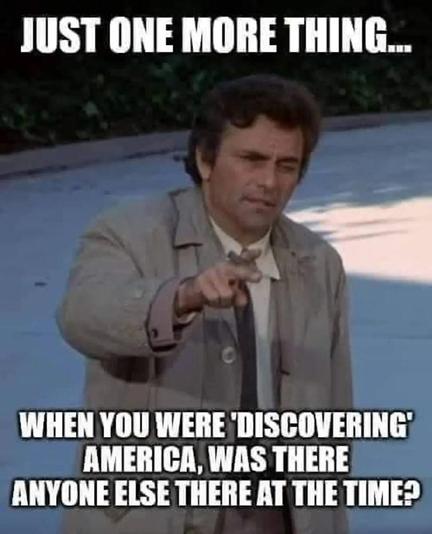
Britannica has nothing like that. It discusses the Louisiana Purchase without a single mention that the indigenous people of North America even exist.
3/
The most Britannica manages to mention of what was actually in that land is this:
❝Much of the territory turned out to contain rich mineral resources, productive soil, valuable grazing land, forests, and wildlife resources of inestimable value.❞
Not a single mention, AFAICT, of the fact that there were already people there.
4/
I remember being extremely confused about this as a kid when I first heard about the Louisiana Purchase. How could the US “purchase” land that nobody from the nation had even explored? Didn’t the people who live there own it? Huh?!?
Wikipedia, for all its messiness, answered Young Paul’s question. Britannica buried it.
But guess which one teachers are •still• trying to keep out of education.
5/
One muddle-headed way of looking at this is “oooooo Wikipedia is wooooke blah blah.”
The better way of looking at it is that Wikipedia lets people jump in and say “What?! No, you are totally missing something important!” It actually •does• the thing the radical centrists (falsely) claim they want: it opens itself to different perspectives.
6/
As humans, we •all• live our lives with our heads up our butts — including but not limited to the Britannica writers. If we’re lucky, someone will help us see what we’re missing. If we’re wise, we listen. At its best, that’s what Wikipedia can do — and in public, at scale, for everyone.
7/
I remember years ago seeing a study that diligently compared the factual accuracy of Britannica vs Wikipedia for a few select articles (will update this post w/link if I find it).
They found a similar rate of factual errors. The short of it: Wikipedia is chaotic and messy, but Britannica often had missing or out-of-date information. Wikipedia had higher noise, but also a higher correction rate. Factuality came out about a wash.
[UPDATE] I think it was this study: https://www.nature.com/articles/438900a
8/

Jimmy Wales' Wikipedia comes close to Britannica in terms of the accuracy of its science entries, a Nature investigation finds. UPDATE: see details of how the data were collected for this article in the supplementary information . UPDATE 2 (28 March 2006). The results reported in this news story and their interpretation have been disputed by Encyclopaedia Britannica . Nature responded to these objections .
Wikipedia has •numerous• problems, but it belongs in education.
And right now, per the McSweeney’s OP, it’s a lifeboat of humanity in a sea of slop.
For reference, snapshots of the two articles concerned at the time of this writing:
https://web.archive.org/web/20250923124231/https://www.britannica.com/event/Louisiana-Purchase
https://web.archive.org/web/20250917014942/https://en.wikipedia.org/wiki/Louisiana_Purchase
/end

Louisiana Purchase, western half of the Mississippi River basin purchased in 1803 from France by the United States. The purchase doubled the size of the United States, greatly strengthened the country materially and strategically, and provided a powerful impetus to westward expansion.
@inthehands
"Britannica has nothing like that. It discusses the Louisiana Purchase without a single mention that the indigenous people of North America even exist."
🤔

 Kid Mania