 Hofmaimaier
Fictional
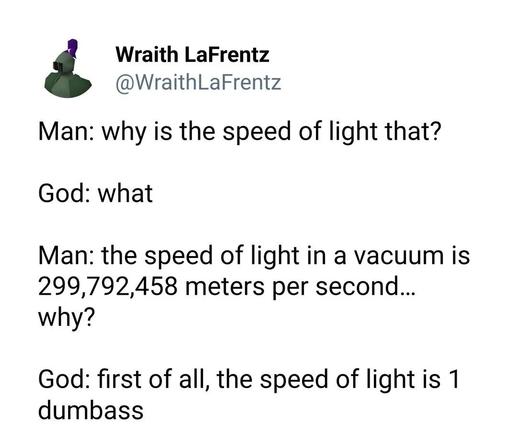
You seems smart.
Can I ask you a question about the speed of light? We measured it as whatever we measured it recently. As in not 13-14 billion years ago. We also noticed that the expansion on the universe is getting faster.
Is it possible that the speed of light changed since the big bang? We just assume it’s the same but what if light (photons or whatever) started off slower and gradually speed up and got more efficient. Kinda like speed runners in video games. We wouldn’t have noticed the changed because we measured it after it got faster. And now with the universe expanding faster, maybe light is getting even more quick.
I heard the idea on a YT video and I’ve been thinking about it.
What your asking directly stems from two related open ended philosophy-of-science questions. These would be " Are universal constants actually constant?" and “Does the speed of light differ in speed at any point of time in its journey between two points of space in a continuous substrate?”
The answer to both like all philosophy questions is a long hit on the pot pipe and a “sure man, its possible but remains unlikely/over engineering the problem until we have justification through observing it” however I’ll give my two cents.
“” Are universal constants actually constant?" " it probably depends on the constant. Fundamental math stuff that tie directly into computations logic and uncertainty precision limits like pi are eternal and unchanging. More physics type constants derived from statistical distribution like the cosmological constant might shift around a little especially at quantum precision error scales.
The speed of light probably is closer to the first one as its ultimately about mathematically derived logical boundaries on how fast any two points universe can interact to quantize a microstate. Its a computational limit and I don’t see that changing unless the actual vaccum substrate of spacetime takes a sudden phase shift.
“Does the speed of light differ in speed at any point of time in its journey between two points of space in a continuous substrate?”
Veritasium did a good video about this one. The answer is its possible but currently unmeasurable . so if all hypothesis generate the same effective results then the simplest among them (light maintaining a constant speed during both ways of trip) is the most simple computationally efficient hypothesis among them.
 SmokeyDope
 Notyou