 Hofmaimaier
Fictional
You seems smart.
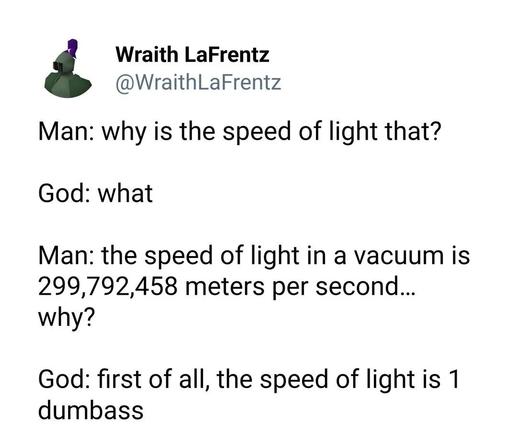
Can I ask you a question about the speed of light? We measured it as whatever we measured it recently. As in not 13-14 billion years ago. We also noticed that the expansion on the universe is getting faster.
Is it possible that the speed of light changed since the big bang? We just assume it’s the same but what if light (photons or whatever) started off slower and gradually speed up and got more efficient. Kinda like speed runners in video games. We wouldn’t have noticed the changed because we measured it after it got faster. And now with the universe expanding faster, maybe light is getting even more quick.
I heard the idea on a YT video and I’ve been thinking about it.
So… I am not a scientist, just an enthusiast. But my understanding is that the speed of universe expansion doesn’t correlate with the speed of light. The speed of light is still constant.
Instead, the universe expansion rate is measured via something called the “doppler effect”. Scientists are able to use telescopes and take a screenshot of the night sky. Stars that tend to be brighter and bluer are closer to us. And stars that tend to be darker and more red are farther away from us. By taking snapshots and comparing it with previous snapshots over a long period of time, we are able to see a difference in color in each star which then shows us which stars are moving closer and which stars are moving further away.
Thus by measuring the speed at which the doppler effect changes, they can determine an estimate and compare whether the universe is expanding faster or slower over time without breaking the cosmic speed limit that is the speed of light.
Another analogy for the doppler effect is that it’s similar to what happens when a train passes by us. But in the case of a train, the doppler effect is with sound. As the train gets closer, the sound gets louder and seems more higher pitched. Then when the train passes us and gets further away the sound fades away and gets lower pitched. All the while though, the speed of the train is still constant.
Hope that makes sense. And anybody that knows more than me feel free to correct me. ;-)
 SmokeyDope
 Notyou
 ImpulseDrive42
 corvus