 fossilesque
one bright second
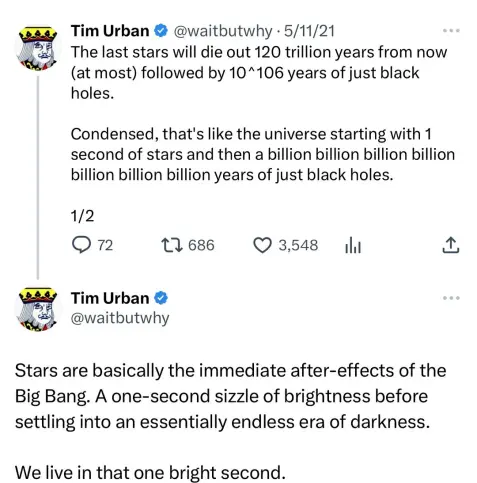
The last stars will burn out in 120 trillion years
We think. We still haven’t solved things like the dark matter/energy problem. The answer to that alone could drastically change what we estimate will happen in the distant future.
Stuff only burns for so long. We might learn more about the geometry of space and that there is more out there at greater distances where maybe even other Big bangs are possible but there is a certain maximum amount of time that a star can exist.
Over the time scales of the life of a proton the maximum variability in the amount of time a star can is a rounding error against the scale of numbers needed to express the amount of time it takes for hawking radiation to reduce black holes to ultra long wavelengths of infrared radiation.
Yes, but we don’t have proof that universe can’t generate new matter. For all we know there is a mechanism in universe not yet observed that can create new matter out of little vacuum and more stars will keep forming.
So technically all we can say is, it’s likely that stars will die out in 1000 trillion years.
Yes, but we don’t have proof that universe can’t generate new matter.
True… we also don’t have proof there isn’t a tea pot orbiting our Sun since it’s creation, either.
However, there’s also a complete lack of evidence of it.
You cannot prove a negative. The evidence says no new matter can be created. No evidence that new matter gets created. Therefore, we work on the model of no new matter creation.
I do also want to point out that stuff like “The conservation of energy” law, in other words, that energy cannot be created or destroyed, does not hold for our universe with our current models. An expanding universe violates the time-translation symmetry
This is our current models. This is what our current physics says. And we know it’s incomplete.
When it comes to scientific predictions, you always, always, need the caveat, “under our current model of”.
 IrateAnteater