 ickplant
Sunlight special
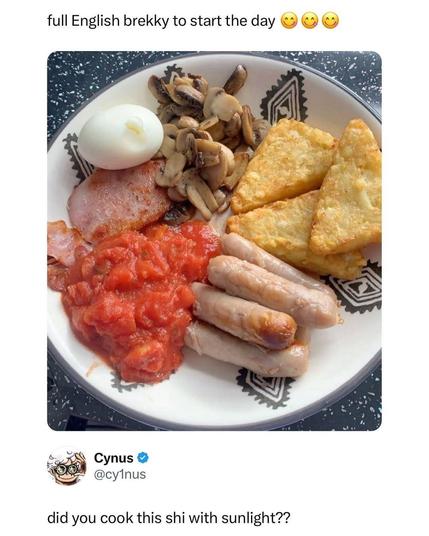
This is not a full English due to the following issues or errors:
There is hearty debate amongst the governing body of the full English about whether or not hash browns are acceptable on a breakfast. Many declare them to be unwanted compared to, for example, bubble and squeak or a tattie scone, or even fried potatoes. They go further and label them ‘trash browns’, ‘American nonsense’, or just ‘shite’. Personally I don’t mind them, and consider them to be an optional addition, but not a core requirement of the full English. There are many other optional additions, not to mention regional specialities which render an Ulster fry very different to a full Welsh or a full Scottish. Hogs pudding, white pudding, fruit pudding, haggis, Lorne sausage, potato farl, soda bread, laverbread, kidneys, etc.
I am available for for keynote speeches on the subject should anyone be organising a full English conference.
I think that a full english isn’t an exclusionary meal. I think there are a few factors it needs to be in the category of full english but that there are many variations and additions or subtractions that still count.
In my opinion the only things required for a full english are any 4 of the following:
Anything less is not “full” and anything more is a variation of the full english.
Hash browns? Sure! ulsterfry? Go for it! Mushrooms? Absolutely! Tomatoes (grilled of course) yes please! Black pudding (not for me) bring it on!
But there is no singular thing that makes it a full english, it just has to have enough of the core ingredients to meet the criteria.
I tend to agree on that more flexible definition with a few core ingredients as baseline but it does seem to me that that core list needs to include at least one regional speciality item specific to the British Isles because I think that’s what the “full” part is really referring to as opposed to just a “fry up” as the other bloke suggested. I think in general in England that’s probably black pudding.
This thinking is because that minimum combination you listed is fairly common in a few places including Australia and while I don’t speak from experience, I think with the exception of the beans if wouldn’t be a totally strange or foreign combination in America either.
Its a fair point and i see where you are coming from but would it not also be fair to say a that a “fry up” is a colloquialism meaning full english? I would ask, where does a fry up cease to be a fry up? Whats the minimum requirements? Is eggs on toast a fry up? Eggs and sausage and beans? Sausages and bacon and toast? Or all of the above?
Or does fry up refer to how its cooked, in that it all goes in the pan? I tend to grill my bacon and sausages, fry my eggs and mushrooms, toaster my toast, microwave my beans. Is that not longer a fry up because its not all in the frying pan?
As to your point about the ingredients being common in a few places like Australia and America. Is it not fair to say that they adopted the meal and that explains the commonality? Like in england a curry is a practically a national dish, but its adopted from indian cuisine. We make it slightly differently to its country of origin but at its core the ingredients required to call it a curry are not uncommon anywhere in the world.
 Hossenfeffer
 Mr_Dr_Oink