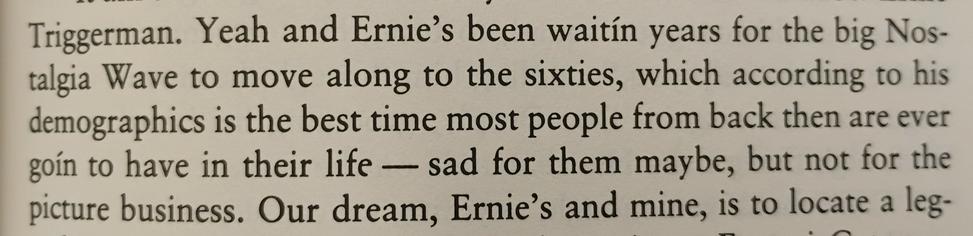
"Ernie's been waitín years for the big Nostalgia Wave to move along to the sixties, which according to his demographics is the best time most people from back then are ever goín to have in their life - sad for them maybe, but not for the picture business."

—Hector to Zoyd, from Vineland (Thomas Pynchon, 1990)

@sherbertmarcuse
that leapt out at me too. i remember when the wave actually hit in '87 - memorably described in the v slept-on Lewis Shiner novel _Glimpses_:
"every radio station has gone to some kind of oldies format, & they’re playing the same stuff over & over again that you haven’t heard in 20 years [...] Tie-dyed T-shirts are back & bands that should never have been together in the first place have reunion tours and everybody shakes their heads over how dumb & idealistic they used to be."
@sherbertmarcuse
that latter part was VERY strong, esp as the USSR started really unwinding, & broke down further into two lines of discourse: the purely triumphalist strand that just wanted to jeer at 60s radicalism & utopianism generally, and the more insidious left-liberal strand that acknowledged anti-oppression struggles & advanced the line that these struggles had positively reformed US society, & that it could/should be reformed further, now that we'd ditched all that silly anticapitalism

@acetone_kitten oof.

Growing up when I did, with my first point of contact with 60's culture being the rock music of the time—that godawful Across the Universe movie came out when I was in high school—the silly anticapitalist radicalism was mostly excised from the narratives I saw, unless it was instead treated as a dated, harmless we-know-better-now thing—like late Victorian credulity towards ghosts. All the genuinely political 60s radicalism, with two exceptions that I can think of, was ignored or subsumed into stoner hippie utopianism: well-intentioned but unrealistic, but yeah peace and love are great ideas, maaan.

The two exceptions—the anti-war movement and Martin Luther King—were basically treated as solid victories, won battles that are now past us.

It took me a long time to realize just how thoroughly the good guys lost.
@sherbertmarcuse
> won battles that are now past us
this is such a great summation of that discourse!
i had a strange path to a different conclusion - all through my teen years i was inhaling Harlan Ellison and the Dangerous Visions books and all this other transgressive sf that was to some extent in contact with or at least inspired by the radical politics of the day, and between that and my parents fleeing the US, i quickly concluded that i was growing up in the shadow of a failed revolution