 ByteOnBikes
How it feels
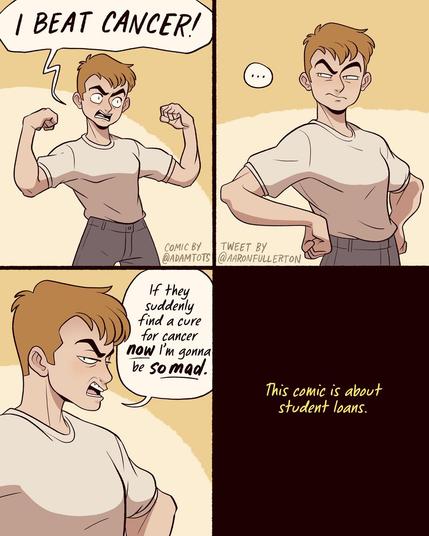
Cause it not like the loans are predatory or anything. Cause its not like the prices keep going up cause the loans keep giving more and more.
Crazy how the rest of the developed nations can send thier young adults to school for basically free but its too hard for the US.
Cause it not like the loans are predatory or anything.
I’ve met people who foolishly took out six-digit loans to go to college, but most people I know went to low-cost public universities or to the private universities that gave them generous need-based scholarships. My own family wasn’t poor by the time I went to college and my education at a prestigious private university cost a total of about $45,000 (in 2006) after the need-based scholarships that I got.
Cause its not like the prices keep going up cause the loans keep giving more and more.
That’s an argument for the government to help college students less, not to help them more.
So because you know a couple people who maybe didnt make the best decisions, forget everybody else. How many students who take out those high loans go on to become something useful and needed by society. Cause the people I know that took out that much mostly went on the become doctor’s.
That’s an argument for the government to help college students less, not to help them more.
Yes cause the students have the power to set the prices. It’s the loan givers dealing with the universities that keep driving up prices. If the government was to step in and say we’re only paying this much the prices wouldn’t be so exorbitant. You know, like the other developed countries do.
The doctors borrow that much for medical school, not for undergrad, and they’re generally able to pay off their own student loans.
The government does step in and run state schools where it sets the prices that it thinks are reasonable.
So the $98,000 it costs for an in-state student to go to my nearest local state college for 4 years is fairly set by the state? What about the $101,000 for the next closest.
That seems totally fair, right?
So as long as you live close enough to commute from your parents house, get to live there for free or real cheap, and jump through the hoops and hurdles without any issues, you too can get by relatively cheap!
Everybody else can get fucked cause this person was one of the lucky ones!
Also, make sure you go to what is considered one of the more affordable universities while living in that state for over a year before hand!
Its super easy and affordable
It’s not just luck. Most people I know who started out poor are immigrants whose families worked extremely hard for their sake, and who worked extremely hard in school themselves so that they could get accepted into colleges that offered them favorable terms. There they majored in well-paid fields like finance, law, medicine, or engineering, and afterwards they were able to pay off their debts without issue and live upper-middle-class lifestyles.
It’s a lot harder for people whose parents can’t or won’t help, but eventually those people do become eligible for financial aid without counting their parents’ income (easiest to do by either waiting until age 24 or getting married) and that financial aid will be quite large if they’re poor.
Just because you know some people that got through unscathed, doesn’t mean there isnt a greater problem.
But I woulda thought your degree would have taught you about survivorship bias
Also:
immigrants whose families worked extremely hard for their sake
Luck
get accepted into colleges that offered them favorable terms
Luck
pay off their debts without issue and live upper-middle-class lifestyles
Luck
I think my experience proves that succeeding without student loan forgiveness is possible, and that’s why I think the problem isn’t student loans.
Which family you’re born into is luck, but how hard you work in high school and which major you choose in college are deliberate decisions.
after the need-based scholarships that I got
Dude…
You quite literally benefited from a fund of money set aside to help you go to college and you are okay with pulling the ladder up behind you.
You didn’t need student loan forgiveness because you got a scholarship. I feel the most logical perspective would be that we shouldn’t be gatekeeping passionate individuals from continuing their educational journey.
College should be free for anyone to go to. College students are adding more dollars to our economy for each dollar that we spend on their education. For higher level degrees, the benefits to our economy could be even greater for each individual.
Take the example of a doctor, if we paid for more doctors’ educations then we could have more specialists available for complex surgeries, potentially extending lives and raising the quality of life for many individuals. Saved lives also means that there are more people contributing to the economy as well.

Most economists and policymakers know that people who complete a college degree tend to earn more than people who have not attended college. Yet they often overlook the fact that these benefits extend beyond individual workers. The college earnings advantage also leads to greater economic activity, fueling prosperity at the regional and national levels.
Its also possible to give your body to sports and go for free like I did. Doesn’t mean everyone is going to be able to do that.
There are also people out there who give their all and don’t get accepted into the college that would be best for the financially. I’ve seen and and helped console them after they freaked out about having to pay a bunch more. I think the problem is student loans and those that benefit from praying on 18 year olds trying to make the “right” decision
But it all brings it back to why can most every other developed nation send their students to University for practically free and still have people living comfortably even though they have to pay taxes for it, but its too hard for the US to do it?
The problem isn’t the student loans per se, its that the principle has been paid off many times over and somehow moat people own many times more in interest.
Forgiving imaginary debt is not the same as paying off someones bad debt.
And it would be trivial to solve that specific problem, which would simply require passing a law that says that the interest on student loans cannot, itself, accumulate interest. It becomes simple interest.
If you owe 5% on a $10,000 student loan, and the first year you pay nothing, you owe $10,500.
The second year you pay nothing, you owe $11,000 because you’re only paying 5% on the initial $10,000.
You are still paying interest, but you are not paying interest on the interest. So if something crazy happens and your loans are in forbearance for a year because you’re homeless or something, the only thing that happens is the interest builds up.
The way it’s currently set up in that same scenario, the first year, at the end of the first year of paying nothing, you would owe $10,500. At the end of the second year of paying nothing, you would owe $11,025.
“Doesn’t sound like that much, easy to overlook, let people deal with their own financial problems”, says the heartless person.
But the thing about compound interest is, as Einstein said, it is the most powerful force in the universe.
After years of only paying minimums (which are often set by the loan handlers to be less than the amount of interest that accrues each month, because our loan handlers are scum) and allowing the interest to compound on the interest, that 5% interest can end up being an additional $10,000 or $15,000 that you have to pay off on top of the $10,000 you initially borrowed.
What a dumb way to view things.
Having never gone to college, I FULLY support my tax dollars going to pay for colleges.
Tax money is to benefit society.
How have m youade it far enough in life to be voicing your opinions on the fediverse, yet haven’t figured out that a well-educated society is good for EVERYONE in that society…
Yeah, the actual college debt per person median is much closer to $40,000 right now ($1.6 trillion split between 43 million borrowers), and the income difference between a high school diploma and an associate’s degree is like $150 a week lifetime income on average.
Also remember that that is a lifetime income difference, so that $150 a week average may not actually be realized until the borrower is in their late 50s or early 60s.
Once again, applying the median, bachelors degrees can add another $500 to that, but once again, that is lifetime income that may not be realized until towards the end of their working career and we’re applying the median, and the thing about the median is, is the median lies to you.
The median makes things look like they’re better than the whole. The median allows one billionaire to counterbalance the poverty income of 10,000 poor and homeless people. The median allows the six-figure job you got in your sixties managing other people to counterbalance the four-figure jobs you worked from the ages of 16-30.
The median paints a rosy picture because it throws everything into one giant blender.
Also, this does not include the number of people that attended college, accrued student loans, and then did not complete college, and so they have no advanced degree to get them a higher income job, but they have bills associated with such a degree, and yeah, those people tend to only make like an extra fifty or sixty dollars a week over their high school graduate-only counterparts lifetime income.
I said all of that to say, using the median to justify your emotional condoning of bad practices is in and of itself a bad practice.
If instead you were to say, “Yes, I want good things to happen to other people, America make it happen,” and another million or two people joined in with you, then collectively, we can do something about it that works for both the people who worked hard and paid things off for themselves, like myself, and for the people in the future to prevent them from ending up in such a terrible situation.
Many raindrops make a storm.
 Catoblepas
 Rhaedas
 UrPartnerInCrime
 bizarroland
 Miles O'Brien