 Stamets
Anything but metric
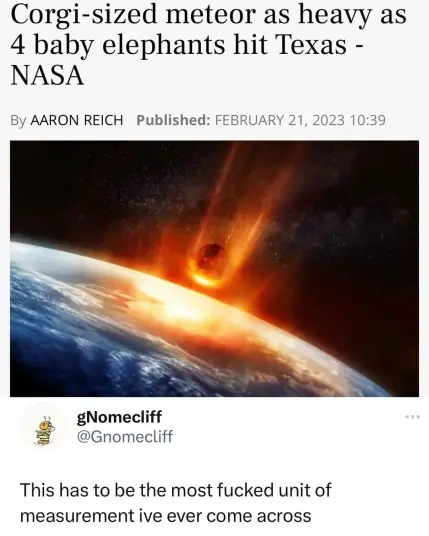
How would a “corgi-sized” meteor have a mass comparable to “four baby elephants”?
OK. Assuming the corgi is 60cm long, and assuming with “size” they think of “a sphere with a diameter of”, we get a volume of 113000cm³. Depending on the weight of a baby elephant (90-120kg) we get 360 to 480 kilograms. Divided by the volume, we get a medium density between 3.1 and 4.2 g/cm³. According to Engineering Toolbox, this is about as dense as garnet or aluminium oxide, common types of stone.
If they took the height of the corgi (30cm) as a base of their spheres’ diameter, the volume is down to ~14000cm³, leading to densities between 25.7 and 34.2 g/cm³. Now that would be interesting, because that would even surpass uranium (which has 19.something g/cm³).
So depending on how to interpret those measures, it’ll be a ball of dirt, or a serious nuclear threat. That’s why scientists use metric…
According to experts from NASA’s Johnson Space Center, the meteor in question was just over 60 centimeters in diameter and weighed half a ton (or around 454 kilograms).
www.jpost.com/science/article-732223
So, yeah, they meant the diameter. Doesn’t make much sense to me either, but then again, I’m not the one making a living writing science-y articles for a definitely non-science audience.
The article is even very specific about this. It’s a Pembroke Welsh Corgi.
For the real numbers:
According to experts from NASA’s Johnson Space Center, the meteor in question was just over 60 centimeters in diameter and weighed half a ton (or around 454 kilograms).
 Treczoks
 Corkyskog