 Apparency
Apparency 3.0 is available now.
What's new? 🧵
Apparency 3.0 is available now.
What's new? 🧵
First up: the Search Components command. Open a complex app, and use search terms to find specific (sub)components.
You can do a quick search on the name, but way more interesting, you can search on attributes such as Info.plist keys or values, entitlement keys or values, and even on string literals that are found in the executable.
This uses a standard macOS rule editor, so you can construct a search with multiple criteria, plus Boolean operators, to narrow down the results.
If you've constructed a particularly interesting or complex search, you can also save it for future use.
Just give the search a name, and you can re-apply it to anything else you open in Apparency, just by picking it from the View menu.
That's all very well and good, but what if you want to search across multiple apps?
Apparency now lets you open a folder directly. This will show you all of the components (apps or otherwise) that are inside that folder.
Of course, you can then search across the entire folder, in the same way that you'd search a single app.
Also, you can now sort on the Signature column in the component browser, which is a quick way to group apps with interesting status (like expired certificates).
You can, of course, open your Applications folder (which will also show apps within subfolders, such as Utilities). This is reasonably fast in my tests, but I know other people have way more complex Applications folders than I do — so I'm interested to hear how this does (or doesn’t) work for you.
Apparency doesn't merge /Applications and /System/Applications, as Finder does, so if you want to see system apps, you should instead open /System/Applications directly.
You can also go crazy and open something like /System/Library, say if you want to do a search across "all" of the system components. Where I quote "all" simply because the system has tendrils in many other places.
Speaking of which, try opening /System/Volumes/Preboot to see what's in the various cryptexes.
The only folders that Apparency will refuse to open are volume mount points (except Preboot), and the directories that contain them (like /Volumes), because madness that way lies.

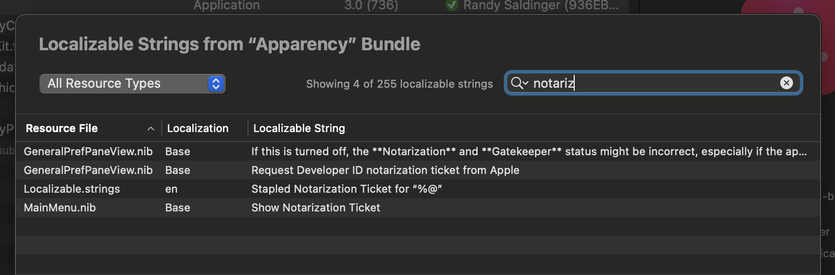
Next up: the Localizable String inspector. These are strings that appear in an app's UI, defined in such a way that they could be localized into another language (even if they haven't been).
This includes any strings and stringsdict files. Also, compiled nib files in the "Base" localization (the only ones that clearly delineate localizable strings).
You can filter and sort the strings here, and use the context menu to reveal the source file, or open it in Archaeology.
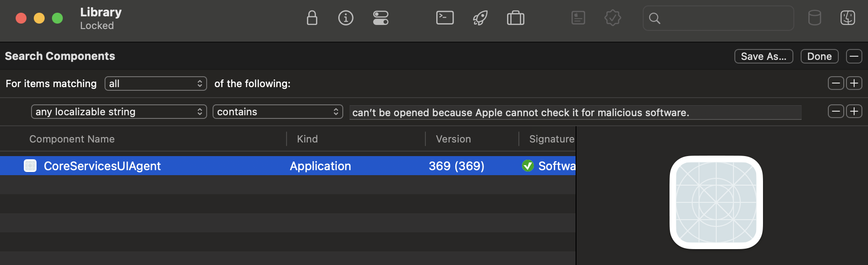
Naturally, you can also search for components with a specific localizable string, using a rule in the Search Components command.
This can be helpful if you're trying to find which component implements a particular bit of UI, based on a label or dialog message.
One more: if you've used Open System Library with String Literal, you know that it searches only in frameworks and dylibs. This is relatively fast, since it uses the DYLD shared cache, but it does miss a lot of the system.
Now there's a pref to let you search "all system components" instead. This takes a bit longer (particularly on the first search, since it does some caching of system binary locations), but it can still be useful if you're trying to hunt down where something is implemented.
There are a bunch of other, smaller changes. Check out the release notes for all the gory details.
Apparency 3.0 requires macOS 13 or later. It supports macOS 26 (but no, it still doesn't adopt “Liquid Glass” ...)
https://www.mothersruin.com/software/Apparency/relnotes.html