 feliks✨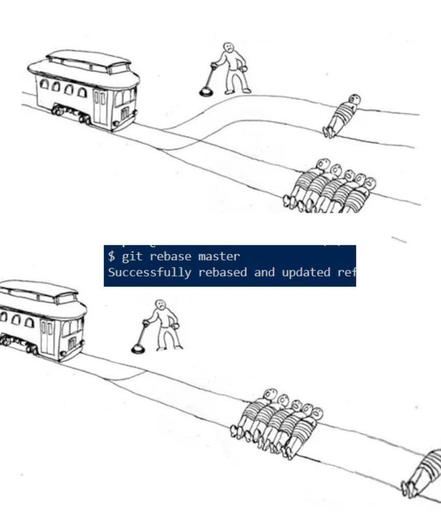
 Klaus Frank
@feliks I like how the railroad switch (the tracks to be more precise) are still there. Making it ambiguous if the trolly will hit nobody and derail or all of them.
 Mia ‘Meetings? I Abstain’ Luna Tearmoon
@agowa338 honestly, I never really understood git's design approach and still prefer Mercurial and Subversion because they do not actively try to subvert my ideas about what consistent command-line interfaces are like
@mia never used either of these much. As someone that started with git both mercurial and subversion always are quite annoying and difficult to work with. The first thing I usually do after having managed to get them locally is "git init ." to track my own changes in it properly...
@agowa338 it might be because I am not a programmer — since childhood I only ever dealt with hobby-tier stuff (Z80/8080/M680x0/PowerPC Assembler, Ada, C#, Rust) and as a linguistics major only had 2 years of mandatory C in the university
so git is inscrutable to me; I do not understand why is it git stash list but git branch --list, etc.
@agowa338 obviously, everyone is just about forced to use git (and the pull request workflow) these days, so there is simply no real choice
 Evelyn Estelle
 mirabilos
@mia but to be fair these aren't the things you need all of the time either. I can't remember when I last used "git branch --list" if at all.
@agowa338 a project that I collaborate on has dozens of branches and it is easy to get lost sometimes haha
git stash list is used by me a lot for weird reasons: I have a git checkout of the FreeBSD ports tree that I want to keep as close to the original as possible, so all my temporary patches are stashed when I'm updating the tree
@mia But how often do you really need to know about all of them?
Like even for big projects it's at most 2-3 branches.
1 The main/master branch of the upstream project
2 Your patch-* branch
3 When someone sent you a diff/patch for your patch or you want to merge in some of their changes into yours.
And even for bigger projects like ansible where backporting is a thing that is basically because of the process not really different either just switch "main/master" with whatever version that pr is
@agowa338 it's a mobile game and they have separate branches for separate features/events/etc… and loc strings are spread all over those
it's terrible but that's what they have
@mia Also this sounds like you should look into git worktrees.
@agowa338 that's one of my issues with git: with svn and mercurial I only needed to know a few basics; with git I need a Ph. D. in git administration \o/
@mia Not really. You could also just do a git clone and use your local folder as a remote too. Everything else is just advanced usages that has some benefits compared to the simpler ways. Like you'll need less disk space.
But all you need is still:
* git clone
* git push
* git pull --all
* git status
* git add
* git commit
* (maybe) git remote add myfork $url
* (maybe, but most of the time you're doing something wrong when you think you need it) git lfs
@agowa338 I am not the one doing git clone, it's poudriere updating its local copy from FreeBSD's main ports repository and I am working on that local copy
 m0xEE
m0xEE@mia @agowa338 Also, git is simple in the same way quantum mechanics is simple.
It is the simplest solution to a complex problem. The complex problem being: a distributed version control system that you can adapt to a lot of different situations.
I can use git without ever configuring a server, I can make a repo, I can clone it to a USB or CD. I can give it to a friend. In fact, I included the whole source repo of my thesis on a CD when I handed in my thesis.
 ⁂ Fish Id Wardrobe