Pentagon Wants It to Be Illegal for Reporters to Ask “Unauthorized” Questions - Lemmy.org
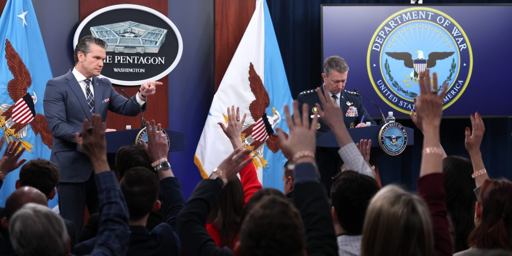
ARLINGTON, VIRGINIA - MARCH 19: Secretary of War Pete Hegseth and Chairman of
the Joint Chiefs of Staff Air Force General Dan Caine (R) provide updates on the
continued military operations on Iran 2during a press briefing on the Iran war
at the Pentagon on March 19, 2026 in Arlington, Virginia. The U.S. and Israel
have continued their joint attack on Iran that began on February 28. (Photo by
Win McNamee/Getty Images)
[https://theintercept.com/wp-content/uploads/2026/03/GettyImages-2267368199_40bcc4.jpg?fit=5766%2C3844]
Secretary of War Pete Hegseth and Chairman of the Joint Chiefs of Staff Air
Force Gen. Dan Caine ® provide updates on the continued military operations in
Iran during a press briefing on the Iran war at the Pentagon on March 19, 2026,
in Arlington, Virginia. Photo: Win McNamee/Getty Images A judge last week struck
down
[https://www.theguardian.com/us-news/2026/mar/20/us-judge-blocks-pentagon-policy]
the Pentagon’s restrictions on journalists seeking “unauthorized” information,
siding with the New York Times in its lawsuit against the government. In
response, the Pentagon on Monday added some meaningless window dressing
[https://freedom.press/issues/meet-the-new-pentagon-press-policy-same-as-the-old-pentagon-press-policy]
and essentially reissued the same restrictions. The administration pledged to
“immediately” appeal the decision on the original policy, and on Tuesday, the
Times filed a motion
[https://thehill.com/policy/defense/5800196-new-york-times-pentagon-media-restrictions/]
to compel the administration to comply with the judge’s order. As alarming as
the Pentagon’s antics are, the Times’ lawsuit is not the only case about whether
reporters have the right to ask questions. It’s not even the only one in the
news this week. In 2017, police in Laredo, Texas, arrested
[https://www.cjr.org/the_media_today/priscilla_villarreal_texas_first_amendment_lawsuit.php]
citizen journalist Patricia Villarreal under an obscure and never previously
used law making it a felony to ask government employees for nonpublic
information for personal benefit. Her supposed crime was asking a police officer
about two local tragedies — a suicide and a deadly car wreck. Her arrest was
widely ridiculed
[https://www.fire.org/news/wide-ranging-coalition-friends-court-continue-support-citizen-journalist-priscilla-villarreal],
and a judge quickly threw out
[https://www.expressnews.com/news/local/article/Judge-throws-out-charges-against-La-Gordiloca-12788458.php]
the charges. When Villarreal sued over her arrest and mistreatment by officers,
the legal question wasn’t whether the charges against her were permissible but
whether they were so obviously bogus that she could overcome qualified immunity
[https://freedom.press/issues/scotus-needs-to-hold-officials-who-ignore-press-freedom-accountable/],
the unjust
[https://www.politico.com/news/magazine/2023/02/19/qualified-immunity-is-burning-a-hole-in-the-constitution-00083569]
and expansive legal shield that protects government employees from liability for
all but the most blatant violations. That issue went
[https://thetexan.news/judicial/u-s-supreme-court-remands-laredo-citizen-journalist-s-first-amendment-case-back-to-appeals/article_87f52b54-8bdb-11ef-beac-5b15409ccb24.html]
to the Supreme Court twice, but on Monday, the Court declined
[https://www.supremecourt.gov/orders/courtorders/032326zor_7mio.pdf] to review a
federal appellate court’s ruling that the officers were shielded from liability.
[https://theintercept.com/wp-content/uploads/2026/01/GettyImages-2255708712-e1768495848482.jpg?w=440&h=440&crop=1]
## Related ### FBI Raid on WaPo Reporter’s Home Was Based on Sham Pretext
[https://theintercept.com/2026/01/15/fbi-raid-washington-post-journalist/] No
matter what our severely compromised
[https://theintercept.com/2025/07/18/litman-scotus-executive-overreach/] Supreme
Court thinks, the local cops who arrested Villarreal were embarrassingly
ignorant of the Constitution. But they were also ahead of their time: The
Department of Justice is making the same claims that turned the Laredo police
into a First Amendment laughingstock — that reporters simply asking questions to
the government is criminal — to federal district Judge Paul Friedman. Most
discussion of the Pentagon’s restrictions has focused on their conditions for
reporters to receive press credentials, which the Pentagon says can be revoked
if reporters publish “unauthorized” information. That policy is wildly
unconstitutional
[https://freedom.press/issues/pentagon-press-restrictions-are-an-affront-to-the-first-amendment/]
on its own, and every mainstream outlet gave up their press passes rather than
sign on, leaving war coverage inside the Pentagon to the likes of
[https://www.politico.com/news/2025/10/22/pentagon-trump-press-corps-00619002]
Turning Point USA’s Frontlines and MyPillow CEO Mike Lindell’s LindellTV
streaming service. But the Pentagon’s legal filings imply that reporters who
don’t follow the rules risk more than their press passes. On March 12, the DOJ
filed a brief
[https://storage.courtlistener.com/recap/gov.uscourts.dcd.287334/gov.uscourts.dcd.287334.32.0.pdf]
to clarify its lawyers’ earlier comments in a discussion with Friedman at a
hearing of “whether asking a question was a criminal act.” The government argued
that although journalists may lawfully ask questions of “authorized” Pentagon
personnel, “a journalist does solicit the commission of a criminal act, and that
solicitation is not protected by the First Amendment, when he or she solicits …
non-public information from individuals who are legally obligated not to
disclose that information.” There you have it. What was once a fringe, failed
legal theory concocted by some local cops in one Texas border city is now the
official position of the federal government’s lawyers, which it felt compelled
to put in writing in case anyone wasn’t sure where it stood after the hearing.
Both the rogue cops and the DOJ’s lawyers contend that journalists merely asking
questions to government officials constitutes unlawful solicitation. > “These
Pentagon policies remind us that people in power will stop literally at nothing
to control the story.” As JT Morris, supervising senior attorney at the
Foundation for Individual Rights and Expression (which represents Villarreal)
told me in an email last week, the First Amendment “unquestionably protects our
right to ask questions, whether it’s a citizen asking police about a local crime
or the New York Times asking Pentagon officials about matters of national
security. Officials can always respond, ‘no comment.’ But they cannot jail
Americans for asking.” The government’s argument would have turned countless
Pulitzer-winning national security reporters into criminals. As Friedman put it
[https://storage.courtlistener.com/recap/gov.uscourts.dcd.287334/gov.uscourts.dcd.287334.35.0_2.pdf]
in his ruling, the “role of a journalist is to solicit information. … [A]
journalist asking questions is not a crime!” (You can tell a judge is miffed
when scholarly language fails and they resort to exclamation points.) The DOJ’s
“concession” in its clarification brief (and later in its revised policy) — that
journalists can direct questions to authorized spokespeople — makes no
difference. That the administration even felt the need to state something so
obvious, presumably because they thought it would make them sound more
reasonable, signals the extent to which they’ve threatened the First Amendment.
Reporters carry their belongings from the Pentagon in Washington, DC, on October
15, 2025 after US and international news outlets including The New York Times,
AP, AFP and Fox News declined to sign new restrictive Pentagon media rules, and
were stripped of their press access credentials. The new rules come after the
Defense Department restricted media access inside the Pentagon, forced some
outlets to vacate offices in the building and drastically reduced the number of
briefings for journalists. (Photo by Brendan SMIALOWSKI / AFP) (Photo by BRENDAN
SMIALOWSKI/AFP via Getty Images)
[https://theintercept.com/wp-content/uploads/2026/03/GettyImages-2240808887.jpg?fit=8256%2C5504]
Reporters carry their belongings from the Pentagon in Washington, D.C., on Oct.
15, 2025, after news outlets including the New York Times, AP, AFP and Fox News
declined to sign new restrictive Pentagon media rules and were stripped of their
press credentials. Photo: Brendan Smialowski/AFP via Getty Images Government
agencies have long routed journalists’ inquiries to PR flacks and instructed
non-public-facing staffers not to answer reporters’ questions. That’s
unconstitutional
[https://brechner.org/wp-content/uploads/2019/10/Public-employee-gag-orders-Brechner-issue-brief-as-published-10-7-19.pdf]
in its own right; earlier this month, the Village of Key Biscayne, Florida,
became the latest
[https://www.wlrn.org/government-politics/2026-03-11/village-of-key-biscayne-to-settle-first-amendment-lawsuit-with-nonprofit-news-outlet]
government agency to settle
[https://www.prisonlegalnews.org/news/2024/dec/15/allegheny-county-settles-suit-lifts-media-gag-policy-pittsburgh-jail-employees/]
a lawsuit over its employee gag rule. But until this administration, the
government at least placed the burden on its own employees to comply with
restrictions on talking to reporters. Now, the government expects journalists to
make themselves a party to its censorship directives, and ignore Supreme Court
precedent
[https://supreme.justia.com/cases/federal/us/491/524/#tab-opinion-1958043] that
they can print any government information they lawfully obtain, even if it
shouldn’t have been released. “A contrary rule … would force upon the media the
onerous obligation of sifting through government press releases, reports, and
pronouncements to prune out material arguably unlawful for publication,” the
Court reasoned. Journalist Kathryn Foxhall, who has for years sounded the alarm
[https://www.cjr.org/criticism/public-information-officer-access-federal-agencies.php]
about “censorship by PIO,” including in collaboration with the Society of
Professional Journalists, says the press has failed to meaningfully oppose these
policies. “The media have done little to fight the ever-tightening rules at
federal agencies and elsewhere banning reporters from buildings and prohibiting
employees from speaking to journalists without the authorities’ oversight. With
amazing negligence journalists just assume whatever reporters get is the whole
story, even in the face of the many thousands of gagged staff people. Now these
Pentagon policies remind us that people in power will stop literally at nothing
to control the story,” she told me. The Pentagon’s position that newsgathering
is a prosecutable offense is not just theoretical. Although the DOJ’s brief
didn’t explicitly reference it, just like the officers in Laredo, federal
prosecutors have their own archaic and constitutionally dubious law on the books
to sane-wash their nonsense arguments — the Espionage Act
[https://www.law.cornell.edu/uscode/text/18/793] of 1917. Read literally, that
law (Rep. Rashida Tlaib recently introduced a much-needed bill
[https://freedom.press/issues/pass-the-daniel-ellsberg-act/] to reform it)
arguably prohibits reporters and anyone else from obtaining or attempting to
obtain national defense information. But reading it that way to go after
journalists would be unconstitutional and politically toxic, which is why past
administrations have refrained
[https://freedom.press/issues/how-espionage-act-morphed-dangerous-tool-used-prosecute-sources-and-threaten-journalists/].
Had the Supreme Court denied the Laredo officers’ qualified immunity in
Villarreal’s case, it would have signaled that arguments for expansive
interpretations of arcane laws to criminalize routine reporting are a
nonstarter.
[https://theintercept.com/wp-content/uploads/2026/03/GettyImages-2206357087-e1773769842660.jpg?w=440&h=440&crop=1]
## Related ### Trump Wants to Put You in a Massive, Secret Government Database
[https://theintercept.com/2026/03/17/government-surveillance-centralized-database-privacy/]
The Court ducked the issue despite being fully aware that the present
administration is looking for any excuse to punish reporters that dare to
undermine its narratives. They’ve already claimed
[https://www.nytimes.com/2026/02/20/us/politics/washington-post-reporter-home-search.html]
Washington Post reporter Hannah Natanson — whose home they raided, seizing
terabytes of data — violated the Espionage Act by obtaining leaked information.
The Trump administration is barging through the door the Biden administration
left wide open, when, despite warnings
[https://www.theguardian.com/media/2023/may/04/julian-assange-us-justice-department-wikileaks]
from First Amendment advocates, it extracted a plea deal
[https://www.theguardian.com/commentisfree/article/2024/jun/25/julian-assange-wikileaks-press-freedom-biden-administration]
from WikiLeaks founder Julian Assange on Espionage Act charges for obtaining and
publishing government records, including about Iraq war crimes. The DOJ’s
adoption of the Laredo police’s discredited theory is an extension of the
Assange and Natanson cases; the claim that publishing leaked documents is
criminal has evolved into a theory that merely asking questions is, too. The
administration lost in court this time, but it said
[https://www.reuters.com/legal/government/us-judge-blocks-restrictive-pentagon-press-access-policy-2026-03-20/]
it will appeal, and may be emboldened by the Supreme Court’s cowardice in the
Laredo case. If this administration succeeds in chipping away at constitutional
protections for journalistic practices as basic as asking questions, reporters
who wish to do anything more than regime stenography may risk imprisonment just
by doing their jobs. In her dissent to the Villarreal ruling, Justice Sotomayor
put it well: “Tolerating retaliation against journalists, or efforts to
criminalize routine reporting practices, threatens to silence ‘one of the very
agencies the Framers of our Constitution thoughtfully and deliberately selected
to improve our society and keep it free.’” The post Pentagon Wants It to Be
Illegal for Reporters to Ask “Unauthorized” Questions
[https://theintercept.com/2026/03/26/pentagon-reporters-first-amendment/]
appeared first on The Intercept [https://theintercept.com/]. — From The
Intercept [https://theintercept.com/] via this RSS feed
[https://theintercept.com/feed/?mk=fl_is_on_feature_page&mv=1]
 FiveMacs
 √𝛂𝛋𝛆
√𝛂𝛋𝛆
 Baron Von J