@aarbrk @karlauerbach @mattblaze This is the key point: lack of what are known as "breeder documents"; error handling is the other big point. I outline some of the issues in https://www.cs.columbia.edu/~smb/papers/age-verify.pdf, with a more complete analysis in Section §V.C of https://scholar.smu.edu/scitech/vol26/iss2/2/. There's a very good analysis of the ID card issue in Crawford v. Marion Count Election Board, 553 U.S. 181 (2008), especially the dissents. For a general discussion of what questions would have to be answered (in the U.S.) by anyone proposing a national ID card before the question could even be discussed intelligently, see the National Academies report "IDs Not Easy", https://nap.nationalacademies.org/catalog/10346/ids-not-that-easy-questions-about-nationwide-identity-systems (I was on the committee). I should add: one of the things I learned while on that committee was that while the US has a pretty good national registry of deaths (the Social Security Administration's Master Death File), birth records are decentralized and are of varying quality and accuracy.
The problem falls disproportionately on certain groups: the poor, the elderly, the disabled, the homeless, etc. Quoting Justice Souter's dissent in _Crawford_: "The need to travel to a BMV branch will affect voters according to their circumstances, with the average person probably viewing it as nothing more than an inconvenience. Poor, old, and disabled voters who do not drive a car, however, may find the trip prohibitive, witness the fact that the BMV has far fewer license branches in
each county than there are voting precincts." Corruption can be a problem—in Hudson County in New Jersey, birth certificates from the county office were not accepted by the state because a scheme to issue fraudulent documents (https://hudsoncountyview.com/after-nearly-two-decades-jersey-city-residents-can-now-obtain-birth-certificates-at-city-hall/). Malice can be an issue: Alabama closed almost half of its motor vehicles offices, mostly in poor, Black counties (https://www.aclu.org/news/voting-rights/alabamas-dmv-shutdown-has-everything-do-race), and I have exactly one guess why.
RealID doesn't solve the problem, it makes it worse: you need more documents to show your identity and address (and if you're poor and unlikely to fly somewhere, you don't actually need it). I just went through this when I went to get a Maryland license after moving: how do I demonstrate that I live where I said? Proving my identity was easy, for me—I have a passport (though only about half of Americans do, and that's up sharply from not long ago; see https://www.apolloacademy.com/48-of-americans-have-a-passport/), NY license, Social Security Card (though it's a replacement I had to get not all that long ago because I thought I'd lost mine), New York City ID card, etc. But my address? For various reasons, I wanted to get my new license very soon after I moved. I hadn't received any bank statements, credit card bills, etc., at my new address yet. Cable TV is included here, so I had no cable bill. I did have an electric bill, and I suppose I could have brought the purchase deed for my condo (though that only shows ownership, not residence). Now translate all of that to someone who's very poor or is living on the streets. Passport? Hah. Electric bill for your park bench or homeless shelter? Etc.
Yes, some of these issues can be worked around, especially in states with good will. In Massachusetts, staff at a homeless shelter can sign affidavits of residence. But a lot does depend on state politics. In Texas, you can vote with a state firearms license—but not with an ID from a public university, even though legally those are government-issued IDs. (Aside: ~20 years ago, I had a Homeland Security ID card for my service on an advisory committee. When I got to the airport the first time after received that ID, I asked the TSA agent if I could use it. "You can, but we won't like it." I took the hint and dug out my driver's license instead…)
I could go on—as you can see, this is an area where I have worked professionally. The bottom line, though, is that while it's not a problem for the majority of Americans (the issues are very different in other countries)—and that likely includes the overwhelming majority of Americans reading this post—for a significant number of people it is quite difficult.
 Matt Blaze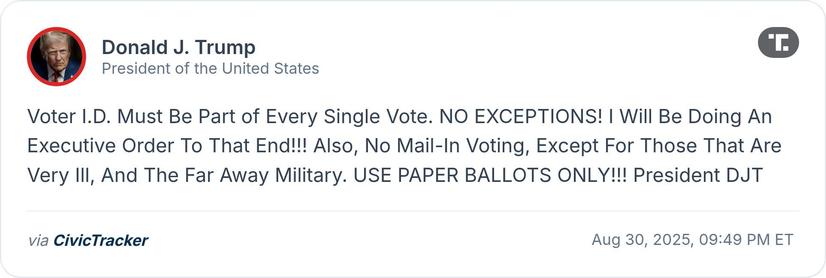
 Karl Auerbach
 Steve Bellovin
 Aaron Brick — אהרן בריק
 NKT
NKT Fritz Adalis