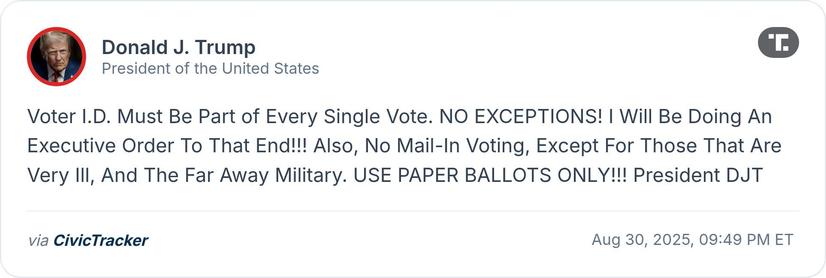
Just for the record, Trump can’t do this. The Constitution is very clear that the “times, places, and manner“ of elections for federal office are determined by individual states (though can be altered by Congress).

The president simply has no role in US elections (except to sign into law or veto whatever election-related bills that congress might pass).

@mattblaze Throw into the brew the situation a few years ago when states tried to require that presidential candidates publish tax returns and were shot down by courts saying that states can not modify the requirements to hold office.

Although that is not directly germane to the voter ID situation, it does reflect a policy that when it comes to election stuff, the Constitution occupies almost the entire space leaving little room for additional Federal or state regulation.

With regard to voter ID - that is an issue that is hard to oppose because it is not irrational. I believe the D's would be better off not opposing voter ID but, instead, using those resources to make sure that every likely D voter has a proper voter ID.

@karlauerbach @mattblaze Providing IDs to every voter is a really hard problem. But the Supreme Court has upheld the right of states to require it.

@SteveBellovin @mattblaze I am far from having expertise in the art of issuing IDs. So I do not understand when you say "Providing IDs to every voter is a really hard problem."

??

(I do remember back when Dave Kaufman and I were trying to figure out operating system access control matrices that we always seemed to back into the question of "how do we know who the actor is?" [Especially when a person or thing was acting as an agent with delegated authorities from another.])

I also keep bumping into the old national ID card issue - and the fears that a person could be "vanished" by a government agency. But then again, we seem to be moving pretty close to a national ID card with things like SecureID driver's licenses.

@karlauerbach @SteveBellovin @mattblaze Printing the IDs is likely easier than getting them to people.... many lack the other documents needed to corroborate who they are. Then what is the state going to do, short of awarding them brand new identities?

@aarbrk @karlauerbach @mattblaze This is the key point: lack of what are known as "breeder documents"; error handling is the other big point. I outline some of the issues in https://www.cs.columbia.edu/~smb/papers/age-verify.pdf, with a more complete analysis in Section §V.C of https://scholar.smu.edu/scitech/vol26/iss2/2/. There's a very good analysis of the ID card issue in Crawford v. Marion Count Election Board, 553 U.S. 181 (2008), especially the dissents. For a general discussion of what questions would have to be answered (in the U.S.) by anyone proposing a national ID card before the question could even be discussed intelligently, see the National Academies report "IDs Not Easy", https://nap.nationalacademies.org/catalog/10346/ids-not-that-easy-questions-about-nationwide-identity-systems (I was on the committee). I should add: one of the things I learned while on that committee was that while the US has a pretty good national registry of deaths (the Social Security Administration's Master Death File), birth records are decentralized and are of varying quality and accuracy.

The problem falls disproportionately on certain groups: the poor, the elderly, the disabled, the homeless, etc. Quoting Justice Souter's dissent in _Crawford_: "The need to travel to a BMV branch will affect voters according to their circumstances, with the average person probably viewing it as nothing more than an inconvenience. Poor, old, and disabled voters who do not drive a car, however, may find the trip prohibitive, witness the fact that the BMV has far fewer license branches in
each county than there are voting precincts." Corruption can be a problem—in Hudson County in New Jersey, birth certificates from the county office were not accepted by the state because a scheme to issue fraudulent documents (https://hudsoncountyview.com/after-nearly-two-decades-jersey-city-residents-can-now-obtain-birth-certificates-at-city-hall/). Malice can be an issue: Alabama closed almost half of its motor vehicles offices, mostly in poor, Black counties (https://www.aclu.org/news/voting-rights/alabamas-dmv-shutdown-has-everything-do-race), and I have exactly one guess why.

RealID doesn't solve the problem, it makes it worse: you need more documents to show your identity and address (and if you're poor and unlikely to fly somewhere, you don't actually need it). I just went through this when I went to get a Maryland license after moving: how do I demonstrate that I live where I said? Proving my identity was easy, for me—I have a passport (though only about half of Americans do, and that's up sharply from not long ago; see https://www.apolloacademy.com/48-of-americans-have-a-passport/), NY license, Social Security Card (though it's a replacement I had to get not all that long ago because I thought I'd lost mine), New York City ID card, etc. But my address? For various reasons, I wanted to get my new license very soon after I moved. I hadn't received any bank statements, credit card bills, etc., at my new address yet. Cable TV is included here, so I had no cable bill. I did have an electric bill, and I suppose I could have brought the purchase deed for my condo (though that only shows ownership, not residence). Now translate all of that to someone who's very poor or is living on the streets. Passport? Hah. Electric bill for your park bench or homeless shelter? Etc.

Yes, some of these issues can be worked around, especially in states with good will. In Massachusetts, staff at a homeless shelter can sign affidavits of residence. But a lot does depend on state politics. In Texas, you can vote with a state firearms license—but not with an ID from a public university, even though legally those are government-issued IDs. (Aside: ~20 years ago, I had a Homeland Security ID card for my service on an advisory committee. When I got to the airport the first time after received that ID, I asked the TSA agent if I could use it. "You can, but we won't like it." I took the hint and dug out my driver's license instead…)

I could go on—as you can see, this is an area where I have worked professionally. The bottom line, though, is that while it's not a problem for the majority of Americans (the issues are very different in other countries)—and that likely includes the overwhelming majority of Americans reading this post—for a significant number of people it is quite difficult.

@SteveBellovin @aarbrk @mattblaze Thanks for that, and the references.

Some years back when I had to dredge up birth and marriage certificates for my mother and birth certificate for my maternal grandfather.

My mother's birth certificate was hand written by a priest in Quebec - and was not acceptable to the Canadian federal government. Fortunately I could get a modern one from Quebec.

My grandfather was born before WW-I in what was then part of Austro-Hungry, which became part of Germany, then Ukraine, then Soviet Union, then Germany, then Ukraine/USSR, then Ukraine. Eventually I got a certificate from Russia but with the CCCP and hammer and sickle on it.

Once upon a time, for a US corporate governance case (against ICANN) I got an "official" report from a US agency that had embossed pages, had a blue ribbon, and a wax seal - nobody had seen anything like it.

(I've seen actively used, 18th century looking, large, wooden embossing presses in some court clerk offices.)

@karlauerbach @SteveBellovin @aarbrk Original patent certificates are like that - very fancy.
@karlauerbach @aarbrk @mattblaze Yup. Some years ago, someone I know needed their father's birth certificate from what is now Poland, from before WW I. It was in Old Russian, so archaic that a native speaker of modern Russian couldn't read it.

@karlauerbach @SteveBellovin @aarbrk @mattblaze the real scenarios are all over the map. It wasn't until the late 20th century that lack of approved documents really became an issue. And you can't create documents that never existed.

Sometimes even getting new ones issued when the old ones get lost or destroyed becomes super hard. Many jurisdictions have been digitizing their official documents. This is a great thing, but transcription doesn't always work out well. Try to find your birth certificate when it was transcribed wrong! The database swears you were never born, but it's just a case of someone typing something wrong into a computer.

@mweiss @SteveBellovin @aarbrk @mattblaze My sense is that the issue is even more broad than the cases you mention.

Our governments have found that then can circumvent various kinds of Constitutional and other constraints by farming out jobs to private actors. I saw this at close hand in internet governance matters.

Those private actors seem to be more sloppy about data integrity than government actors. For instance, I seem to have morphed into multiple people because information aggregation companies have conflated me with my ex (our names differed by one character) and because some scanner sometime in the past mis-scanned my name and thought an 'a" was a 'u' character. This has caused me no end of troubles.

What are we going to end up with? Will each birth be assigned a GUID that links to the child's DNA sequence? (Could this revive the practice of signing documents in blood? ;-)

Corporate ID is potentially worse given sub-corporations, linked trusts, etc.

@karlauerbach @SteveBellovin @aarbrk @mattblaze there are a handful of problems with using DNA. First, we as a species have trouble these days differentiating between identification and authentication. Second, while DNA is mostly unique (maternal twins being the exception), it contains far more information than merely what amounts to a unique identifier. This makes it rather unfit for the purpose of being a human ID.