 John Lusk
Glorious. I'd love to know how they did it.
 Florence
@tarheel @nando161 @pluralistic It's just a frame from a video recording. That's how most people catch lightning strikes.
 Dec [{(
 )}]
)}]@themaritimegirl @tarheel @nando161 @pluralistic
There's also CHDK (for some Canon camera models) which has an auto trigger mode that can capture lightning strikes.
https://chdk.fandom.com/wiki/CHDK
"Motion detection trigger - automatically fires camera on motion detection.
Ability to capture lightning strikes.'
https://chdk.fandom.com/wiki/CHDK_1.6_User_Manual

 Ret
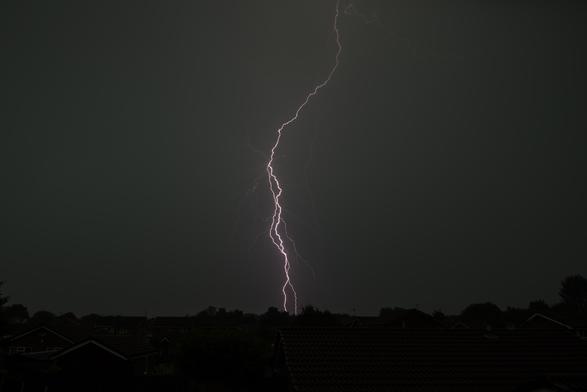
Ret@dec23k @themaritimegirl @tarheel @nando161 @pluralistic I captured this with my Nikon D600 about 10 years ago. The old "continuous shooting mode, hold the shutter button down and hope" approach. I think I filled two SD cards and got ~4 usable images.
 fops Now On Merping Synth Download
@ret @dec23k @themaritimegirl @tarheel @nando161 @pluralistic huh now im wondering if it'd be possible to do captures in like a ring buffer (like slow motion cameras) and trigger off a photodiode or something (or just the images assuming the processing wouldn't end up being too slow)
 Ge0rG
Ge0rG@ret @dec23k @themaritimegirl @tarheel @nando161 Canon + CHDK, or Samsung + NX-KS, or a simple external shutter with a lock switch.
Manual mode. Make the shutter time as long as possible (30s), low ISO, small aperture (clean your lens and check results for sensor dust). Underexpose (a shot without lightning should be just barely above black).
Shoot RAW if you can. Shoot in continuous shooting mode.
Result: https://photog.social/@ge0rg/110893054901928523
Video: https://photog.social/@ge0rg/112962700110665684
Details: https://photog.social/@ge0rg/112710547979801379
