 ꓤɔᴉʇɐʇS
"sideloading" is a stupid made up term invented to delegitimize installing software.
Heres a bunch of other things I'm doing while "sidestepping" some supposed central authority:
- sideshopping (buying stuff from a store that isn't amazon)
- sidedining (eating or making food that isn't from mcdonalds)
- sidethinking (using my own brain instead of asking chatgpt)
- sidelistening (to my own music instead of on spotify)
- sidechatting (irl instead of online)
 lia
lia@StaticR Eh, the analogy doesn't quite work. When you cook a homemade dinner, you're not interacting with McDonald's at all, but when you "sideload" an app onto your Android phone, it's still Android.
A more accurate analogy would be "bringing homemade food into a McDonald's", which... well, would be banned too.
However, adding your local music library to Spotify, and adding your own local video games to Steam, both are a thing.
The real question is whether Android is a service Google provides to you similar to a McDonald's restaurant (which by sideloading you're illegitimately changing) or a tool similar to a file manager, which can be used however you please.
I'm also on your side obviously. It was just a bad analogy I think.
 Leeloo
 Jacob
Jacob@leeloo @lianna @StaticR uh, actually the correct analogy would be licensing a franchise of a McDonald’s in a building that you own, and then breaking the rules of that franchise agreement by selling or eating food outside the dining standards. don’t license the franchise, i.e., don’t run software you don’t agree with, even if you need it for technical reasons.
@lianna @leeloo @StaticR it’s not, though. just in the sense that you do not own the order of the words of a book you purchase, you do not own the cleverness of the OS. you own the ink the renders the words, and you own the electrons that represent a copy of that cleverness. The cleverness is licensed to you, not sold.
@jazaval @lianna @leeloo This was actually the point I was gonna get to earlier when I said I'll post something "in a bit".
The difference is a McDonalds franchisee works for McDonalds and represents their brand and sells stuff under their banner, so they have to uphold the expectation what a McDonalds is.
A private person using the android OS themselves does not work for google, does not represent their brand to others so they shouldnt need to uphold the brand's expectations.
@leeloo @StaticR @lianna you don’t need to use that software to use the phone though, the EULA has nothing to do with the *phone*. you accept terms to use *software*.
if you disagree, you’re more than capable of just pulling a Terry Davis and writing your own bootloader, kernel, OS, etc. in order to utilize that hardware you now own if you disagree with those terms the software creators set.
@leeloo @StaticR @lianna that’s weird, cause you can completely replace it with all new software without physically modifying the phone at all.
software is just someone’s interpretation of the best way to arrange electrons in a way that represents your intentions. it’s intellectual property, not physical, and is subject to different ownership rules.
@leeloo @jazaval @lianna I wanna chime in and say that any sort of agreement needs to be sorted out BEFORE a purchase or transaction is made. It shouldn't be possible to buy something and then be forced into a contract after the fact.
Usually, the first time you're presented with terms of use is when you first boot up your system after having paid for it so you're basically pressured into agreeing because if you don't you got a brick a brick that does nothing of what was advertised to you.
@leeloo @jazaval @lianna On top of that, those terms of service agreement are usually entirely non-negotiable and written up in such a way to give the company pretty much complete freedom to do whatever they want, including stripping your right to legal action even when they outright break the law due to binding arbitration clauses.
On top of that they can change the terms whenever they want and the new terms automatically apply to you. They CAN actually agree you to new terms and its fucked up
On top of that they can change the terms whenever they want and the new terms automatically apply to you. They CAN actually agree you to new terms and its fucked up
@StaticR @leeloo @lianna so? if what they’re providing is of so little value as to not merit the leverage they are wielding, surely you can just provide yourself?
or maybe what they’re providing is valuable, complex, and difficult enough to produce in this day and age that only a massive monolith can? how is that their problem?
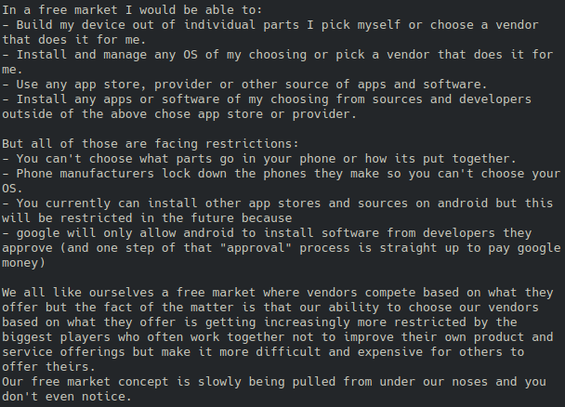
@jazaval Thank you for bringing up the free market because you are right, in a free market I'd be able to freely choose which vendor, provider, manufacturer, developer and so on I conduct my business with.
But the reality is there is no free market anymore, the existence of a free market has been eroded away by big companies like google and their peers over time step by step, the most recent step being the one we've been arguing about.
(see image cuz post is long and I don't wanna split it up)
you can absolutely build a device out of parts of your choosing or have a vendor do it, you just don’t find it convenient.
@StaticR you could then install any OS made by someone or some organization that’s okay with their intellectual property being applied to any device, or just write your own.
@StaticR you can then install any application on that system so long as the developer has made their source code available, and licensed it with terms agreeable for doing so.
@StaticR a truly *free* market also enables *me* to build devices, systems and applications that allow *me* to restrict *you* from doing any of these things with the devices, systems and applications I build, and whichever has the greater competitive advantage as a result, will be more successful.
@jazaval Actually no, you can make a device or system that has a set of capabilities and your competitiveness on the market is based on these capabilities compared to your competitors.
What you can not do is arbitrarily restrict how these capabilities are used by customers eg you can make a computer with an OS but you cannot put restrictions on customers for what sets of bits they are allowed or not allowed to compute or where those bits come from.