In the midst of the summer torpor, our paper with Mirna Safi and Matthew Soener, “Organizational Intersectionality” was finally published at Work, Employment and Society. https://journals.sagepub.com/doi/full/10.1177/09500170251348848
What is it about? Small thread.[1/n]
– Hmm … INTERSECTIONALITY? This must be dangerously WOKE…
– Nope.
– Oh “organizational intersectionality”? This must talk of the complexity of the lived experiences of those facing in organization multiple prejudices at the intersection of many minorized dimensions.
– Not really either.[2/n]
– So?
– Well, we’re just asking a very simple question. Are firms that are highly unequal in terms of gender also highly unequal in terms of migration origin? It’s trivial once you know the answer… But before that, the answer is not easy to guess… Try![3/n]
And the question is not easy to answer, either. Gender and migrant wage gaps are estimated using the same underlying variable: wages in the same establishments. There’s a big risk of capturing artifacts. Therefore, in the appendices, lots of equations we had a hard time solving… [4/n]
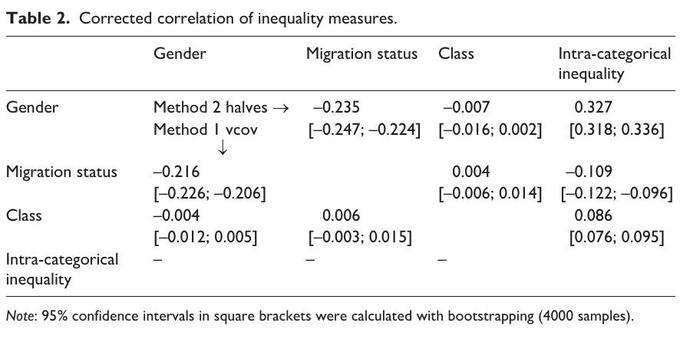
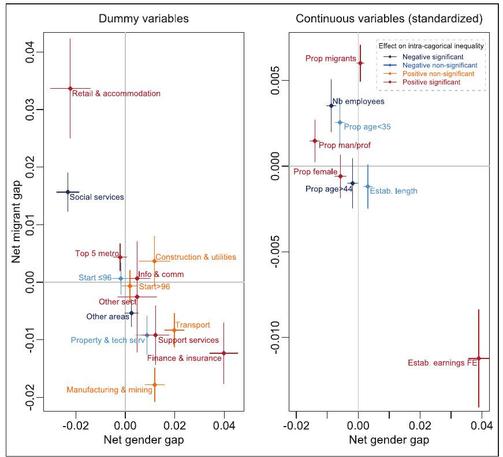
Using DADS admin data from France (1996-2021), we find that firms with higher gender gaps have lower migrant gaps, and vice versa. Firms with high gender gaps are also highly unequal within gender/migrant categories. In contrast, firms with high migrant gapsare less unequal.[5/n]
 Olivier Godechot