 Álvaro Prieto
 Luke Wren
Cool, a thing I worked on is public https://www.raspberrypi.com/news/rp2350-a4-rp2354-and-a-new-hacking-challenge/

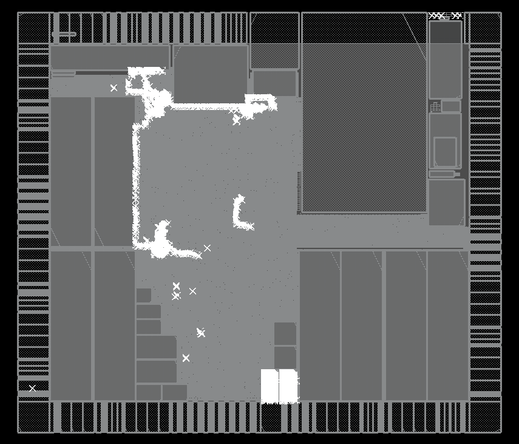
Please nobody ask why the chip ID register counts 2, 3, 8. There is a reason but I don't want to talk about it
Since people are doing the thing I explicitly asked them not to do: we accidentally case-analysed the timing through the tie cells that are read through that register. Changing bits 2 or 3 would cause a setup violation. For A3 we fixed the timing on bit 3 by reimplementing that part of the bus mux with an ECO cell and stealing a nearby buffer. It wasn't possible to fix bit 2 in the same way, so we can't use the value 0x4.
The same issue applies to the tie-cell-programmable IDAU watermark over the ROM, as described here in the bootrom source: https://github.com/raspberrypi/pico-bootrom-rp2350/blob/c6cdb1711f32c3e34faaebd58618a6d096dbd52e/src/main/arm/arm8_bootrom_rt0.S#L238-L264

 Ignas Kiela
@wren6991 that's both better and worse than what I thought
 Lambda
@wren6991 is it related to one of those little X's in the image being off by a pixel
 F4GRX Sébastien
@wren6991 EDC and parity-like stuff, right?
 unnick
@wren6991 ohno
"typo'd" the wrong bit? (my guess it's shuffled in the mask for some reason)
"typo'd" the wrong bit? (my guess it's shuffled in the mask for some reason)
 Mimir
Mimir@wren6991 ah, of course, n!+(n-1)!, so the next stepping is ID 0x1E
 meta
meta@wren6991 you love to see it
 The Penguin of Evil
@wren6991 so everyone who gets an A3 will be hoarding it to sell as rare collectable in 25 years ?
 penguin42
@wren6991 'Those of you interfacing RP2350 to retro computer hardware will be pleased to hear that, after an extensive qualification campaign, RP2350 is now officially 5V tolerant!' ooh
(Hey where's that big pile of withdrawn A2's ?)
(Hey where's that big pile of withdrawn A2's ?)
 Jonathan ‘theJPster’ Pallant
@wren6991 how bad would it be if I fed it 5V signals (with pull ups) but VDDIO came from the Pico 2’s on-board regulator? Does the regulator output track the input on power up or does it lag enough to damage the pin?
@wren6991 OK so the Pico 2 appears to have an RT6150 buck-boost driving VDDIO, and that produces 3.3V output given at least 1.8V input. So I'd want to put a scope on the output to track the voltage when power is applied, but it can probably start quick enough?
I'm thinking about a situation where the bus the RP2350 sits on is pulled up. Obviously is the bus floats, it'll be eons before it comes out of reset and starts doing active things on the bus.
@thejpster Yes it depends on the external ramp. Ideally, switch the external supply to the 5V circuit and sequence it to come up after IOVDD, or hold the external 5V circuitry in a state (e.g. reset) where its outputs are low or floating.
@wren6991 non-trivial if you are putting a card in an ISA slot, or a cartridge in a C64. But probably safest.
@thejpster You could also look at disabling the internal regulator and adding an external LDO from 5V to Pico 3V3. That should track the external 5V ramp quite closely. It's not "nothing when unpowered" but rather "no more than 3.3V + 10% when unpowered".
 Tom Verbeure
@wren6991 Is there a chance that the RP2350 will be declared 200 MHz capable sometime soon?
@tom_verbeure We've been collecting data from ATE since A2 production ramp-up, but nothing to announce
@wren6991 I’m holding my breath!
 Raph Levien
@wren6991 I just want to say how much I'm enjoying playing with this chip. Most recently, I've written optimized Cortex-M33 assembly for TERC4 encoding of HDMI data islands. There are a lot of boards coming out, and it looks like it's going to be a thing.
 Manuel Wick