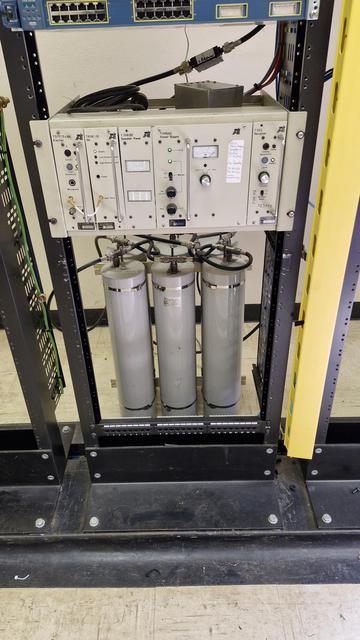
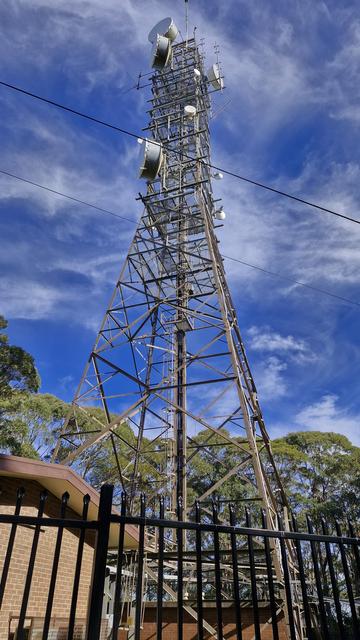
Our new home. Neighbours are mainly possums and lyrebirds. Coverage of the Blue Mountains Amateur Radio Club 2m #hamradio repeater is matching our forecasts, some very happy hams in the entire region. All the dead spots have disappeared 😃👍
@weezmgk I was going to google it, but they only make me upset these days. What are the large grey cylinders with coax tees on top for? I am not a electromagnetic radiation person.
@Heterokromia that is a 6 cavity duplexer for VHF. It allows the repeater's transmitter and receiver to share the same antenna. Without it, the repeater's transmitter would interfere with the repeater's receiver.
@Heterokromia in our case, the repeater is listening on 147.650MHz, demodulates the signal to audio, which is then fed into a transmitter on 147.050MHz, thus repeating what it heard. The repeater has to transmit and receive at the same time. The duplexer makes this possible using a single antenna.

@weezmgk Thank you very much. I always imagined repeaters having such different frequencies that two antennas would be compulsory.
I see now (https://en.wikipedia.org/wiki/Duplexer that the two frequencies can be *very* close together indeed.

In your photo there's three cavities in each in/out leg, I imagine each one must be really 'thin' on the relevant frequency, and also each one *very* tricky to adjust.
Do you do that, or does someone-else? And, once adjusted, a 'touch this and you die' sign gets added, yes?

Duplexer - Wikipedia

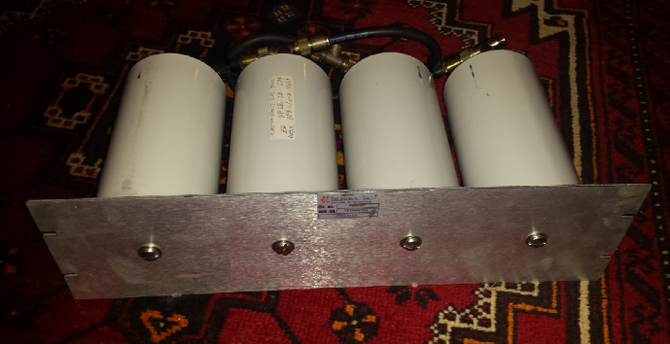
@Heterokromia on the 2m amateur band, the offset is 600khz, and you're right, that's very close together. This is also why 6 cavity duplexers are the norm on 2m. In the 70cm band, which is much wider than the 2m band, the offset is typically 5 MHz, so 4 cavity systems are sufficient. This is the duplexer for our 70cm repeater. I can tune duplexers, but you're right, it's tricky.