 Thomas Dugaro
Was ist euer bestes unnützes Wissen?
Meins: Es gibt in Norwegen eine Stelle, die näher an China gelegen ist als an Portugal.
Was ist euer bestes unnützes Wissen?
Meins: Es gibt in Norwegen eine Stelle, die näher an China gelegen ist als an Portugal.

Ich habe eine passende Kugel in der Büroschublade - mit aufgemalten Kontinenten und Ozeanen. 🙂
Erd-große Schwarze Löcher verliert man so leicht, bei der Größe 😅
Ja, wäre blöd sonst. Obwohl... kommt auf die Perspektive an.
Und wie wir jetzt wissen, müssen sie gar keine SL sein, um Hawkingstrahlung abzugeben.
Wo war noch mal der Artikel von kürzlich? Ah, da: https://ui.adsabs.harvard.edu/abs/2025JCAP...05..023F/abstract
Black holes are assumed to decay via Hawking radiation. Recently we found evidence that spacetime curvature alone without the need for an event horizon leads to black hole evaporation. Here we investigate the evaporation rate and decay time of a non-rotating star of constant density due to spacetime curvature-induced pair production and apply this to compact stellar remnants such as neutron stars and white dwarfs. We calculate the creation of virtual pairs of massless scalar particles in spherically symmetric asymptotically flat curved spacetimes. This calculation is based on covariant perturbation theory with the quantum field representing, e.g., gravitons or photons. We find that in this picture the evaporation timescale, τ, of massive objects scales with the average mass density, ρ, as τ ∝ ρ <SUP>-3/2</SUP>. The maximum age of neutron stars, τ ∼ 10<SUP>68</SUP> yr, is comparable to that of low-mass stellar black holes. White dwarfs, supermassive black holes, and dark matter supercluster halos evaporate on longer, but also finite timescales. Neutron stars and white dwarfs decay similarly to black holes, ending in an explosive event when they become unstable. This sets a general upper limit for the lifetime of matter in the universe, which in general is much longer than the Hubble-Lemaître time, although primordial objects with densities above ρ <SUB>max</SUB> ≈ 3 × 10<SUP>53</SUP> g/cm<SUP>3</SUP> should have dissolved by now. As a consequence, fossil stellar remnants from a previous universe could be present in our current universe only if the recurrence time of star forming universes is smaller than about ∼ 10<SUP>68</SUP> years.
@gwoptics @vicgrinberg @dugartogo
Aus der Vergangenheit :-) Habe ich vor Jahren mal von jemandem im Netz gekauft.
 Dr. Victoria Grinberg
 Knud Jahnke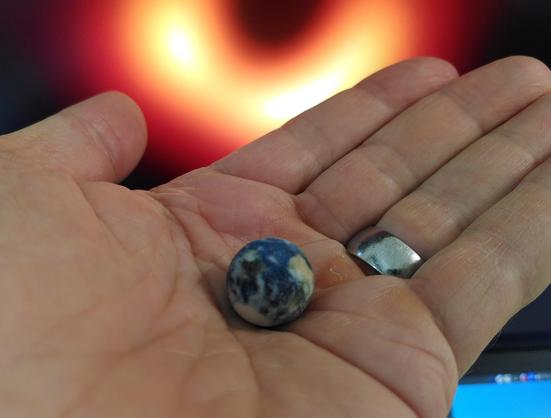
 Andreas Freise