 Dr. Lucky Tran
Gilead has announced that lenacapavir, the game-changing HIV prevention drug just approved by the FDA will cost $28,218 USD per person per year.
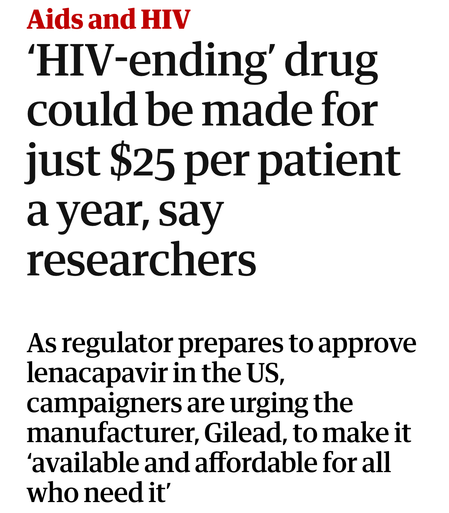
Researchers say a generic version could be made for just $25 per person a year.
Capitalism kills.
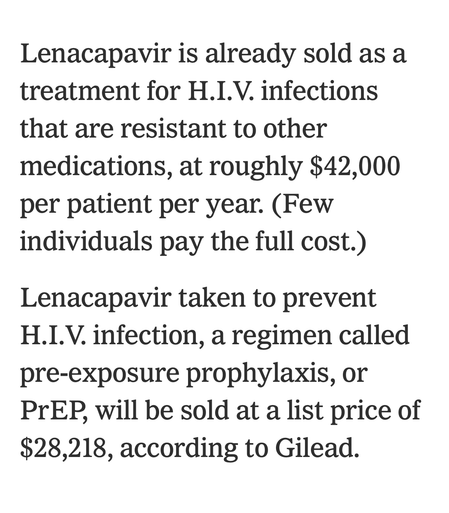
Gilead has announced that lenacapavir, the game-changing HIV prevention drug just approved by the FDA will cost $28,218 USD per person per year.
Researchers say a generic version could be made for just $25 per person a year.
Capitalism kills.
@luckytran In a hypothetical world without those greedy bastards at Gilead, though, we don't get lenacapavir at $25/year, we get no lenacapavir at all. (Because lenacapavir was discovered by Gilead. They were willing to put in the effort and resources because they hoped it would lead them to a drug that they could make a lot of money from.)
In a more distant hypothetical world without capitalism, _maybe_ we get all the same drug discovery that in our rotten greedy capitalist world is done by companies who hope it will make them rich, and then the drugs get made available at non-extortionate prices. That would be nice. But how do you know that's what we'd get?
I guess it's impossible to know what would happen in the alternative hypothetical world, but I'd take my chances any day of the week in a world where people's actions are motivated by personal interest and joy instead of maximizing profit for the shareholders
@adamsaidsomething @luckytran I too prefer joy and benevolence to greed and ambition. But so far as I can see the options we actually have, if we don't get to reform _human nature_, are (1) whatever drugs will be developed by curious/benevolent people just out of the goodness of their hearts, or (2) that _plus_ whatever others will be developed by greedy profit-seekers who want to get rich, and #2 seems better to me than #1.
Gilead may well be evil greedy bastards (or they may not, I don't actually know) but apparently their greed led to the production of this game-changing therapy, which will do a lot of good even at $40k/year, and it won't cost $40k/year for ever.
It absolutely would be much better if they sold it for $25/year from the outset, provided extra subsidies for people in poor countries where even $25/year is a lot of money, etc. But in a world where they had to do that they (being, as I stipulate, evil greedy bastards) wouldn't have developed the drug in the first place.
The way I see it, capitalism is a roadblock to reforming human nature. In a different world where society doesn't reward greed and punish benevolence while brainwashing people with egocentric ideologies, people would be more free to rediscover the natural joy of altruistic pursuits
@adamsaidsomething @luckytran I'd love that to be true. But in the history of the world, are there actually any examples of this? And how well have they done at actually making difficult and useful things happen?
(That's a genuine question, not an I-know-the-answer-is-no gotcha. Maybe Bhutan is a bit that way, for instance? Though so far as I know it isn't much of a hotbed of scientific discovery.)
I feel about capitalism roughly as Churchill allegedly felt about democracy: the worst system there is, apart from all the others that have ever been tried. The healthiest societies I know of seem to be ones that combine capitalism (harnessing greed to get valuable things done -- along, alas, with lots of not so valuable things) with unashamedly redistributive taxation (so that as well as the valuable things that are motivated by that greed, we also direct some of its products to help the people who aren't well served by a brutally capitalist system).
Maybe something much better is possible. It would be nice to think so, because the capitalist meat-grinder ain't pretty. But there seems to be rather a shortage of examples of plausibly-better systems.
 gjm
gjm Adam
Adam