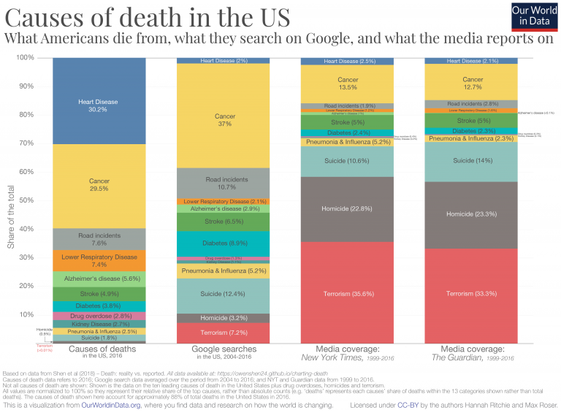
I always find this chart by Hannah Ritchie -- of Our World In Data -- deeply informative of how disjointed is our sense of personal risk
https://x.com/_HannahRitchie/status/1133703638432526337

@clive This is interesting. But it also just kind of makes sense. People being murdered, and terrorist attacks, are outliers. They are less common and therefore more noteworthy. Very few people are going to click to read an article about every individual who dies of cancer, heart disease, or diabetes.

@fuminghumanist

yeah, also terrorism and homicide involve human intent and human activity, which holds understandable intrigue

that said, it doesn't quite explain the gulf between cancer and heart disease ... I gotta think about why that difference is so big

@clive I was thinking that gulf might be due to all the foundations, research developments, and the seeming randomness of cancer. "Finding the cure for cancer" is its own trope. We already, pretty much, know the "cure for heart disease" is diet, and other lifestyle choices. Cancer is simply more sensational than being scolded to eat better and exercise more.

@fuminghumanist

yeah, that’s a really good point!

and also, the things that improve heart health are things people tend to not want to do lol

@clive @fuminghumanist Might also be that not all articles about health improvement, fitness, … in general which also help against heart and respiratory diseases were counted as being specifically *about* heart disease, while trying to find a cure for cancer or studies on things causing cancer are rather specific topics more easily counted as about cancer.