Where’s Brude? Where’s Brude?
So many souls to be saved!

—Edwin Morgan, “Columba’s Song”
in CENTENARY SELECTED POEMS (Carcanet, 2020)

Today, 9 June, is the feast day of St Columba (c.521–597), who led the Irish monastic missions to Dál Riata & the kingdoms of the Picts

1/4

https://www.carcanet.co.uk/9781784109967/centenary-selected-poems/

#Scottish #literature #poem #poetry #EdwinMorgan #saints #StColumba

Columba has a fair claim to being Scotland’s first patron saint. What were (possibly) his relics were (perhaps) carried as the Breacbennach battle standard at the forefront of the Scottish army at Bannockburn

2/4

https://blog.nms.ac.uk/2015/05/27/glenmorangie-research-project-monymusk-reliquary/

#Scottish #history #medieval #Saints #StColumba #Bannockburn

Glenmorangie Research Project: Monymusk reliquary

The Monymusk reliquary is arguably the most important piece of early Christian metalwork to survive in Scotland. It is also one of the most iconic objects in National Museums Scotland's archaeology collections. As part of the Glenmorangie Research Project we are currently revisiting this most fascinating find, looking again at how the reliquary is constructed … <a href="https://blog.nms.ac.uk/2015/05/27/glenmorangie-research-project-monymusk-reliquary/">Continued</a>

National Museums Scotland Blog

“Thou shalt go no further, nor touch the man; go back with all speed.”

The first recorded sighting of a monster connected to Loch Ness is given in Adomnán’s VITA COLUMBÆ (“Life of St Columba”, c.7th/8th century). St Columba sends it packing

(The story is too long for the ALT text but the whole transcript can be found via the link)

3/4

https://sourcebooks.fordham.edu/basis/columba-e.asp

#Scottish #literature #history #medieval #Saints #StColumba #monster #lochnessmonster

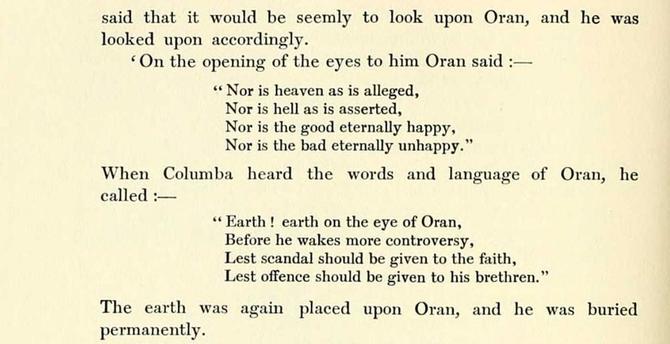
“Nor is heaven as is alleged.
Nor is hell as is asserted…”

Scaring off the Loch Ness Monster is quite an achievement, but my favourite St Columba story is the one where he buries St Oran alive, twice

—from CARMINA GADELICA, via the National Library of Scotland

4/4

https://digital.nls.uk/early-gaelic-book-collections/archive/75758828?mode=transcription

#Scottish #literature #history #Saints #legends #StColumba

@scotlit of of my fav stories ! I've tried to pinpoint the exact place where he was buried, his so-called chapel is still up and the oldest thing on the site, but it's hard to fathom ahah given we don't even know where macbeth or columba are :)
@poum It’s an interesting version of a “foundation sacrifice” legend – not least because it’s not exactly flattering to Columba, & because it puts some decidedly non-orthodox, not to say heretical, utterances into the mouth of Oran (Odhrán) – who is himself a saint. There are other variations on it, too:
https://en.wikipedia.org/wiki/Oran_of_Iona
Oran of Iona - Wikipedia

@scotlit I would not consider Columba as a flattering figure in any way :) Interestingly from what i gathered on Hy, from its inhabitants, Oran is way better considered.... But Columba has put his fingerprints everywhere, so... (and I love his relationship with angels tbh)

@poum There are some odd bits of early Gaelic/Irish literature where orthodox Christianity gets some short shrift. The “Colloquy” between St Patrick & Ossian is another one. They’re especially odd considering that they all must have been written down & preserved by monks

https://www.popmatters.com/020315-stpatrick-stephens-2496101765.html

Oisin's Arguments with St. Patrick » PopMatters

St. Patrick is said to have lived in the 5th Century, although only two contemporary documents attest to his existence: the Letter to Coroticus and a last

PopMatters
@scotlit oooh thankies for that !