 Sundray
Sorry, Cthulhu -- you'll always be my number 2
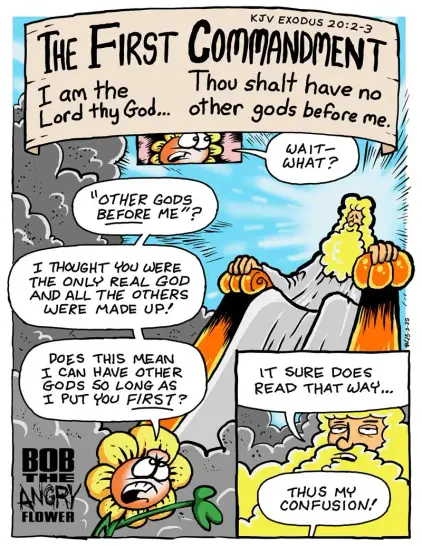
I mean, there’s even other godlike characters in the Bible. Satan may not be the most powerful deity in the book but he’s canonically a deity. Same for angels and their ilk. Hell, even the later bits struggle to keep a lid on the numbers, jumping through hoops to make the claim that three deities is actually one.
Way back when, the religion that turned into Judaism was openly polytheistic, and simply held that Yahweh, the king of the pantheon and God of war and weather, was the only god worthy of worship.
Over time Yahweh merged with an adjoining religions god El, and started the transition to being the only god, instead of just the only worthy god.
This transition happened literally a thousand years after many of the earliest texts were written, so there’s a lot of verbiage where the deity explains that the other gods aren’t important, which is later clarified to them not existing, or really just being servants and not at all lower tier gods in a complex pantheon.
It’s why there’s so many weird turns of phrase, beyond it being thousands of years old and translated a lot.
“El” being a word that was used for both “a god” and “this god” didn’t help. “The high god divided the world for all the gods, and our god God the only God and creator of all was given our land as he’s the high god and father of God the only God of the sky and also that mountain”.
Different parts of the world took a lot of the same root deities and went a different direction with them. There’s a degree of overlap between aspects of ancient Greek religion and the Abrahamic religions because parts of each of them came from a common root. Just one mushed then together and made the grammar extra confusing. “King sky god”, “water god”, “afterlife god” being the children of mother and father cosmic creator gods. Also a big sea snakes who are up to no good. That one had legs, so to speak.
Probably wasn’t edited because it wasn’t a deliberate change. People were the ones to write the texts and stories, but not a person.
Telling the story you were told as you understand it will introduce some drift, as will making the jump to writing it down. Translation also introduces points where meaning can drift, since you have to write down what you understand the text to read, and you can be unclear on both sides.
People making a good faith effort try not to intentionally embellish their important texts, even if parts seem to contrasict.
Judaism and the old testament have had a lot of the quirks stick out so much because there are strict rules about preserving the integrity of the stories, once they got written down. Not from memory, only from another scroll created in this fashion and no other sources, only a specific font with specific text alignment, copy letter by letter and read aloud as you go, and then you can check the number of letters as you go to verify.
Other religions over time haven’t had as much of a focus on textual preservation, so the stories can drift to match with the change in beliefs.
Wait wait wait, did Judaism invent the basic concept of a checksum?
That is… very interesting. I know numerology and the like are very popular parts of Jewish occultism.
 ricecake
 Rhaedas