The book "System Archetype Basics" studies 7 troublesome patterns. Here's one.

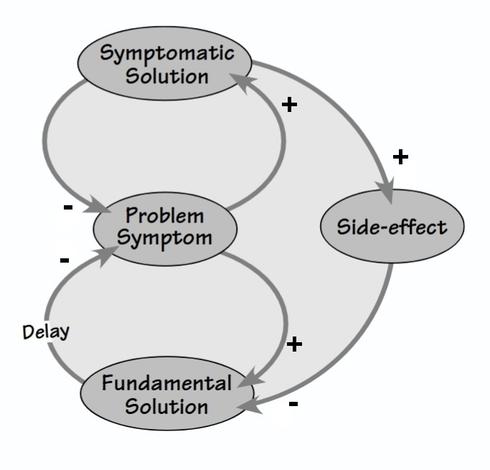
As the symptom of some problem increases, we work harder at the "fundamental solution" but also the quicker and easier "symptomatic solution". Both of these decrease the symptom of the problem. But the fundamental solution takes longer - there's a delay. Also, the symptomatic solution tends to cause a side-effect that tends to work against the fundamental solution.

The picture here is called a 'causal loop diagram' because it helps you spot feedback loops. Just find a loop in the picture and multiply the plus and minus signs around it to tell if it's a positive or a negative feedback loop!

The math of these things runs deeper than you might think. I'm talking about it at a category theory workshop in Glasgow on Monday June 2nd. It's at 2 pm UK time, and you can watch it on Zoom if you register here:

https://jademaster.xyz/TACT25.html

This workshop is being run by my former student @JadeMasterMath and it's at the University of Strathclyde, Royal College, room RC 512. My long-time n-Category Cafe co-host, the philosopher David Corfield, will be giving a talk on how modalities in homotopy type theory can be thought of as 'logical', and my friend Nathaniel Osgood will be talking about compositional modeling in public health. There are also lots of other great talks. Abstracts are here:

https://jademaster.xyz/ListOfAbstracts

and a tentative schedule is here:

https://jademaster.xyz/TACTSchedule.html

I hope to see you there, at least virtually!
@johncarlosbaez @JadeMasterMath
There is nothing so permanent as a temporary solution.
@johncarlosbaez @JadeMasterMath If I put "System Archetype Basics" into Bookfinder.com, nothing comes up. Is that really the title?
@skewray @johncarlosbaez @JadeMasterMath You may have better luck with the book’s ISBN: 9781883823047
@johncarlosbaez That reminds me of Robert Rosen's Anticipatory Systems - the system analysis regarding response time looks quite interesting. On the philosophical side, knowledge of a "Fundamental Solution" depends on the system frame of the observer. Also that is an interesting problem.

@JadeMasterMath
@tg9541 - I find this all much more concrete and mathematically solid than Rosen's work.

@johncarlosbaez @JadeMasterMath
I didn't know there was a category theory connection there.

In engineering Control Theory, in systems with feedback "The PID (Proportional–integral–derivative) algorithm in the controller restores the actual speed to the desired speed in an optimum way, with minimal delay or overshoot"

But "The use of the PID algorithm does not guarantee optimal control of the system or its control stability (see § Limitations, below)"

https://en.wikipedia.org/wiki/Proportional%E2%80%93integral%E2%80%93derivative_controller

https://en.wikipedia.org/wiki/Control_theory

Proportional–integral–derivative controller - Wikipedia

@dougmerritt - Adittya Chaudhuri and I are working out the category theory of graphs with edges labeled by elements of a monoid. I should sometime try to connect it to control theory, since the theory in my paper "Categories in control" should be able to handle things like the PID algorithm. Thanks!
@johncarlosbaez
I'll look forward to it! I'm always learning new things from you.

@johncarlosbaez @JadeMasterMath

Ok, the kitty that tracks the cursor on that web page is about the cutest thing I've ever seen on the web! 😍

@TonyVladusich @johncarlosbaez Thanks! It's this one if you're interested in the source https://en.m.wikipedia.org/wiki/Neko_(software)
Neko (software) - Wikipedia

@johncarlosbaez @JadeMasterMath I assume that the idea is that the negative side effect nullifies the positive work on the fundamental solution, (the delay preventing the solution to finish before the side effect begins), thus making the work on the symptomatic solutions to go on forever...

But I cannot see any effect accumulating. The system seems to be in equilibrium, it it only the delay that prevents the fundamental solution to finish...

@abuseofnotation - when we turn this diagram into ordinary differential equations we need to choose some constants. Depending on the constants involved, the system can be in equilibrium, or it can get worse and worse as shown here, or it can even get better.