 Charlie Stross
If your corporation's business model relies on lawbreaking, your corporation has no legal legitimacy.
We don't let narcotic cartels and trafficking rings list themselves on the stock exchange: why should OpenAI or Facebook be any different?
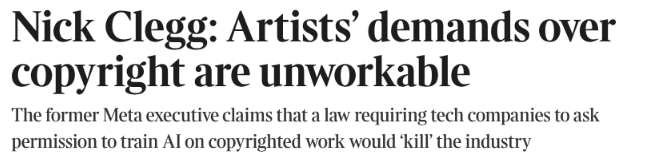
If your corporation's business model relies on lawbreaking, your corporation has no legal legitimacy.
We don't let narcotic cartels and trafficking rings list themselves on the stock exchange: why should OpenAI or Facebook be any different?
@cstross copyright doesn't give you total control over your creative work.
under US and Canadian law, there are "fair use" exceptions, and "being transformative" is one of those, meaning, no consent of the original author is required. And as far as I know, most copyright lawyers expect "training an AI" as transformative.
So, artists are actually demanding a change to the law in free use, while the drug cartels are breaking law that already exists.
@nicemicro
> And as far as I know, most copyright lawyers expect "training an AI" as transformative.
Can you back up this claim?
I was under the impression that the debate on whether AI training falls under "fair use" hasn't reached a consesus yet.
@yaarur @cstross Sure, it is not a consensus, the one I read in detail was the one commissioned by the Free Software Foundation to analyze the legality of Microsoft's Copiot on Github.
Maybe saying "most" is not warranted, but I have not read or heard any serious analysis by actual lawyers which said "not fair use", but this just might be based on bias.
In this write-up, section "B" has the Fair Use part.
 NiceMicro
 Ur Ya'ar