#BabelOfCode 2024
Week 7
Language: Haskell

Confidence level: Medium low

PREV WEEK: https://mastodon.social/@mcc/114308850669653826
NEXT WEEK: https://mastodon.social/@mcc/114463342416949024
RULES: https://mastodon.social/@mcc/113676228091546556

I was going to do Fennel this week, but then I looked at the problem and thought "this is ideal for Haskell "amb". I have been looking for an excuse to use Haskell "amb" for 25 years. So Haskell.

I have tried to learn Haskell 3 times now and failed. This "Babel of Code" thing was originally in part an excuse to do Haskell
I am not sure whether the reason I previously failed Haskell is

1. Because it's actually hard
2. Because of a mental block caused by failing at it more than once already
3. Because Haskell users are really bad at explaining things

I think it's a little 2 and mostly 3. I *love* ML, I know two MLs (3 if you count Rust) plus have in the past written my own ML. I understand the parts of Haskell that are just ML and get lost whenever I hit "do"— the point of divergence from ML; the dreaded Monad.

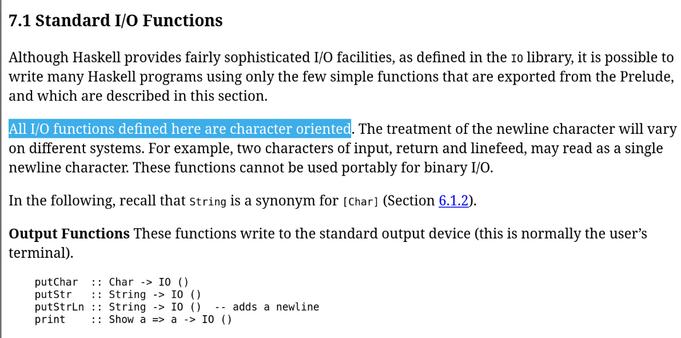
Question: The Haskell 2010 documentation describes its basic I/O functions, somewhat ambiguously, as "character oriented". I assume this means "ASCII character oriented". Is there a way in Haskell to get equivalents of getChar, putChar, string operations etc which are *UTF-8 character* oriented? I don't need graphemes, I'm happy with codepoint resolution.

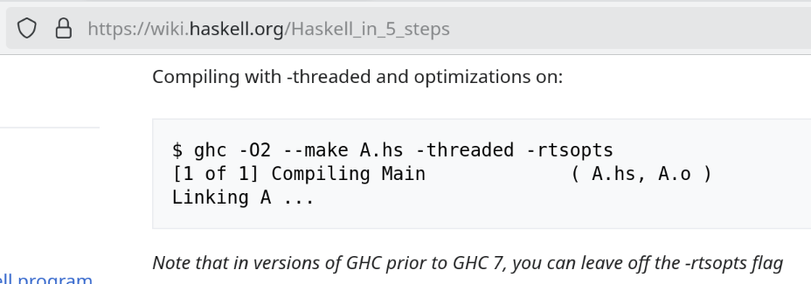
In the Haskell docs

https://wiki.haskell.org/Haskell_in_5_steps

It states this is how you build a Haskell program to run it.

Assuming I realize I can drop -threaded, is actually the easiest/correct way to build a Haskell program to run in the year 2025?

Haskell in 5 steps - HaskellWiki

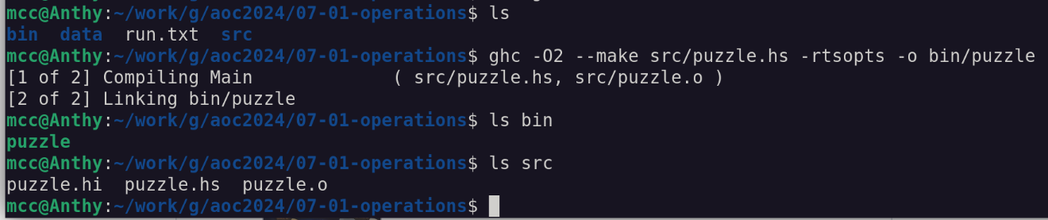
I run the given ghc --make command. It leaves some crap in src/. Say I do not want intermediate files in my source tree. I would like them to be moved to bin/ or obj/ or something, or simply not retained. Is this possible, or is Haskell in 2025 simply a "leaves crap in src/" kind of language in 2025?

I found -no-keep-hi-files and -no-keep-o-files (despite them technically not being documented) but say I want to retain them, just in a place of my choosing.

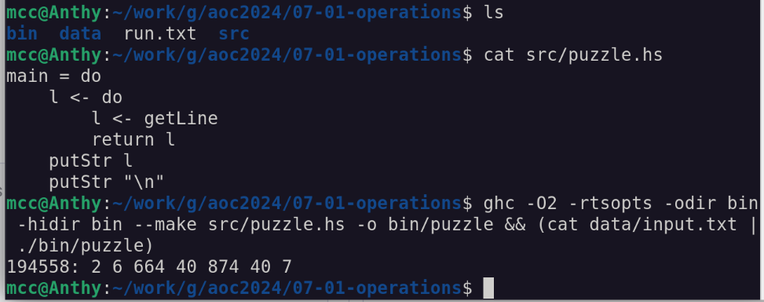
Welp, after 25+ years of trying, I have written my first working Haskell program. It reads one line from stdin and then prints it back out. I have now finally used a "monad", although I still don't feel I know what one ~is~.
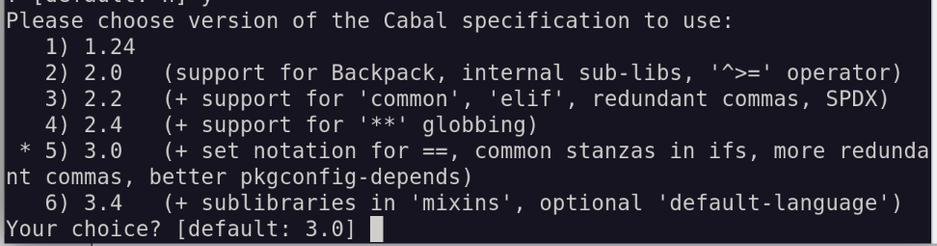
I am trying to switch my program to Cabal-driven builds. This is one of the questions it asks you when you run `cabal init`. I think I understand what it is about the Haskell community that lead them to do it this way, but in my opinion, this is bad user experience. If the newest version of the Cabal format isn't the recommended one then why did you release it at all?
@mcc LTS and supporting multiple versions of GHC in the wild... 😮‍💨
Debian stable is at GHC 9.0.2, Debian unstable at GHC 9.6.6 and upstream GHC is maintained at versions 9.6 up to 9.12. I have seen some good work from Cabal devs, but feature sets may be more practical to have packages available over a broad range of versions. I totally agree and would want new packages to take up the new features, though!
@mu Oh, is that the idea? That 3.0 is LTS?
@mcc I think it's a bit conservative for that. Cabal 3.0 is relatively old, and I suspect the choices in cabal init might not be up to date.