#BabelOfCode 2024
Week 7
Language: Haskell

Confidence level: Medium low

PREV WEEK: https://mastodon.social/@mcc/114308850669653826
NEXT WEEK: https://mastodon.social/@mcc/114463342416949024
RULES: https://mastodon.social/@mcc/113676228091546556

I was going to do Fennel this week, but then I looked at the problem and thought "this is ideal for Haskell "amb". I have been looking for an excuse to use Haskell "amb" for 25 years. So Haskell.

I have tried to learn Haskell 3 times now and failed. This "Babel of Code" thing was originally in part an excuse to do Haskell
I am not sure whether the reason I previously failed Haskell is

1. Because it's actually hard
2. Because of a mental block caused by failing at it more than once already
3. Because Haskell users are really bad at explaining things

I think it's a little 2 and mostly 3. I *love* ML, I know two MLs (3 if you count Rust) plus have in the past written my own ML. I understand the parts of Haskell that are just ML and get lost whenever I hit "do"— the point of divergence from ML; the dreaded Monad.

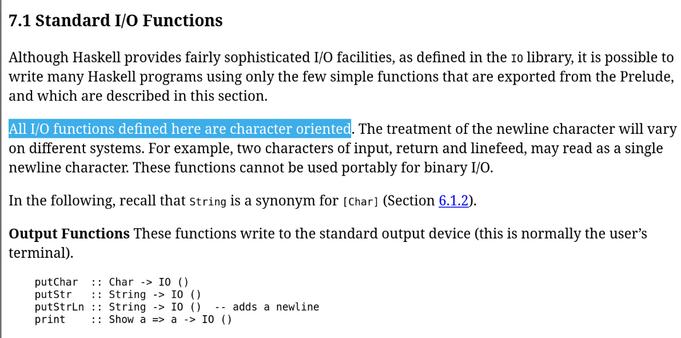
Question: The Haskell 2010 documentation describes its basic I/O functions, somewhat ambiguously, as "character oriented". I assume this means "ASCII character oriented". Is there a way in Haskell to get equivalents of getChar, putChar, string operations etc which are *UTF-8 character* oriented? I don't need graphemes, I'm happy with codepoint resolution.

In the Haskell docs

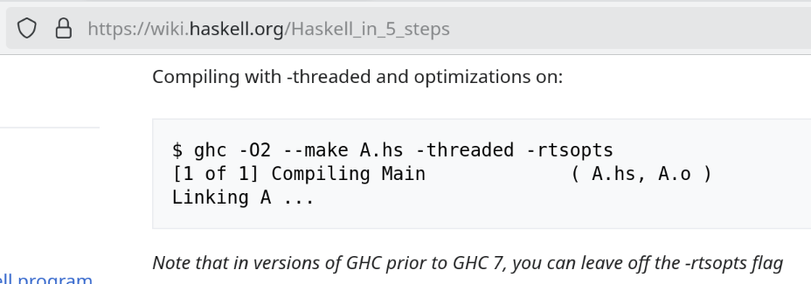
https://wiki.haskell.org/Haskell_in_5_steps

It states this is how you build a Haskell program to run it.

Assuming I realize I can drop -threaded, is actually the easiest/correct way to build a Haskell program to run in the year 2025?

Haskell in 5 steps - HaskellWiki

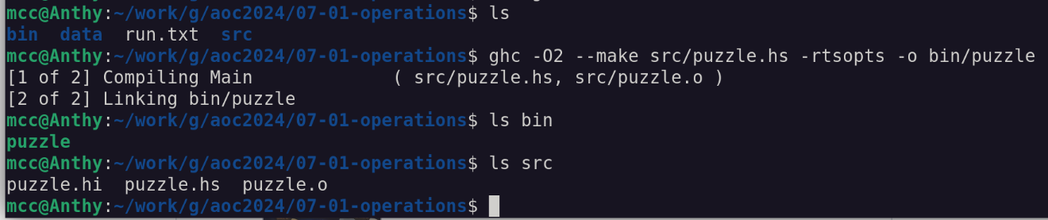
I run the given ghc --make command. It leaves some crap in src/. Say I do not want intermediate files in my source tree. I would like them to be moved to bin/ or obj/ or something, or simply not retained. Is this possible, or is Haskell in 2025 simply a "leaves crap in src/" kind of language in 2025?

I found -no-keep-hi-files and -no-keep-o-files (despite them technically not being documented) but say I want to retain them, just in a place of my choosing.

@mcc -odir and -hidir for where to put the files. i think --make and -threaded are there by default today
@mcc i guess the "normal" way to use haskell is exclusively via cabal which puts all the output files elsewhere

@annanannanse Wait, what? I can use cabal for normal builds?

Are these the directions to use ?

https://cabal.readthedocs.io/en/stable/nix-local-build.html

3.1. Quickstart — Cabal 3.14.2.0 User's Guide

@mcc i'm afraid i'm not up to speed on howto cabal best (i only use haskell via a custom build system that also just calls ghc...), but you need a .cabal file defining your exe and the `cabal build/run` should work.

@mcc @annanannanse You need a cabal project to be able to use `cabal build` or `cabal run`. There is `cabal init` to produce a skeleton. Not so simple unfortunately.

I think for simple tasks it is better to run stuff from ghci and just forego compiling entirely.