 The Picard Maneuver
Sometimes we have to create our own problems.
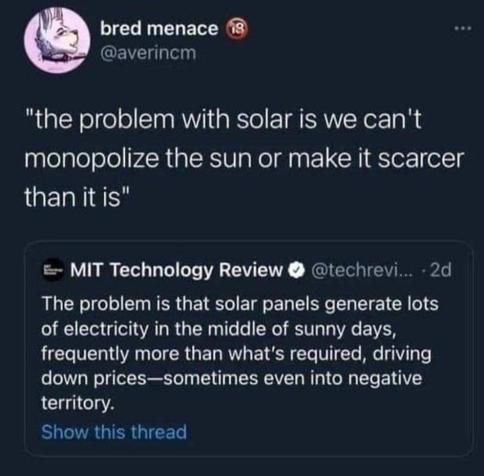
Sometimes we have to create our own problems.
Home owned windmills, solar panels and battery storage solves that.
Edit: Look at this awesome diagram of how it’s done for a hybrid setup that’s about $400 on Amazon.
I don’t see why home batteries are propaganda. Those prices are plummeting and they have decent payback times in some markets.
The reasons for getting solar is the same reasons for getting batteries.
Because home batteries, while provisionally useful in the same way as a standby generator (though the generator is going to be far more eco friendly than the batteries over their respective lifetimes), is a vastly inferior solution to the implementation of even local grid scale solutions. Also because there is essentially 0 infrastructure designed to handle said batteries, they wear out quite quickly at home scales (unless you’re using uncommon chemistries, but if you’re using iron-nickle batteries you’re not the target audience here) and because Elon popularized them with his “powerwall” bullshit entirely to pump the stock value of Tesla’s battery plant (which is it’s own spectacular saga I encourage you to look up, it’s a real trip).
Batteries in the walls are useful in niches, but the current technology which uses lipo/lion/lifepo4 chemistries is inherently flawed and a route to both dead linemen and massive amounts of E-waste. They could be useful potentially, but as it stands, it’s really bad right now.
provisionally useful in the same way as a standby generator (though the generator is going to be far more eco friendly than the batteries over their respective lifetimes)
A generator can provide backup power for unlimited time if fuel is available, but it is highest cost power in the world. Batteries can be charged/discharged every day, displacing dirty energy. A generator is either rarely used or eco destructive.
home units are still restricted
LFP batteries are the right home solution (Sodium Ion soon enough). US is tariff/capacity/policy restricted. Utility monopoly restricted if you want to export to grid, or use your EV as V2G. Utilities are also protected from off grid choices, and are changing their pricing with extortive fixed portions of utility bills. Biodiesel is not a sustainable (worse than ethanol if produced intentionally) solution.

 Rooskie91
 pelespirit