NASA's Lucy spacecraft is getting ready for its close flyby of asteroid Donaldjohanson on Easter Sunday April 20, 2025 at 13:51 EDT (17:51 UTC).

Closest Approach Distance: 960 km
Speed: 13.4 km/s (48,240 km/h).
Distance From Earth: 1.5 AU (223 million km, 12 light-minutes).

Lucy will use this encounter to test its instruments and tracking systems, in preparation for its main mission of surveying 7 Jupiter trojan asteroids in 2027-2033.

https://www.nasa.gov/missions/lucy/nasas-lucy-spacecraft-prepares-second-asteroid-encounter/
1/n
NASA’s Lucy Spacecraft Prepares Second Asteroid Encounter - NASA

NASA’s Lucy spacecraft is 6 days and less than 50 million miles (80 million km) away from its second close encounter with an asteroid; this time, the small

NASA

Lucy is a NASA mission to explore the trojan asteroids in Jupiter's orbit. Along its journey, it will also explore two asteroids in the main asteroid belt between Mars and Jupiter.

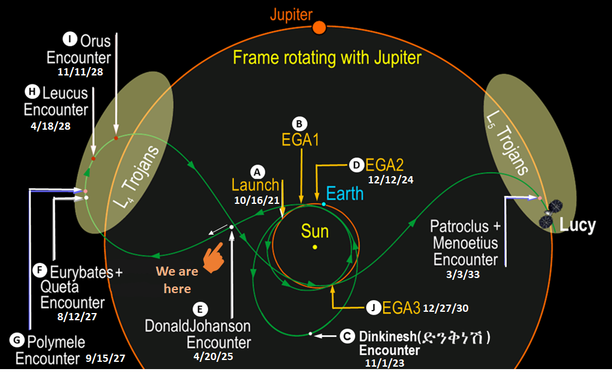
The graphic below shows the trajectory and major events of the mission.

Nov 11, 2023: flyby of main belt asteroid Dinkinesh.
April 20, 2025: flyby of main belt asteroid Donaldjohanson.
2027-2028: survey five L4 trojan asteroids.
2030: Earth flyby
2033: Visit two L5 trojans.

https://lucy.swri.edu/mission/Tour.html
2/n

Tour - Lucy Mission

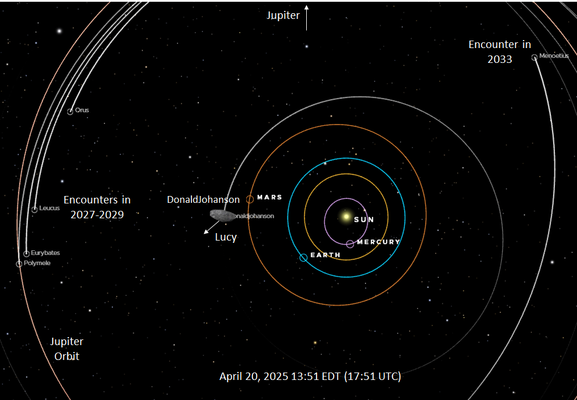
The following map of the solar system shows the location of the Lucy spacecraft, the planets, asteroid Donaldjohanson in the main asteroid belt between Mars and Jupiter and the Trojan asteroids in Jupiter's orbit on April 20, 2025.

https://eyes.nasa.gov/apps/solar-system/#/sc_lucy?rate=0&time=2025-04-20T17:51:00.000+00:00
3/n

Eyes on the Solar System - NASA/JPL

Explore the 3D world of the Solar System. Learn about past and future missions.

Eyes on the Solar System - NASA/JPL

Here is a video overview of the Lucy flyby of Asteroid Donaldjohanson on April 20.

~30 minutes before closest approach, Lucy will orient itself to track the asteroid, turning its high-gain antenna away from Earth. The two imaging and one spectrometer instruments will be active.

40 seconds before closest approach, Lucy will stop tracking DJ to protect its sensitive instruments from the Sun.

Comms link will be established an hour later.

https://www.youtube.com/watch?v=OL9_0sagfBg
https://www.nasa.gov/missions/lucy/nasas-lucy-spacecraft-prepares-second-asteroid-encounter/
4/n

NASA’s Lucy Mission Will Explore Asteroid Donaldjohanson

YouTube

Asteroid Donaldjohanson is part of the main belt of asteroids located between the orbits of Mars and Jupiter. It is a fragment of a collision 150 million years ago that produced the Erigone family of asteroids.

Distance from Sun : 1.936 - 2.830 AU
Orbital period: 3.68 yr (1,343 d)
Mean diameter: 3.895 km
Rotation period: 252 hr

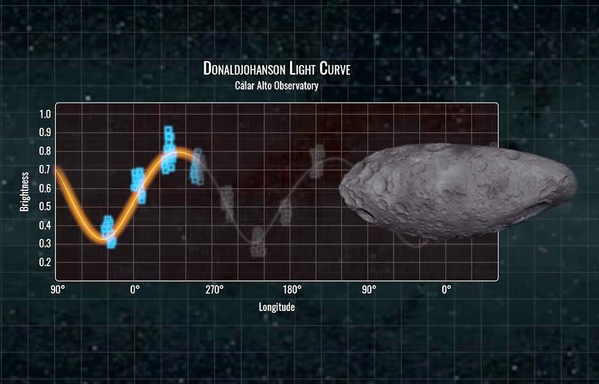
DJ's periodically varying lightcurve suggests that it must either be highly elongated in shape or have a satellite companion. Stay tuned!

https://en.wikipedia.org/wiki/52246_Donaldjohanson
5/n

52246 Donaldjohanson - Wikipedia

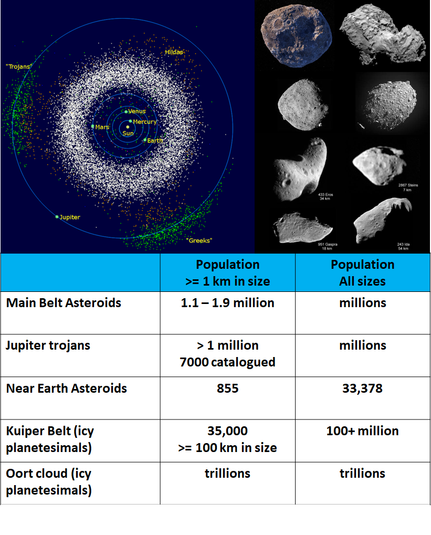
The Jupiter trojans (aka trojan asteroids) are a large group of asteroids located in Jupiter's orbit around the Sun.

The group known as the Greek camp is located around the L4 Lagrange point, 60° ahead of Jupiter, the Trojan camp is located around the L5 Lagrange point, 60° behind.

There are millions of asteroids between here and Jupiter and trillions of icy ones beyond the orbit of Pluto. Only the nearest and largest ones have been catalogued.
https://en.wikipedia.org/wiki/Asteroid
6/

Asteroid - Wikipedia

The Lucy mission is named after the 3.2 million old Lucy hominin fossils discovered in 1974 in Ethiopia, because study of the trojans can "revolutionize our knowledge of planetary origins."

Dinkinesh is the Ethiopian name for the Lucy fossil. The name means "you are wonderful" in the Amharic language.

Asteroid (52246) Donaldjohanson is named after one of the co-discoverers of the Lucy fossil.

The names for these two asteroids were recommended by the Lucy team.

https://en.wikipedia.org/wiki/Lucy_(Australopithecus)
7/n

Lucy (Australopithecus) - Wikipedia

The Lucy (Australopithecus afarensis) hominid was named after the 1967 Beatles song "Lucy in the Sky with Diamonds". Apparently, the song was played loudly and repeatedly in the expedition camp all evening after the team's first day of work on the excavation site.

Also, the Lucy spacecraft carries a lens and a beam splitter made of lab-grown diamonds for its L'TES instrument.
💎💎

https://www.youtube.com/watch?v=Kqcpkx8tfKI
https://link.springer.com/article/10.1007/s11214-023-01029-y
#Lucy
8/n

Finding the Lucy Fossil — HHMI BioInteractive Video

YouTube

"Australopithecus afarensis, mother and child" by paleoartist Mauricio Anton.

"Mauricio Antón Ortuzar (born 1961 in Bilbao, Spain) is a paleoartist and illustrator specializing in the scientific reconstruction of extinct life, well known for his influential paintings of hominids, extinct carnivores and other vertebrate fossil groups. He currently works in association with the Natural Science Museum in Madrid."

Goosebumps!

https://mauricioanton.wordpress.com/
https://en.wikipedia.org/wiki/Mauricio_Ant%C3%B3n
#Lucy
9/n

Mauricio Anton

Welcome to the official site of paleoartist Mauricio Anton

Mauricio Anton

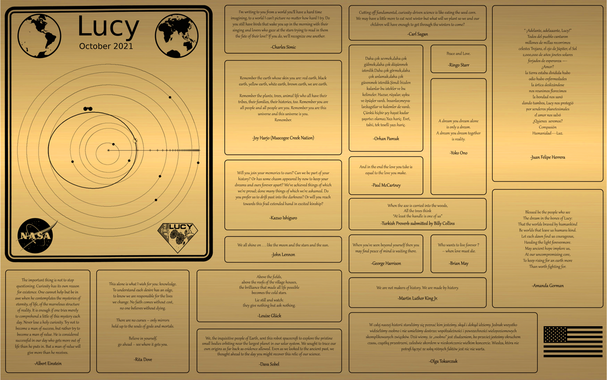
The Lucy spacecraft carries a plaque as a time capsule, with messages from prominent thinkers of our time and positions of the planets on the date of Lucy’s launch.

Carl Sagan has a message for the present time with science under attack: "Cutting off fundamental, curiosity-driven science is like eating the seed corn. We may have a little more to eat next winter but what will we plant so we and our children will have enough to get through the winters to come?"

https://lucy.swri.edu/LucyPlaque.html
10/n

The Lucy Plaque - Lucy Mission

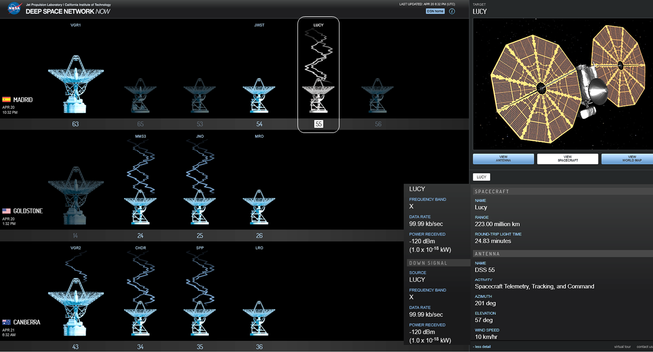
The Lucy spacecraft is currently 229,000 km from asteroid Donaldjohanson.

It is communicating with the NASA DSN site in Canberra at 100 kbps.
👍
https://eyes.nasa.gov/apps/solar-system/#/sc_lucy/distance?to=52246_donaldjohanson
https://eyes.nasa.gov/apps/dsn-now/dsn.html
11/n

Eyes on the Solar System - NASA/JPL

Explore the 3D world of the Solar System. Learn about past and future missions.

Eyes on the Solar System - NASA/JPL

Lucy is back to communicating with mission control on earth via NASA DSN Madrid after its successful flyby of asteroid Donaldjohanson at 17:51 UTC today.
 

https://eyes.nasa.gov/apps/dsn-now/dsn.html
12/n

Deep Space Network Now

The real time status of communications with our deep space explorers

Deep Space Network Now

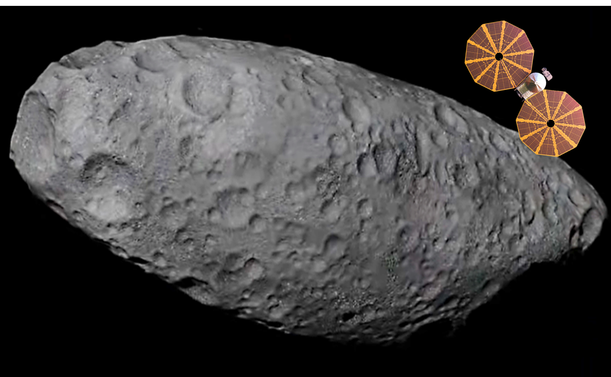
The first image of asteroid Donaldjohanson has been released, taken by the NASA Lucy spacecraft during the close flyby yesterday.

The image was taken by Lucy's Long-Range Reconnaissance Imager (L’LORRI) 40 seconds before closest approach around 17:51 UTC, from a distance of 1,100 km. Closest approach was 960 km.

As expected, Donaldjohanson seems to be an elongated contact binary but with an odd shaped narrow neck between the two lobes. Size = 8 km x 3.5 km.

https://science.nasa.gov/image-article/nasas-lucy-spacecraft-images-asteroid-donaldjohanson/
13/n

NASA’s Lucy Spacecraft Images Asteroid Donaldjohanson

In its second asteroid encounter, NASA’s Lucy spacecraft obtained a close look at a uniquely shaped fragment of an asteroid that formed about 150 million

NASA Science

Does that image of asteroid Donaldjohanson taken by the NASA Lucy spacecraft during the close flyby yesterday remind you of anything?

Perhaps, a hominid bone, as depicted in "The Dawn of Man" scene from Stanley Kubrick's "2001: A Space Odyssey?"

https://science.nasa.gov/image-article/nasas-lucy-spacecraft-images-asteroid-donaldjohanson/
14/n

NASA’s Lucy Spacecraft Images Asteroid Donaldjohanson

In its second asteroid encounter, NASA’s Lucy spacecraft obtained a close look at a uniquely shaped fragment of an asteroid that formed about 150 million

NASA Science
@AkaSci or a flying peanut, maybe tossed by a vendor at a baseball game
@AkaSci
I'm amazed at the meteoroid impact craters. There is not much gravity holding them together, you might think any hit would disrupt the join; or maybe they joined after all the hits.