 cm0002
Excel logic
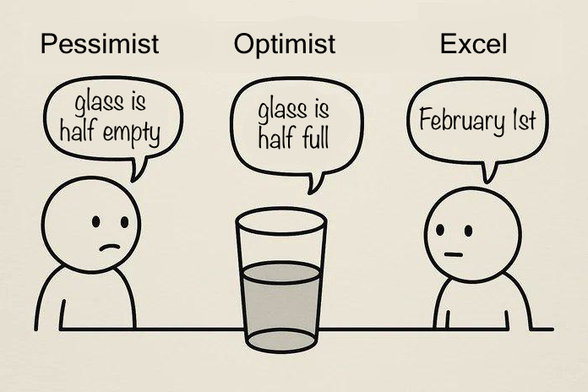
I mean, that is the way you say it verbally.
1/2 - January second.
Oh my god.
Jesus christ.
I was thinking, “nah, that seems nitpicky, I’m sure a real person could write either.” But that is the entire setup for the punchline. I’m gonna rip my hair out.
Nah just stupid number formatting, my UPCs regularly turn into scientific notation or my UOM automatically convert to a string =“12” which ruins math operations so first I have to make a helper column =NUMBERVALUE([@UOM]).
Or being unable to convert datetime to a simple date for date calculations without loading the table into power query and transforming it there. You can change the format into short date but if the actual value is datetime it will still throw an error but now the type issue is hidden, so have fun reading docs and troubleshooting until you realize your mistake :)
You can make a date from a datetime in cell A1 with
=Date(year(A1), month(A1), day(A1))
you
No I can’t. Have you considered you might be beyond normal smart about this stuff?
just based off the background color
… white?
Scientists rename human genes to stop Microsoft Excel from misreading them as dates
Sometimes it’s easier to rewrite genetics than update Excel
Aug 6, 2020

Scientists have renamed 27 human genes to stop Microsoft Excel misreading them as dates. The changes have been underway for the past year but have been formally announced as new guidelines published by the HUGO Gene Nomenclature Committee. Scientist are overjoyed but annoyed Microsoft didn’t make the changes itself.
I mean, I know of a Microsoft product that allows for a batch import of data provided in an Excel file. You need to use their template file. Which, when used, automatically formats all dates the American way, ignoring your locale settings. Depending on which date is first encountered on import (e.g. which date you entered in the first line) then designates whether the whole file is imported with dates read as MM/DD/YYYY or DD/MM/YYYY.
You start your list on January 1st? It will import everything as MM/DD/YYYY then. You start you list on e.g. January 22nd? DD/MM/YYYY it is then. Good luck getting that import running without errors…
MM/DD/YYYY
DD/MM/YYYY
Both of these are the wrong way to format dates.
Nothing works in Excel. Excel will do what it wants.
But that doesn’t stop the MS support and a thousand stupid people from claiming “oh, you just have to format it as text, are you dumb or what”…
maibe
I also noticed how it suddenly went from great to crap.
But the real reason I think is ironically AI. It used to be that you could easily crawl the web, but after the AI craze, images suddenly became valuable to crawl and every website gets bombarded by scrapers, so tineye probably can’t compete with them and so can’t find any new images
Most of it for me is the font. It seems like chatgpt likes to use the same font for everything
It also kind of feels off somehow. I can’t explain. it, but there’s just something wrong with this image
Left guy has 1 arm.
Perspective.
Both guys have an arm that melds into the surface that the glass is sitting on.
Nah the arms are in front of the railing.
The “optimist” is the glass.
So what it’s visually balanced. I would shy away from reading surrealist meaning into it but it’s not like humans never make that kind of choice.
The plain fact of the matter is that nowadays it’s often simply impossible to tell, and the people who say “they can always tell” probably never even tried to draw hands or they could distinguish twelve-fingered monstrosities from an artist breaking their pencil in frustration and keeping the resulting line because it’s closer to passing than anything they ever drew before.
I agree that the “arm things” are wrong, as it’s pretty clearly just an artistic choice that a human could very much do.
But that said these images are 100% provable to be AI. If you haven’t built up the intuition that immediately tells you it’s AI (it’s fair, most people don’t have unlimited time for looking at AI images), these still have the trademark “subtle texture in flat colors” that basically never shows up in human-made digital art. The blacks aren’t actually perfectly black, but have random noise, and the background color isn’t perfectly uniform, but has random noise.
This is not visible to the human eye but it can be detected with tools, and it’s an artifact caused by how diffusion models work
Not using plain RGB black and white isn’t a new thing, neither is randomising. Digital artists might rather go with a uniform watercolour-like background to generate some framing instead of an actual full background but, meh. It’s not a smoking gun by far.
The one argument that does make me think this is AI was someone saying “Yeah the new ChatGPT tends to use that exact colour combination and font”. Could still be a human artist imitating ChatGPT but preponderance of evidence.
I can generally spot SD and SDXL generations but on the flipside I know what I’d need to do to obscure the fact that they were used. The main issue with the bulk AI generations I see floating around isn’t that they’re AI generated, it’s that they were generated by people with not even a hint of an artistic eye. Or vision.
But that doesn’t really matter in this case as this work isn’t about lines on screen, those are just a mechanism to convey a joke about Excel. Could have worked in textual format, the artistry likes with the idea, not in the drawing, or imitation thereof.
I actually kind of looked at (jpeg) compression artifacts, and it’s indeed true to the extent that if you compress the image bad enough, it eventually makes it impossible to determine if the color was originally flat or not.
(eg. gif and dithering is a different matter, but it’s very rare these days and you can distinguish it from the “AI noise” by noticing that dithering forms “regular” patterns while “AI noise” is random)
Though from a few tests I did, compression only adds noise to comic style images near “complex geometry”, while removing noise in flat areas. This tracks with my rudimentary understanding of the discrete cosine tranform jpeg uses*, so any comic with a significantly large flat area is detectable as AI based on this method, assuming the compression quality setting is not unreasonably low
*(which should basically be a variant of the fourier transform)
I recreated most of the comic image by hand (using basic line and circle drawing tools, ha) and applied heavy compression. The flat areas remain perfectly flat (as you’d expect as a flat color is easier to compress)
But the AI image reveals a gradient that is invisible to the human eye (incidentally, the original comic does appear heavily jpeg’d, to the point I suspect it could actually be chatgpt adding artificial “fake compression artifacts” by mistake)
there’s also weird “painting” behind the texts which serves no purpose (and why would a human paint almost indistinguishable white on white for no reason?)
the new ai generated comic has less compression, so the noise is much more obvious. There’s still a lot of compression artifacts, but I think those artifacts are there because of the noise, as noise is almost by definition impossible to compress
I fed it into ChatGPT, highlighted the errors, and told it what I wanted to be different.

 Nougat
 I Cast Fist
 skulblaka
 ShayKStage
 Smee
Smee stebo
stebo
 StellarSt0rm
 MoonRaven
 SqueakyBeaver
 cannedtuna
 TheLowestStone
 irelephant [he/him]🍭