I just discovered that the National Museum of American History has a UCLA Computer Club "Moose" IBM card as a display. The moose was there since the IBM 360/91 was the only system that most students had access to at that time, and was used in batch mode (students not working on our ARPA projects that most students and faculty didn't even know existed at UCLA that is). The museum URL says this dates from the 60s, but it actually extended well into the 70s.

The Campus Computing Network's (CCN, not to be confused with CNN!) 91's resource usage was billed in so-called Machine Unit Seconds (MUS - ah, Moose!), that different departments and projects were allocated for their work. Of course the museum write-up doesn't discuss any of that backstory. I have multiple decks of these cards around somewhere from some classes where I had to submit jobs that way, even though I was simultaneously working on ARPANET.

https://americanhistory.si.edu/collections/object/nmah_690512

UCLA Computer Club Punch Card

In the 1960s, when UCLA (the University of California at Los Angeles) purchased a commercial computer from IBM, students formed a club where they could…

National Museum of American History

@lauren

COBOL?

@ipd @lauren

Sure, we had COBOL, FORTRAN, ALGOL 68, PL/1, and MIX (Donald Knuth's assembly language).

@weaselx86 @ipd And PL/C !
//SYSIN DD DUMMY

@lauren @weaselx86
PL/C, PL/1, data structures class, yes, that was my second language. I couldn't remember the name yesterday, but I do remember it's modularity.

third was watfor, and forth was APL.

@weaselx86 @ipd One of the amusing things was a class I had to take where you had to turn in the program decks. So I wrote all the programs on those 40 char URSA screens (2 lines == one card) using my access to URSA (which of course almost no undergrads like me had access to, but I had access to a private terminal room with a couple of URSA terminals), then I'd do an RJE to the 91 and I sent the card data to the 91 card punch. But that left me with cards with nothing printed at the top. So I'd take the cards to the horrific keypunch room just outside the 91 card reader room and service desk, configure one of the keypunches to interpret mode, and ran the cards through to get the printing on them.

One time a girl in the same class as I caught me doing that and was astonished, asking me what I was doing. So (in a bad mood I was) I told her I had figured out a way to get the keypunches to write the programs for me. She was stunned. I still feel a bit bad about that exchange.

@lauren @ipd

I didn't have access to URSA, but I still didn't want to pay for another box of blank cards, so I wrote a little program to output 2000 blank lines and directed the output to the card punch.

@weaselx86 @ipd As I recall, the operators got wise to that one eventually.

@lauren

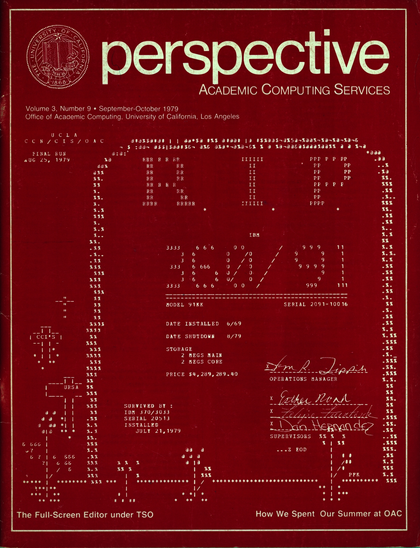
The image is of the front cover of the issue of CCN's monthly magazine, "Perspective", commemorating the demise of the 360/91 in 1979. The 360/91 was replaced with a 370/3033.

This link is to a PDF of a scan of the cover and a few pages from that issue of "Perspective" (including a description of CCN's DEC-10 computer running TOPS-10).

https://github.com/DavidButterfield/Random/blob/master/PRE-1983/UCLA_CCN_Perspective_1979-09.pdf

Random/PRE-1983/UCLA_CCN_Perspective_1979-09.pdf at master · DavidButterfield/Random

Random non-code. Contribute to DavidButterfield/Random development by creating an account on GitHub.

GitHub
@weaselx86 @lauren There was also Ursa on the mainframe, with program lines displayed on a CRT in two 40 character rows, if I remember correctly. Not sure why I got to use that when I was an undergrad.
@weaselx86 @lauren From my time using the mainframe as an undergrad, I still unfondly remember the error code 322.