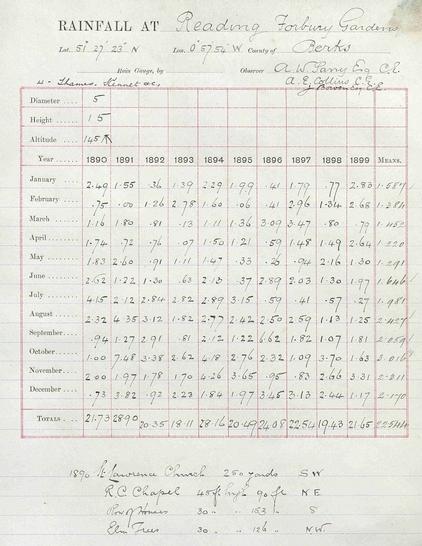
Five years ago today, most historical UK monthly rainfall observations were not available to scientists. But the 66,000 pieces of paper containing the data had been scanned. With covid lockdown approaching we saw an opportunity to transcribe the data. #RainfallRescue began... 🧵
Bluesky

Bluesky Social
The idea was simple: ask for online volunteers to help. There were millions of hand-written rainfall observations to transcribe, along with all the metadata. We thought it would take many months for volunteers to complete the tasks. 100 million keystrokes were needed. www.bbc.co.uk/news/science...

Help needed to rescue UK's old...
Help needed to rescue UK's old rainfall records

Pre-1960s handwritten rain gauge data can inform drought and flood planning, but only if digitised.

BBC News
Within hours we had 6000 volunteers helping. Within days we had 16,000 volunteers transcribing numbers. And, just 16 days later, all 5.3 million rainfall amounts had been transcribed, each by at least 4 different volunteers, along with all the location information. www.bbc.co.uk/news/science...

Self-isolation proves a boon t...
Self-isolation proves a boon to rainfall project

Scientists have been amazed at the public's response to help digitise the UK's old rainfall records.

BBC News
But, that was not the end. The sheets had to be collated for the same location, but sometimes the information was incomplete. 8 dedicated volunteers helped to finalise the dataset, searching old maps, ancestry & census information to track down the missing locations.
 www.bbc.co.uk/news/science...

UK's rainfall records rescued ...
UK's rainfall records rescued by volunteer army

We now have a clearer idea of when these islands were sodden or parched going back almost 200 years.

BBC News
Two years later the dataset was complete & the Met Office updated their official rainfall statistics back to 1836. We now have detailed reconstructions of rainfall across the UK, including the reigns of Queen Victoria to Queen Elizabeth & beyond. rmets.onlinelibrary.wiley.com/doi/full/10....

Millions of historical monthly...
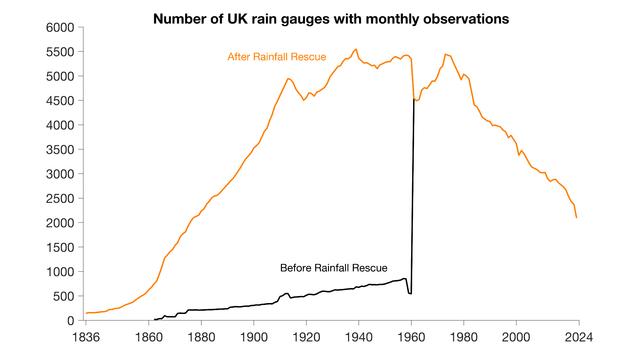
But, why are these hand-written observations important? Before #RainfallRescue the data before 1961 was largely missing. Now there are thousands of locations with rainfall data back to the 1870s, and hundreds back to the 1840s. There are more observations available for the 1880s than today.
Bluesky

Bluesky Social
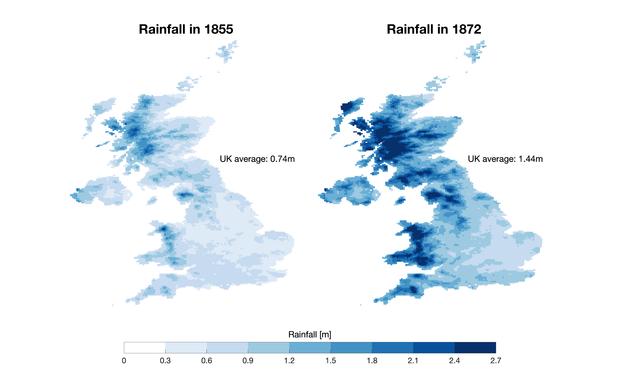
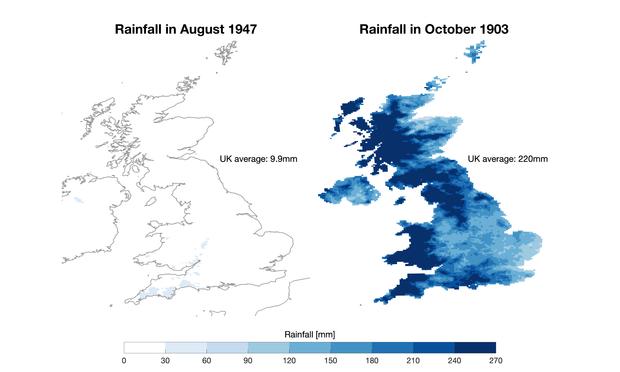
After these efforts, we can map out and explore rainfall variations across the UK in extreme years and extreme months. The driest year on record is now 1855 - drier than the previous record - and the wettest is 1872. The driest month on record is August 1947, and the wettest is October 1903.
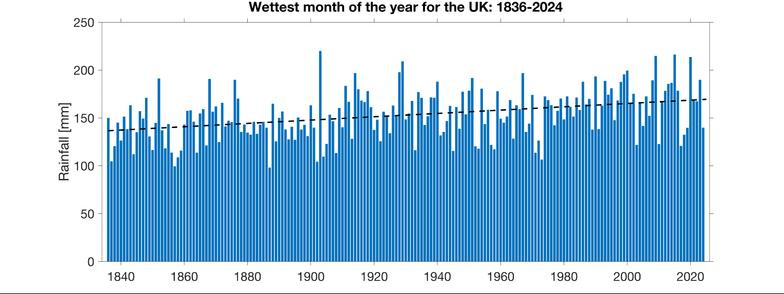
We can also explore trends in extreme months. The wettest month of the year has become 20% wetter in the period since 1836. #RainfallRescue
Bluesky

Bluesky Social
Thank you to every one of the volunteers who transcribed the data & those who took the original observations. We note the efforts of George Symons who created the British Rainfall Organisation in the 1860s, without which none of this data would be available today.
We also need to thank @chrislintott.bsky.social and the @zooniverse.bsky.social team for building the Zooniverse platform that we used. It makes developing these projects possible for anyone. It's fair to say that #RainfallRescue broke records for citizen science participation in an online project.
Chris Lintott (@chrislintott.bsky.social)

Astronomer, writer and zookeeper. Oxford, Gresham and the Zooniverse. The human half of the Dog Stars podcast. New book: 'Our Accidental Universe' (UK/rest of world) and 'Accidental Astronomy (US) now out.

Bluesky Social