@ai6yr

🤦
Oh, FFS.

Finally applied some logic & took the time to compare/contrast the pole saw with the other saws.

WTF #MilwaukeeTool.

I've got pics & an explanation to share later, but I'm on a break from fruit tree pruning time right now.

Short version is excellent construction of flawed design.

(Yeah, I know you don't really care - but too bad. You can mute me this evening if I actually get around to ranting.)

@phpete Oooh, I would LOVE to know, this kind of stuff is great. Learning from bad designs for stuff is so illuminating. PLEASE do share!!! I actually do love this stuff and would enjoy it.

@ai6yr

As you wish!

Based on a bit of flabbergasted Google sleuthing, I've come up with the following TL;DR

Actually leaking oil (not drips, normal spray that's condensed, or other general messiness) from a...

Stihl, Husqvarna, echo, shindaiwa, or poulan pro - Problem.

Craftsman, poulan, Ryobi, or homelite - expected to varying degrees.

I will now explain.

@ai6yr

Some pertinent facts:

Most homeowner through farm and ranch (also called property owner depending on brand) bars are laminated sheets of metal.

The bar has a groove for the chain. That's obviously where we want the oil to stay.

Regardless of the mechanism, chainsaw oil reservoirs are positively pressured at least - on bigger saws a decent pump is used.

The chain is tightened on the bar by use of an adjustable stud which is in a hole of the bar.

@ai6yr
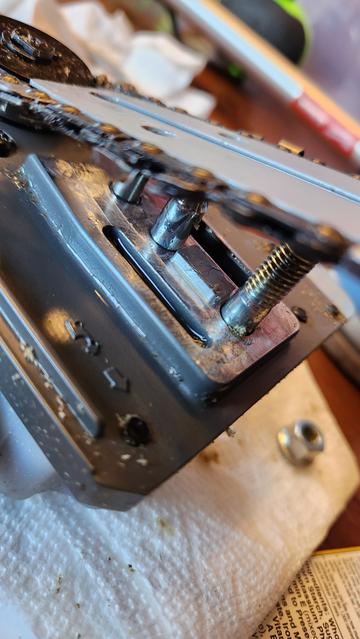
The 'trough' in the 1st attached photo is how the oil gets out of the reservoir.
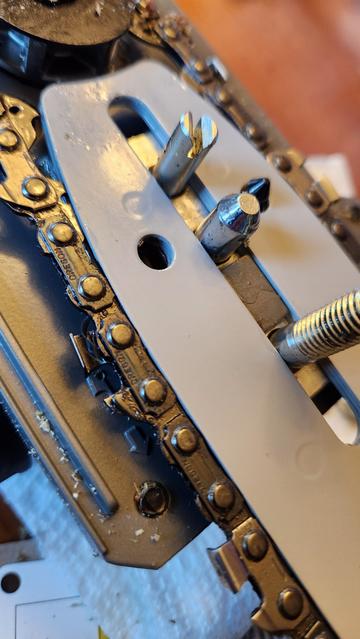
Photo 2 shows the bar & chain as they're oriented while in use.
The black stud in pic2 is the tension stud. The large hole opposite it is there so the bar can be flipped and used in both directions.

This is when I first became confused.

How does the oil get into the groove where the chain sits? Something looked wrong so I grabbed an old backup bar for the firewood saw...

@ai6yr

Where the oil hole on the new bar?

@ai6yr
Remember how I said that the bars being laminated was pertinent?

Someone somewhere decided that cutting a slit in the center third of the lamination and making the adjustment stud do double duty was a great idea.

*Some* oil goes in, but exhibit A shows where most of it ends up.

Exhibit B shows the bar and chain attached... and a toothpick sitting all the way in the oil tube which leads to the reservoir.

@ai6yr
In addition to the Stihl bar I had in my hand, all the attached screenshots show that oil hole.

The oil hole does NOT go all the way through and thus there's nowhere for the oil to go when it's not running.

@ai6yr
Now I mentioned a bit back that my poulan p4018wt didn't leak.

And it turns out that in spite of lacking an oil hole and simply pumping oil into the center of the lamination, that model does so at an upward angle.

So the maximum oil spill is whatever's retained in the bar after use.

Considering I clean the bar before storage, I never would've had any to spill.

@ai6yr
On balance with the lack of oil hole, the single vs double bar nut with the Oregon bar & chain, the solid construction, & the rest of the tool, I'm content - just utterly confused as to why a supposedly higher end tool is using a design seemingly used more commonly by lower end saws.
@phpete @ai6yr Interesting thread. I had to go out and look at my spare Oregon bars to check it out. None had holes, just the slots to the bar from the tensioner. We routinely flip the bars over when we get uneven wear side to side (or the saw starts cutting in an arc). The bar would need 2 oil holes to accommodate that. Maybe it has 2. I always assumed that the bar oil just ran down the side of the bar and was pulled into the slot by the chain motion. In any case, running the saw over a piece of cardboard will usually produce a stripe of oil if the oil pump is working.

@CavedaleRhones
The bars with holes do indeed have one on each side each going only through the closest lamination layer of the bar.

Having always used Oregon, and having outgrown my earlier saws, I now have Oregon bars in both "styles".

As you likely expect, Oregon makes solid aftermarket for everyone, at or above OEM. In fact, part of this evening's rabbit hole was comparing compatibility charts on their website to support my observation.

@ai6yr

@CavedaleRhones
Oh!

I'm fact you can see that from the pictures as well!

Looks like I flipped the Stihl bar between these two shots. (Note the factory etching)

In each shot, the hole visible would be on the outside bottom, the back side hole in these photos is positioned saw side top, which is where the oiler is on the ms250. Oil pulls from the top and down to the nose of the bar.

@ai6yr

@phpete @ai6yr Now I am wondering if I should drill holes in all my bars. 🤣

@CavedaleRhones
😆

I take no responsibility!

@ai6yr